
Discussion: Prescribing for Pregnant Women
Treatment Recommendations for Major Depressive Disorder in Pregnant Women
Managing major depressive disorder (MDD) during pregnancy is a careful balance of maternal mental health versus fetal safety. MDD has significant complications with pregnancy outcomes and, if left untreated, may lead to preterm delivery and low birth weight (Wheeler, 2020). Below are some recommended treatments, including an FDA-approved drug, an off-label drug, and a nonpharmacological intervention.
FDA-Approved Drug
Selective serotonin reuptake inhibitors (SSRIs), with a focus on Sertraline, are some of the common medications for major depressive disorder that are prescribed to pregnant women. Singh and Saadabadi (2023) note that Sertraline is safe, with very few cases of congenital anomalies attributed to it. This is significantly safe; however, patients should keenly monitor for possible risks such as neonatal adaptation syndrome affecting the newborn or infant, thus the need for personalized care. Antidepressants help relieve the depressive disorders of the mothers and, at the same time, enable them to offer proper care and health promotion to the fetus.
Off-Label Drug
Bupropion, primarily approved for smoking cessation and depression, is also used off-label in pregnant women with MDD, especially where SSRIs are contraindicated. Evidence suggests that bupropion carries a minimal risk of congenital anomalies; thus, it could be a viable alternative (Huecker et al., 2023). Though quite effective in mitigating depressive symptoms, the trade-off calls for generally careful monitoring to manage probable side effects of insomnia or appetite changes.
Nonpharmacological Intervention
Cognitive-behavioral therapy (CBT) is an efficient, nonpharmacological intervention. It equips pregnant women with coping skills to manage depressive symptoms without the risks of medication exposure to the fetus. CBT can reduce the number of depressive episodes, enhance resilience, and promote maternal attachment behaviors (Chand et al., 2023).
Risk Assessment and Guidelines
Risk assessments, including maternal and fetal health evaluations, guide these decisions. The American College of Obstetricians and Gynecologists provides guidelines that note SSRIs as first-line pharmacological interventions for MDD during pregnancy. Bupropion is used off-label when the benefits outweigh the potential risks, especially in cases where one is resistant to SSRIs. Further, nonpharmacological interventions like CBT are universally encouraged as low-risk alternatives to supplement pharmacological treatments (Wheeler, 2020). Combining appropriate treatments from a multidisciplinary approach like that of psychiatry and obstetrics ensures patients receive proper care. Besides, treatment that focuses on safety can obviate the notable effects that untreated MDD has on both a mother and her child.
References
Chand, S.P., Kuckel, D. P., & Huecker, M. R. (2023, May 23). Cognitive behavior therapy. PubMed. https://pubmed.ncbi.nlm.nih.gov/29261869/
Huecker, M. R., Smiley, A., & Saadabadi, A. (2023). Bupropion. PubMed; StatPearls Publishing. https://www.ncbi.nlm.nih.gov/books/NBK470212/
Singh, H. K., & Saadabadi, A. (2023). Sertraline. PubMed; StatPearls Publishing. https://www.ncbi.nlm.nih.gov/books/NBK547689/
Wheeler, K. (Ed.). (2020). Psychotherapy for the advanced practice psychiatric nurse: A how-to guide for evidence-based practice (3rd ed.). Springer Publishing.
ORDER A PLAGIARISM-FREE PAPER HERE
We’ll write everything from scratch
Question 
Discussion: Prescribing for Pregnant Women
After assessing and diagnosing a patient, PMHNPs must take into consideration special characteristics of the patient before determining an appropriate course of treatment. For pharmacological treatments that are not FDA-approved for a particular use or population, off-label use may be considered when the potential benefits could outweigh the risks.
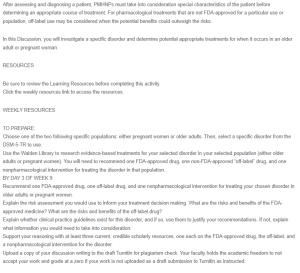
Discussion – Prescribing for Pregnant Women
In this Discussion, you will investigate a specific disorder and determine potential appropriate treatments for when it occurs in an older adult or pregnant woman.
RESOURCES
Be sure to review the Learning Resources before completing this activity.
Click the weekly resources link to access the resources.
WEEKLY RESOURCES
TO PREPARE:
Choose one of the two following specific populations: either pregnant women or older adults. Then, select a specific disorder from the DSM-5-TR to use.
Use the Walden Library to research evidence-based treatments for your selected disorder in your selected population (either older adults or pregnant women). You will need to recommend one FDA-approved drug, one non-FDA-approved “off-label” drug, and one nonpharmacological intervention for treating the disorder in that population.
BY DAY 3 OF WEEK 9
Recommend one FDA-approved drug, one off-label drug, and one nonpharmacological intervention for treating your chosen disorder in older adults or pregnant women.
Explain the risk assessment you would use to inform your treatment decision making. What are the risks and benefits of the FDA-approved medicine? What are the risks and benefits of the off-label drug?
Explain whether clinical practice guidelines exist for this disorder, and if so, use them to justify your recommendations. If not, explain what information you would need to take into consideration.
Support your reasoning with at least three current, credible scholarly resources, one each on the FDA-approved drug, the off-label, and a nonpharmacological intervention for the disorder.
Upload a copy of your discussion writing to the draft Turnitin for plagiarism check. Your faculty holds the academic freedom to not accept your work and grade at a zero if your work is not uploaded as a draft submission to Turnitin as instructed.
Read a selection of your colleagues’ responses.
BY DAY 6 OF WEEK 9
Respond to at least two of your colleagues on 2 different days who selected different disorders. Propose an alternative on-label, off-label, or nonpharmacological treatment for the disorders. Justify your suggestions with at least two references to the literature.
 Complete the order form and upload all of your files, including any instructions, rubrics, or other materials provided by your instructor.
  Complete the order payment after filling in the order form. We’ll receive your order and assign it to a writer.
 The assigned writer will complete your paper and forward it to our Editing Team for review and approval.
 Once approved by the editor, the completed paper will be uploaded to your account for you to download, review and approve.