
Week 7: Training Title 9 – Comprehensive Psychiatric Evaluation
Subjective
CC (chief complaint): “They want to fire me. It is because Eric is in love with me, and I am a distraction.”
HPI: Ms. Fatima Branning is a 28-year-old Latina female presenting for psychiatric evaluation due to workplace difficulties involving delusional beliefs and somatic complaints. She reports being targeted by her supervisor and another colleague due to what she perceives as Eric’s (her supervisor) “lust” for her. Although Eric has never displayed any inappropriate behavior, she feels threatened to their professional standing since she is attractive and able to hold her own. Another concern that she expresses is that the pressure has led to medical disease, such as back, neck pain, and the perceived presence of a cancerous lump, despite the fact that any medically administered test has not confirmed her suspicions. She does not report hallucinations or suicidal/homicidal ideation.
Past Psychiatric History: The patient is defensive and refused to say anything about her psychiatric history. Records of previous diagnoses, treatment, and hospitalizations were not provided.
- General Statement: This is the first psychiatric assessment of Ms. Branning in record. She was recommended by her employer, given the issues of behavior and work performance concerns.
- Caregivers (if applicable): Not at all at the moment.
- Hospitalizations: No history of hospitalization reported.
- Medication trials: None revealed.
- Psychotherapy or Previous Psychiatric Diagnosis: Not revealed because of guardedness, and no records.
Substance Current Use and History: No history of substance use. No history of intoxication, no odor of alcohol.
Family Psychiatric/Substance Use History: Refused to enable family contact to verify.
Psychosocial History: Grew up in Coronado, CA, with both parents. She is a solitary person and has no children. She works as an administrative assistant in a car dealership and holds a bachelor’s degree in hospitality. No known traumatic or legal history. The social support system is ambiguous.
Medical History: Chiropractic treatment of scoliosis. No reported surgeries or chronic illnesses. No medications reported.
- Current Medications: None indicated.
- Allergies:
- Reproductive Hx: Regular menses, no birth control, and no sexual health issues reported.
ROS:
- GENERAL: Reports fatigue and back/neck pain. No fever or weight change.
- HEENT: No visual or auditory complaints.
- SKIN: No rashes or lesions noted.
- CARDIOVASCULAR: Denies chest pain or palpitations.
- RESPIRATORY: No cough or shortness of breath.
- GASTROINTESTINAL: No nausea or vomiting.
- GENITOURINARY: No urinary complaints.
- NEUROLOGICAL: Reports vague back/neck pain; no seizures or headaches.
- MUSCULOSKELETAL: Reports neck/back pain, believes there is a lump.
- HEMATOLOGIC: No bruising or bleeding.
- LYMPHATICS: No swelling of lymph nodes
- ENDOCRINOLOGIC: Denies cold/heat intolerance.
Objective
Physical Exam
General appearance was neat and clean. Observation showed no abnormal motor behaviors or neurological deficits. Normal vitals.
Diagnostic Results
No labs or imaging available to confirm somatic complaints. Physical work-up recommended, refer to PCP to rule out organic etiology.
Assessment
Mental Status Examination
Ms. Branning appears to be her stated age, well-groomed, with normal hygiene and dress. She is alert and oriented ×4. Her speech is clear, coherent, and spontaneous. Thought process is linear but tangential when discussing perceived workplace injustices. Thought content reveals delusional ideation centered on erotomanic and persecutory themes, believing her supervisor is in love with her and others are conspiring against her. She denies hallucinations. Mood is euthymic with an irritable affect. Insight is poor, and judgment is impaired due to the inability to discern reality from distorted beliefs. No suicidal or homicidal ideations noted.
Differential Diagnoses
Delusional Disorder, Erotomanic and Persecutory Type (ICD-10: F22.0)
Ms. Branning’s belief that her supervisor is “lustful” toward her and that coworkers are conspiring to have her fired reflects fixed, non-bizarre delusions persisting for over one month. Per DSM-5-TR, delusional disorder is diagnosed when one or more delusions exist without accompanying hallucinations, disorganized speech, negative symptoms, or marked functional impairment (Joseph & Siddiqui, 2023). Ms. Branning meets these criteria, and her content is specifically erotomanic and persecutory in theme, with no evidence of a broader psychotic syndrome.
Schizophrenia (ICD-10: F20.9)
While schizophrenia also includes delusions, the DSM-5-TR requires two or more core symptoms (delusions, hallucinations, disorganized speech, grossly disorganized or catatonic behavior, and negative symptoms), lasting at least one month with functional deterioration (Hany et al., 2020). Ms. Branning lacks hallucinations, speech disorganization, or negative symptoms, which rules out this diagnosis.
Somatic Symptom Disorder (ICD-10: F45.1)
Her somatic complaints, such as back pain and belief of cancer, are unsubstantiated by medical evidence and accompanied by distress. However, these appear to stem from delusional thought content rather than a health anxiety focus, making this secondary (D’Souza & Hooten, 2021).
Critical Thinking Summary
Pertinent positives include persistent delusions and poor insight. Pertinent negatives include the absence of hallucinations, mood symptoms, or thought disorder. Therefore, delusional disorder (F22.0) is most appropriate.
Reflections
If I could conduct the session with Ms. Branning again, I would spend more time building rapport and trust to overcome her guardedness. Given her reluctance to disclose psychiatric history and her resistance to collateral interviews, a more patient, nonjudgmental approach may have encouraged openness. I would also employ motivational interviewing techniques to explore her beliefs and concerns without confrontation. Additionally, I would implement a structured risk assessment to explore any underlying suicidal or homicidal ideation, especially given her belief that others are conspiring against her and the psychosomatic nature of her complaints. A follow-up physical exam referral would be made to address her reported somatic concerns to help differentiate psychiatric from medical causes and to build a therapeutic alliance.
From a legal and ethical standpoint, this case raises concerns regarding impaired insight and decision-making capacity. While the patient does not meet criteria for involuntary treatment, careful monitoring is necessary in case her delusions escalate into behaviors that could compromise her safety or others’. Ethnically, as a Latina woman, cultural perceptions of strength, self-image, and mental illness stigma may shape how she expresses and copes with psychological distress (Laureano et al., 2024). Socioeconomic stressors, isolation, and lack of family engagement are additional risk factors. Health promotion should include psychoeducation, culturally sensitive care, and engagement in supportive therapy.
References
D’Souza, R. S., & Hooten, W. M. (2021). Somatic syndrome disorders. PubMed; StatPearls Publishing. https://pubmed.ncbi.nlm.nih.gov/30335286/
Hany, M., Rehman, B., Azhar, Y., & Chapman, J. (2020, January 1). Schizophrenia. PubMed. https://pubmed.ncbi.nlm.nih.gov/30969686/
Joseph, S. M., & Siddiqui, W. (2023). Delusional disorder. National Library of Medicine; StatPearls Publishing. https://www.ncbi.nlm.nih.gov/books/NBK539855/
Laureano, C. D., Laranjeira, C., Querido, A., Dixe, M. A., & Rego, F. (2024). Ethical issues in clinical decision-making about involuntary psychiatric treatment: A scoping review. Healthcare, 12(4), 1–22. https://doi.org/10.3390/healthcare12040445
ORDER A PLAGIARISM-FREE PAPER HERE
We’ll write everything from scratch
Question 
Week 7: Training Title 9 – Comprehensive Psychiatric Evaluation
Assessing and Diagnosing Patients With Schizophrenia, Other Psychotic Disorders, and Medication-Induced Movement Disorders
Complete and submit your Comprehensive Psychiatric Evaluation, including your differential diagnosis and critical-thinking process to formulate primary diagnosis.
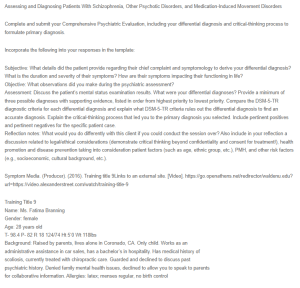
Week 7 – Training Title 9 – Comprehensive Psychiatric Evaluation
Incorporate the following into your responses in the template:
Subjective: What details did the patient provide regarding their chief complaint and symptomology to derive your differential diagnosis? What is the duration and severity of their symptoms? How are their symptoms impacting their functioning in life?
Objective: What observations did you make during the psychiatric assessment?
Assessment: Discuss the patient’s mental status examination results. What were your differential diagnoses? Provide a minimum of three possible diagnoses with supporting evidence, listed in order from highest priority to lowest priority. Compare the DSM-5-TR diagnostic criteria for each differential diagnosis and explain what DSM-5-TR criteria rules out the differential diagnosis to find an accurate diagnosis. Explain the critical-thinking process that led you to the primary diagnosis you selected. Include pertinent positives and pertinent negatives for the specific patient case.
Reflection notes: What would you do differently with this client if you could conduct the session over? Also include in your reflection a discussion related to legal/ethical considerations (demonstrate critical thinking beyond confidentiality and consent for treatment!), health promotion and disease prevention taking into consideration patient factors (such as age, ethnic group, etc.), PMH, and other risk factors (e.g., socioeconomic, cultural background, etc.).
Symptom Media. (Producer). (2016). Training title 9Links to an external site. [Video]. https://go.openathens.net/redirector/waldenu.edu?url=https://video.alexanderstreet.com/watch/training-title-9
Training Title 9
Name: Ms. Fatima Branning
Gender: female
Age: 28 years old
T- 98.4 P- 82 R 18 124/74 Ht 5’0 Wt 118lbs
Background: Raised by parents, lives alone in Coronado, CA. Only child. Works as an
administrative assistance in car sales, has a bachelor’s in hospitality. Has medical history of
scoliosis, currently treated with chiropractic care. Guarded and declined to discuss past
psychiatric history. Denied family mental health issues, declined to allow you to speak to parents
for collaborative information. Allergies: latex; menses regular, no birth control
Symptom Media. (Producer). (2016). Training title 9 [Video].
https://go.openathens.net/redirector/waldenu.edu?url=https://video.alexanderstreet.com/wa
tch/training-title-9
 Complete the order form and upload all of your files, including any instructions, rubrics, or other materials provided by your instructor.
  Complete the order payment after filling in the order form. We’ll receive your order and assign it to a writer.
 The assigned writer will complete your paper and forward it to our Editing Team for review and approval.
 Once approved by the editor, the completed paper will be uploaded to your account for you to download, review and approve.