
Analyzing a Sample Intelligence-Achievement Report
Standardized tests help provide important information about a particular person’s cognitive and educational skills. This analysis looks into Bob’s performance in the Wechsler Abbreviated Scale of Intelligence -Second Edition (WASI-2) and the Wide Range Achievement Test—Fourth Edition (WRAT-4). The assessment provides an in-depth picture of Bob’s strengths and weaknesses. It also provides the proper recommendations on how to help him operate in both ordinary and workplace situations.
Strengths and Weaknesses
Bob has definite strengths in verbal intelligence and reading. The Full-Scale IQ (FSIQ) on the WASI-2 score of 94 would indicate that his intellectual functioning is average in general, in comparison with his peers. Above-average verbal reasoning skills, vocabulary acquisition, and abstract thinking skills are denoted by his Verbal Comprehension Index (VCI) of 99, which is proven by a strong subtest result in Vocabulary (47) and Similarities (51). These good strengths are reflected in his WRAT-4 scores, since Word Reading (99) and Sentence Comprehension (93) are at average levels, indicating good reading skill and comprehension, which is crucial to everyday communication and academic performance.
Despite these strengths, Bob demonstrates weaknesses in visual-spatial and academic areas of performance. Low average visual-motor integration and spatial processing (Block Design of 43 in the WASI-2) was reflected in his Perceptual Reasoning Index (PRI) of 91, which was average but lower than his VCI. His WRAT-4 scores indicate academic issues where the scores showed borderline range on Spelling score-78 and low average on Math Computation scoring-83. Such scores grade equivalents are 11.5 and 5.5, which means that Bob could have difficulties in exercising his task-related skills in written expression or simple mathematical operations.
Overall Functioning
Verbal strengths show that Bob may comprehend complicated directions, make dialogue, and also comprehend the written word. These skills are a necessity in working and study settings that depend on spoken communication and reading (Darcho et al., 2024). His average IQ and verbal comprehension results indicate that he can fulfill tasks that involve reasoning and conceptual understanding, which facilitates daily operation and resiliency.
Conversely, his weakness can be a barrier to him in education or employment activities that involve accurate writing or computations. His written spelling problems may influence his capacity to write business or reports, and poor math skills can hamper budgeting, planning, or job tasks involving arithmetic analysis. Combined with his minor difficulty in perceptual reasoning, these can potentially affect his self-esteem and lower productivity in an environment where accuracy is of the essence (Gómez-Jorge & Díaz-Garrido, 2023). These gaps can hinder his academic or professional progress unless they are addressed.
Recommendations
Specifically, Bob should undergo remediation by working on spelling and math skills at a basic adult education program, a learning center, or one-on-one tutoring. Basic skills should be reinforced through repetition and multisensory learning, which should be the focus of such interventions (Esplendori et al., 2022). Assistive technology, including word prediction software programs and calculators, can also be used to compensate for his weaknesses and make him more productive in real-life tasks.
Besides, career counseling and vocational rehabilitation aim to direct Bob to a job that requires verbal skills and little technical writing or computation. His abilities could suit occupations that involve communication, supervision, or customer service. Some job accommodations that he would benefit from most are visual aids, templates, or additional time to spend on written work. Lastly, communication counseling might raise confidence, motivation, and resilience to allow Bob to train better skills and pursue opportunities (Kunzler et al., 2020).
Conclusively, Bob’s cognitive and academic assessments demonstrate a clear profile: good scores in verbal comprehension and reading, with poor scores in spelling, math, and visual-spatial. These results enable a specific intervention strategy to accommodate his weaknesses and mobilize his strengths to facilitate personal, academic, and vocational achievement.
References
Darcho, S., Ayele, B., Demena, M., Firdisa, D., Shawel, S., & Berhanu, A. (2024). Organizational communication skills and its associated factors among healthcare providers working at Wolaita Sodo Health Facilities, Southern Ethiopia: A cross-sectional study. Risk Management and Healthcare Policy, Volume 17, 79–88. https://doi.org/10.2147/rmhp.s445682
Esplendori, G. F., Kobayashi, R. M., & Püschel, V. A. de A. (2022). Multisensory integration approach, cognitive domains, meaningful learning: Reflections for undergraduate nursing education. Revista Da Escola de Enfermagem Da USP, 56. https://doi.org/10.1590/1980-220X-REEUSP-2021-0381
Gómez-Jorge, F., & Díaz-Garrido, E. (2023). The relation between self-esteem and productivity: An analysis in higher education institutions. Frontiers in Psychology, 13(1112437). https://doi.org/10.3389/fpsyg.2022.1112437
Kunzler, A. M., Helmreich, I., Chmitorz, A., König, J., Binder, H., Wessa, M., & Lieb, K. (2020). Psychological interventions to foster resilience in healthcare professionals. Cochrane Database of Systematic Reviews, 7(7). https://doi.org/10.1002/14651858.cd012527.pub2
ORDER A PLAGIARISM-FREE PAPER HERE
We’ll write everything from scratch
Question 
Analyzing a Sample Intelligence-Achievement Report
Overview
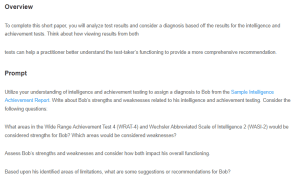
To complete this short paper, you will analyze test results and consider a diagnosis based off the results for the intelligence and achievement tests. Think about how viewing results from both
Analyzing a Sample Intelligence-Achievement Report
tests can help a practitioner better understand the test-taker’s functioning to provide a more comprehensive recommendation.
Prompt
Utilize your understanding of intelligence and achievement testing to assign a diagnosis to Bob from the Sample Intelligence Achievement Report. Write about Bob’s strengths and weaknesses related to his intelligence and achievement testing. Consider the following questions:
What areas in the Wide Range Achievement Test 4 (WRAT-4) and Wechsler Abbreviated Scale of Intelligence 2 (WASI-2) would be considered strengths for Bob? Which areas would be considered weaknesses?
Assess Bob’s strengths and weaknesses and consider how both impact his overall functioning.
Based upon his identified areas of limitations, what are some suggestions or recommendations for Bob?
 Complete the order form and upload all of your files, including any instructions, rubrics, or other materials provided by your instructor.
  Complete the order payment after filling in the order form. We’ll receive your order and assign it to a writer.
 The assigned writer will complete your paper and forward it to our Editing Team for review and approval.
 Once approved by the editor, the completed paper will be uploaded to your account for you to download, review and approve.