
Analysis of Theory Worksheet: Feminist Theory
| Name of theory | Feminist Theory |
| Author or founder | Mary Wollstonecraft, Betty Friedan, and Bell Hooks |
| Historical origin of the theory | Evolved out of 1960s and 1970s women’s liberation movements, feminist theory is a critical examination of institutionalized sexism and power asymmetries that are implicit in society’s institutions, including the household, workplace, and courts of law. |
| Basic assumptions | Personal lives are formed through political, social, and economic arrangements. The political is personal. Relations of power and gender are socially constructed and maintain inequity. |
| Underlying assumptions | Oppression is at a structural, cultural, and individual level. Traditional models of therapy are patriarchal and may reinforce patriarchy. These (race, class, sexuality) all intersect with gender. |
| Key concepts | Empowerment, intersectionality, lived experience, patriarchy, power imbalance, voice, and agency. |
| Foci/unit of analysis | Individual behavior is a component of broader systems of society. Particular focus is given to society’s influences that dictate behavior and decision-making, including society’s norms, oppression, and gender. |
| Philosophical or conceptual framework | Critically examines how gender, power, and inequality are socially constructed and maintained across institutions and cultures. It seeks to challenge patriarchal structures and advocate for equity by analyzing intersecting forms of oppression such as race, class, and sexuality. |
| Strengths of the theory | Empowers clients, respects lived experience, advocates for social justice, addresses structural inequity, and builds mutual relationships. |
| Limitations of theory | Less directive or organized; effectiveness will depend upon the client’s readiness to address sociopolitical issues. It may not help address intrapsychic issues when practiced alone. |
| Common criticisms | Overemphasizing gender, not enough attention to evidence-based outcomes, and potential biases against traditional families. |
| When and with whom would it be appropriate to use the theory/model | Ideal for clients who have been victims of gender violence, marginalization, or oppression because of their identity. Of most profound significance to women, LGBTQs, and adolescents like Ella. |
| Consistency of theory/model with social work principles | Very consistent; values client self-determination, human dignity, empowerment, and relationships very much. |
| Identification of goodness of fit with ethical principles | Supports client independence, cultural competence, and social justice as embodied in the NASW Code of Ethics. |
| Ways in which theory/model informs research methods | Advances in qualitative, participatory, action research that centers marginalized voices and respects client narration |
| Implications for social work practice | Supports anti-oppressive, strength-based practice. Guides planning of non-hierarchical relationships, advocacy of clients’ rights, and systemic change efforts. |
ORDER A PLAGIARISM-FREE PAPER HERE
We’ll write everything from scratch
Question 
Analysis of Theory Worksheet: Feminist Theory
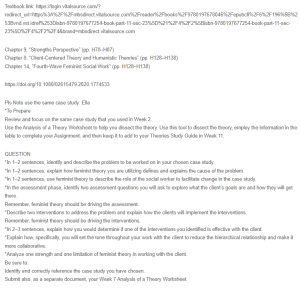
Chapter 9, “Strengths Perspective” (pp. H78–H87)
Chapter 8, “Client-Centered Theory and Humanistic Theories” (pp. H128–H138)
Chapter 14, “Fourth-Wave Feminist Social Work” (pp. H128–H138)
https://doi.org/10.1080/0261547
Analysis of Theory Worksheet – Feminist Theory
9.2020.1774533
Pls Note use the same case study: Ella
*To Prepare
Review and focus on the same case study that you used in Week 2.
Use the Analysis of a Theory Worksheet to help you dissect the theory. Use this tool to dissect the theory, employ the information in the table to complete your Assignment, and then keep it to add to your Theories Study Guide in Week 11.
QUESTION:
*In 1–2 sentences, identify and describe the problem to be worked on in your chosen case study.
*In 1–2 sentences, explain how feminist theory you are utilizing defines and explains the cause of the problem.
*In 1–2 sentences, use feminist theory to describe the role of the social worker to facilitate change in the case study.
*In the assessment phase, identify two assessment questions you will ask to explore what the client’s goals are and how they will get there.
Remember, feminist theory should be driving the assessment.
*Describe two interventions to address the problem and explain how the clients will implement the interventions.
Remember, feminist theory should be driving the interventions.
*In 2–3 sentences, explain how you would determine if one of the interventions you identified is effective with the client.
*Explain how, specifically, you will set the tone throughout your work with the client to reduce the hierarchical relationship and make it more collaborative.
*Analyze one strength and one limitation of feminist theory in working with the client.
Be sure to:
Identify and correctly reference the case study you have chosen.
Submit also, as a separate document, your Week 7 Analysis of a Theory Worksheet.
 Complete the order form and upload all of your files, including any instructions, rubrics, or other materials provided by your instructor.
  Complete the order payment after filling in the order form. We’ll receive your order and assign it to a writer.
 The assigned writer will complete your paper and forward it to our Editing Team for review and approval.
 Once approved by the editor, the completed paper will be uploaded to your account for you to download, review and approve.