
Analyzing a Research Paper on Appendicitis
Abstract Screenshot

Sentinel U Patient Screenshot
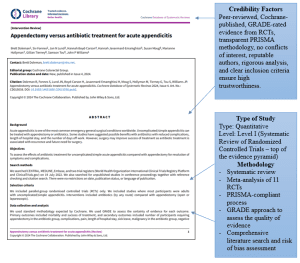
The diagnosis chosen on the Sentinel U Patient Management and Delegation simulation is appendicitis, which is a widespread emergency and normally needs quick action. I found this case interesting because of its clinical urgency and applicability in general nursing practice. The chosen scholarly article to analyze is titled “Appendectomy versus Antibiotic Treatment of Acute Appendicitis” by Doleman et al. (2024). The paper explores the possibility of using antibiotics as an alternative to operating on uncomplicated appendicitis. It is applicable to nursing in that it underscores the importance of close monitoring and effective patient education should one adopt a conservative approach to treatment. The knowledge of this evidence equips nurses to have a significant role in treatment decision-making and influence patient outcomes better by disseminating proper information and clinical awareness.
Type of Study, Methodology, and Level of Evidence
The article is a systematic review of randomized controlled trials (RCTs)—the highest level of evidence on the pyramid. A quantitative meta-analysis of the findings of 11 RCTs performed by the authors assessed various outcomes, including the success of treatment, the occurrence of recurrence, complication rates, and patient satisfaction. The article focuses on PRISMA reporting guidelines so that the review process is transparently reported. A systematic approach was used, which entailed a thorough literature review, pre-determined selection criteria, use of statistics, and evaluation of the quality of evidence using GRADE. The detailed, replicable quality gives credence to the quality and practicality of the results. It is an effective methodology that establishes conclusions based on existing and best-representative data.
Credibility Factors of the Article
The article has several good indicators of credibility. First, it is indexed in The Cochrane Database of Systematic Reviews, which is internationally renowned for its high levels of editorial scrutiny and evidence-based healthcare. Second, it is peer-reviewed; that is, it has been subjected to critical appraisal by specialists in the field before it is released. Third, the authors are credible scholars and practitioners associated with well-known institutions. Their multidisciplinary experiences in terms of surgery, public health, as well as clinical research increase the value of the credibility of the study. Fourth, the authors have no conflicts of interest and clearly report funding. Lastly, the GRADE methodology supports the credibility of the findings by showing the certainty of evidence on various outcome measures. All these make this article a good source of clinical decisions.
Importance of the Content to the Diagnosis of Appendicitis
This study is highly relevant to the clinical understanding of acute appendicitis, especially in the context of evolving treatment standards. Traditionally, surgery has been the default intervention, but this review challenges that norm by validating the effectiveness of non-operative antibiotic therapy for uncomplicated cases. The authors found that while surgery has a higher treatment success rate, antibiotics can avoid immediate operation and reduce complications such as wound infection. However, antibiotics carry a higher risk of recurrence. For nurses, this knowledge is vital to supporting informed consent, monitoring for signs of deterioration, and facilitating patient education. By understanding both approaches, nurses can more effectively participate in interdisciplinary care planning and help ensure safe, individualized patient outcomes.
Application to Nursing Practice and Work Environment
The results of this article can readily be applied in my present practice within a surgical-medical unit. Suspected appendicitis is common in patients who attend our unit, and this fact confirms personalizing treatment alternatives to patients according to their needs under different clinical circumstances and their desires. This evidence can be used to clarify the advantages and disadvantages of each, assist in the development of reasonable expectations, and observe patients in order to detect early evidence of failed treatment or development of complications. Furthermore, this study helps nurses promote the implementation of protocols, including antibiotic treatment, as one of the choices for the relevant patients. This gives the nurses the power to improve the way care is provided, remove unnecessary surgical burdens, and achieve patient satisfaction through the development of a care plan aligned with the current evidence.
Article Link
https://pmc.ncbi.nlm.nih.gov/articles/PMC11057219/pdf/CD015038.pdf
References
Doleman, B., Fonnes, S., Lund, J. N., Boyd-Carson, H., Javanmard-Emamghissi, H., Moug, S., Hollyman, M., Tierney, G., Tou, S., & Williams, J. P. (2024). Appendectomy versus antibiotic treatment for acute appendicitis. Cochrane Database of Systematic Reviews, 4. https://doi.org/10.1002/14651858.cd015038.pub2
ORDER A PLAGIARISM-FREE PAPER HERE
We’ll write everything from scratch
Question 
Analyzing a Research Paper on Appendicitis
Identify and write a summary of the various factors that contribute to the credibility of a research article related to a diagnosis of interest (Appendicitis) that you identified from the Sentinel U simulation on Patient Management & Delegation. In the module, there are 10 patients listed with various diagnosis. Select one diagnosis of interest to you from the simulation.
Analyzing a Research Paper on Appendicitis
Collapse All
Introduction
Evidence-based practice (EBP) integrates the best evidence available to guide optimal nursing care, with a goal to enhance safety and quality. EBP is crucial to nursing practice because it incorporates the best evidence from current literature, along with the expertise of the practicing nurse. The concern for quality care that flows from EBP generates a desired outcome. Without these factors, a nurse cannot be an effective leader. It is important to lead not only from this position but from knowledge and expertise. To gain the knowledge, you require a good understanding of how to search for scholarly resources, as well as make decisions regarding the content of the scholarly resources.
Professional Context
As a baccalaureate-prepared nurse, you will be responsible for providing patient-centered, competent care based on current evidence-based best practices. You will be required to do research, analysis, and dissemination of best evidence to stay abreast of these best practices. Understanding where to go to find credible evidence, determining the type of evidence and being able to make decisions based on the findings of credible evidence is the foundation of evidence-based care.
Preparation
Review the What Is Scholarly? Campus page. Specifically, look at the following two items on the page:
What Are Peer-Reviewed Articles?
Anatomy of a Scholarly Article.
These will give you the factors that contribute to credibility, which you will need to identify in the article you choose for this assessment.
Also, look at the “Find EPB Articles” section of the Evidence-Based Practice in Nursing & Health Sciences library guide (found in the guide’s left-hand menu). This may help you locate an article to use for this assessment.
Instructions
Write a 2-page analysis of a scholarly research article, demonstrating your ability to locate credible, useful evidence related to a diagnosis of interest selected from the Sentinel U simulation on Patient Management & Delegation. There are 10 patients, each with a different medical diagnosis. Select one patient with a diagnosis of interest to you.
Once you have chosen your diagnosis of interest from the Sentinel U simulation, complete the following:
Use a credible search engine to locate a research article on your topic.
Review the article for the following criteria:
Type of study (quantitative or qualitative, the level on the pyramid of evidence, methodology).
Credibility factors.
Importance of content to selected diagnosis.
The ability to apply the content in your current workplace or patient population.
Take a screenshot of the abstract and paste it into a Word document (see the Example of Screenshot [PDF] document). You can refer to the instructions in the Taking Screenshots [PDF] document.
Create a table or series of text boxes next to or below the screenshot and use that to label each criterion.
Also take a screenshot of the patient and the diagnosis from Sentinel U simulation you used.
Write up a summary of your findings on the second page. Note what information is important to your specified diagnosis. How credible is the article you’ve found and how useful is it related to your specified diagnosis and your ability to apply it?
Include a link to your article.
Include a reference to your article in APA format.
Review the Analyzing a Research Paper scoring guide for specific details of grading prior to submission.
Competencies Measured
By successfully completing this assessment, you will demonstrate your proficiency in the following course competencies and scoring guide criteria:
Competency 1: Interpret findings from scholarly quantitative, qualitative, and outcomes research articles and studies.
Determine the type of study and the level of evidence according to the pyramid of evidence.
Identify the credibility factors of an article.
Summarize the findings of an article, noting what information is important to a specified diagnosis.
Competency 2: Analyze the relevance and potential effectiveness of evidence when making a decision.
Summarize the ability to generalize article findings in a specified work space and patient population.
Competency 5: Apply professional, scholarly communication strategies to lead practice changes based on evidence.
Provide an APA-formatted reference and link to an article.
 Complete the order form and upload all of your files, including any instructions, rubrics, or other materials provided by your instructor.
  Complete the order payment after filling in the order form. We’ll receive your order and assign it to a writer.
 The assigned writer will complete your paper and forward it to our Editing Team for review and approval.
 Once approved by the editor, the completed paper will be uploaded to your account for you to download, review and approve.