
Visual Analysis Infographic
ORDER A PLAGIARISM-FREE PAPER HERE
We’ll write everything from scratch
Question 
Visual Analysis Infographic
A visual analysis is a close inspection of the artist’s use of art elements and design principles. A visual analysis moves beyond pure description. It is intended to enhance your observational and analytical skills, asking you to think critically about the choices that an artist makes. You will explain how an artist uses line, color, texture, space, emphasis, balance, proportion, and so forth, to create a unique composition. You will want to provide a detailed description of the formal (meaning “related to the form”) characteristics of the artistic composition. Remember you’re not just describing what you see, you’re describing what these elements do in the work.
Visual Analysis Infographic
Some things to consider in your analysis:
- Line: Are there any prominent lines in the work? Do you see psychological or implied lines? If so, do they serve any compositional purpose? Is line used to create a contour of an object or exist in its own right? Are the lines mostly horizontal, vertical, or diagonal? What do they suggest?
- Shape: What shapes do you see? Are they geometric? organic? biomorphic? Are there well-defined figure and ground shapes? Is shape a prominent aspect of the work?
- Mass: Does this work have real or implied mass? Where do you see this in the work? What indicates mass?
- Light: How is light used in the work? is there real or implied light? What are the values like? Do the values span white to black? Is the image relatively light or dark?
- Color: What types of colors are used? Are they warm or cool, bright or dull? Are they natural or arbitrary? Are the colors organized to lead your eye in a particular direction? Is color used to create space? What is the overall effect of color?
- Space: Is implied space created? If so, which pictorial devices (including, but not limited to overlapping, linear perspective, vertical placement, etc) are used to render the illusion of three dimensions on the two-dimensional plane. Does the artist use linear perspective, atmospheric perspective, vertical placement, overlapping, etc.? Are line and color used to create the illusion of mass or volume?
- Texture: Is there actual texture (impasto) or implied texture? Can you see the artist’s brushstrokes? Or, is the artist’s hand totally concealed? What is the overall effect of texture?
- Time and motion: Is there an implied time of day/year/era in history? Do you see implied movement or real movement? What is the effect of these elements to how we see the work?
- Design: How are the formal elements organized? What is the focal point of this composition? Describe how the artist creates emphasis in this work and why your eye moves to this area of Is the work symmetrical or asymmetrical?
Do not try to explain the subject, interpret the meaning, or judge the quality of the work. Instead, think about what you see. As you write your analysis, remember that the goal is to sharpen your visual literacy skills. You want to focus on the formal elements and design principles the artist used to create the composition (not on the meaning of the work).
Do not include outside information about the artist, the genre or the history of the work. This assignment analysis based purely on what you can see in the work. Outside research and historical context is completely unnecessary.
All analysis must be your own. Do not research these images, or work with peers past or present. Artificial intelligence (AI), ChatGPT, Bard, etc. may not be used.
The Infographic:
Choose one of the 4 images provided in the Infographic Images folder, under the Visual Formal Analysis folder.
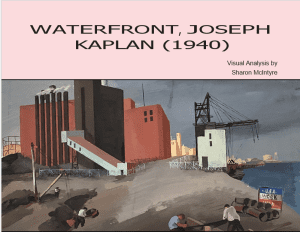
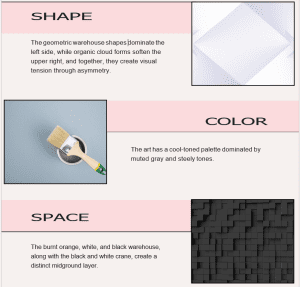
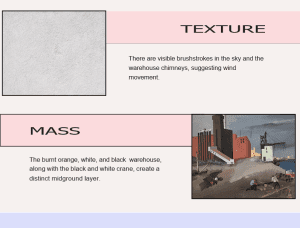
Design an infographic that highlights 4-6 main visual characteristics of your chosen artwork. Focus on the ones that are most prominent in the work.
Your infographic should include the image with artist’s name and information.
All information should be concise, grammatically correct, and easy to read.
The information should be organized well. Think of this assignment as designing an informational poster for a conference. Your poster should be well designed and informative.
Making the Infographic
I recommend using a free, online image editing program such as Canva, Pixlr, or Google Slides. All have offered template options in the past (though these change frequently). I encourage you to put your own stamp on your infographic to make it fully your own (instead of relying 100% on the template).
Your infographic must be uploaded as a PDF.
 Complete the order form and upload all of your files, including any instructions, rubrics, or other materials provided by your instructor.
  Complete the order payment after filling in the order form. We’ll receive your order and assign it to a writer.
 The assigned writer will complete your paper and forward it to our Editing Team for review and approval.
 Once approved by the editor, the completed paper will be uploaded to your account for you to download, review and approve.