
Unit 9/Module 5 Journal NU552
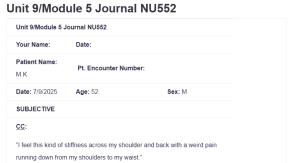
| Unit 9/Module 5 Journal NU552 | |||
| Your Name: | Date: | ||
| Patient Name: M.K | Pt. Encounter Number: | ||
| Date: 7/9/2025 | Age: 52 | Sex: M | |
| SUBJECTIVE | |||
| CC:
“I feel this kind of stiffness across my shoulder and back with a weird pain running down from my shoulders to my waist.” |
|||
| HPI:
M.K., a 52-year-old Caucasian male, presents to the clinic accompanied by his 21-year-old son with a complaint of feeling stiff in his shoulders and back. He also notes that he has a pain that runs down from his shoulders to his waist area, especially his lower back. He reports that both the stiffness and pain have been there for the last 4 months, but have been getting worse over the last 2 weeks. He notes that the stiffness and pain are making it hard for him to take care of himself, and he fears that he is getting too dependent on others. He rates the pain at a 4 out of 10. He denies any other pains, including muscle pain, fever, weakness, or numbness. |
|||
| Medications:
· Metformin 500 mg BID · Lisinopril 20 mg daily · Advil 200mg PRN |
|||
| Allergies: NKDA
|
|||
| Past Medical History:
· HTN · T2DM (Managed) · Overweight |
|||
| Family History
Maternal HTN and T2DM Older brother obese, with T2DM, HTN |
|||
| Social History
· Quit smoking at 46 years (6 years ago) · Takes alcohol (Beer 8 bottles over weekends, no drinking during weekdays) · Veteran · Majorly sedentary lifestyle in his later age · Lives with wife and 2 sons · Daughter married |
|||
| ROS | |||
| General: Reports feeling fatigued, slight weight gain within the last 1 year. Denies fever or chills | Peripheral Vascular | ||
| Skin: No report of rashes or lesions | Urinary | ||
| HEENT: No reported visual changes or eye movement restrictions. No hearing loss, ear pain, or discharge. Denies sinus pain or sore throat. | Genitalia/Reproductive: N/A | ||
| Neck: No reported sore throat, no swelling or tenderness, reports feeling tight where the neck meets the shoulders | Musculoskeletal
Reports shoulder and back stiffness and pain between the shoulders, and upper and lower back, no reported joint swelling |
||
| Breasts: N/A | Neurologic
Denies numbness, tingling, or dizziness |
||
| Respiratory
Slight cough, No wheezing or SOB reported, No reported history of COPD or other respiratory infections. |
Hematologic
No reported bleeding or ease of bruising |
||
| Cardiovascular
Denies chest pain, reports palpitations, and slight throbbing with physical exertion |
Endocrine
Reports of polyuria (T2DM-associated) (Managed) |
||
| Gastrointestinal
Reports regular bowel movements, denies constipation, abdominal pain, no N/V/D |
Psychiatric
Denies episodes of depressive symptoms, anxiety, or mood swings |
||
| OBJECTIVE | |||
| Weight 180 | Ht 5’6’’ | BMI 29 | SPO2 96% |
| B/P 140/70 | P 88 | R 22 | Temp 98 |
| General Appearance
Alert, oriented to time, space, and person, appears mildly uncomfortable when moving. |
|||
| Skin
Warm, dry, intact |
|||
| HEENT
Normocephalic, atraumatic, pupils appear round, normoreactive to light, one eye slightly closed, no redness in throat. No visible or palpable masses on face or neck |
|||
| Cardiovascular
RRR, no murmurs, normal peripheral pulses. Palpitations with physical exertion |
|||
| Respiratory
Clear to auscultation bilaterally, No crackles or wheezes |
|||
| Abdomen
Soft, non-tender, normoactive bowel sounds, distended |
|||
| Breast DEFERRED | |||
| Genitourinary DEFERRED | |||
| Musculoskeletal/Spine
Mild paraspinal muscle tenderness along the thoracic and lumbar spine. Decreased ROM in the shoulders and lumbar spine. Pain on the back to the touch and minor exertion at the third lumbar spine vertebra (L3) noted. No joint warmth, deformity, or swelling noted |
|||
| Neurological
CN II–XII intact, strength 5/5 in upper and lower extremities, normal reflexes, strong for age. |
|||
| Psychiatric
Cooperative during examination, appropriate mood and affect. |
|||
| How might diagnostic reasoning and clinical judgment be used to move toward a diagnosis in one of these systems? In your response include physical changes in older adults. Include 2-3 evidence based resources, at least one of which is a clinical guideline for a condition that may be a differential. Word count 75-100 | |||
| Clinical reasoning refers to the process of obtaining information and interpreting it to reach a plausible conclusion in healthcare settings, while clinical judgment refers to the thought process that identifies and defines diagnoses (Nunes et al., 2020). Both utilize subjective and objective data to arrive at a conclusive diagnosis.
Older adults, due to physical changes, are likely to develop musculoskeletal issues due to reduced flexibility and loss of muscle function. Such musculoskeletal issues can lead to physical disability and impairments, which contribute to social isolation, depression, and anxiety (Welsh et al., 2020). Early and targeted diagnosis, treatment, and follow-up care is recommended to reduce comorbidity-associated risks (Tengesdal et al., 2024). |
|||
References
Nunes, J. G. P., Amendoeira, J. J. P., da Cruz, D. de A. L. M., Lasater, K., Morais, S. C. R. V., & de Carvalho, E. C. (2020). Clinical judgment and diagnostic reasoning of nursing students in clinical simulation. Revista Brasileira de Enfermagem, 73(6), e20180878. https://doi.org/10.1590/0034-7167-2018-0878
Tengesdal, S., Diamantopoulos, A. P., Brekke, L. K., Besada, E., & Myklebust, G. (2024). Norwegian society of rheumatology recommendations on diagnosis and treatment of patients with Polymyalgia Rheumatica: a narrative review. BMC Rheumatology, 8(1), 1–11. https://doi.org/10.1186/S41927-024-00422-6/TABLES/5
Welsh, T. P., Yang, A. E., & Makris, U. E. (2020). Musculoskeletal Pain in Older Adults: A Clinical Review. Medical Clinics of North America, 104(5), 855–872. https://doi.org/10.1016/J.MCNA.2020.05.002/ASSET/554F318D-92F7-4F56-B983-B914B438CFFC/MAIN.ASSETS/GR1.SML
ORDER A PLAGIARISM-FREE PAPER HERE
We’ll write everything from scratch
Question 
Construct a process for comprehensive assessment, diagnostic reasoning, and appropriate examination techniques for specific patient populations across the lifespan.
Head to Toe Assessment: The Older Adult
In this competency assessment you will submit a Kaltura video and objective note, demonstrating your skill in completing a head to toe exam. Use this Journal Template.
All components of the subjective interview should be included in the documentation. Do not video the subjective portion, but complete it.
The video will be you introducing yourself and beginning the physical exam. You do NOT need to verbalize why you are performing assessment techniques in this journal as in other evaluations. You will use a live person volunteer, not a patient, and conduct the examination as a professional medical provider.
The patient is to be considered an older adult. Prepare in advance. Be sure to read the required readings and watch the videos assigned.
Your final production video should be about 10 minutes. Do not exceed 12 minutes. Your preparation and succinctness in the process and moving the patient through the exam is important.
Unit 9/Module 5 Journal NU552
Consider how you will divide your time as you begin to prepare and practice. Your communication should be clear and concise with regards to any adaptation for an older adult.
Follow the pattern and process for the exam. See the text for examples and the learning activity resources.
Your video demonstration should align with the objective documentation for this examination of an older adult.
- Your video journal should be of the objective examination only.
- Complete head to toe examination in a systematic way.
- The breast and genitalia exam are deferred for the purpose of this journal.
- Document the full subjective and objective assessment in the journal template.
- Comment on how diagnostic reasoning and clinical judgment would be used to move toward a diagnosis in an older adult. Include 2-3 evidence-based resources about older adult exam considerations; at least one of which is a clinical guideline or evidence-based support for an example condition that may be a differential if any abnormalities were found.
- Please come up with patient details
 Complete the order form and upload all of your files, including any instructions, rubrics, or other materials provided by your instructor.
  Complete the order payment after filling in the order form. We’ll receive your order and assign it to a writer.
 The assigned writer will complete your paper and forward it to our Editing Team for review and approval.
 Once approved by the editor, the completed paper will be uploaded to your account for you to download, review and approve.