
Curated Exhibit
Section 1: Personal Statement on My Theme
My exhibit explores the theme: Artists’ Self-Portraits as Tools of Social Commentary and Defiance. I chose this theme because I am deeply fascinated by how artists, throughout history and across vastly different societal contexts, have turned the deeply personal act of self-representation into a powerful public statement. More than just capturing their likeness, they use their own image to challenge prevailing norms, critique injustices, assert marginalized identities, and bear witness to personal struggles that resonate with broader societal issues: Curated Exhibit.
In an age saturated with curated online personas, looking back at these deliberate, often raw, self-examinations feels profoundly relevant. I want viewers to see the self-portrait not merely as vanity or technical exercise, but as a potent weapon and shield in the artist’s struggle for visibility and social change (Fichner-Rathus). This theme resonates with me as it highlights the universal human desire to be seen and understood on one’s own terms, especially when those terms challenge the status quo.
Section 2: Exhibition Labels
Main Exhibit Label
Exhibition Title: Mirrors of Defiance: The Self-Portrait as Social Voice
This exhibition brings together self-portraits from four distinct artistic eras, united by a powerful common thread: the artist’s use of their own image to engage with and critique the social realities of their time. Moving beyond simple self-representation, these works are acts of courage and commentary. Each artist employs the self-portrait to challenge societal expectations, confront prejudice, articulate personal pain with universal resonance, or reclaim narratives denied to them.
From the gender constraints of the 17th century to the racial dynamics of the 21st, these faces look back at us, demanding recognition not just as individuals, but as voices speaking against the currents of their respective worlds (Fichner-Rathus). As you move through the exhibit, consider: How does the artist transform their likeness into a statement?
What societal pressures or injustices are they confronting? What does their chosen style, symbolism, and presentation reveal about their defiance? Look closely; these are not passive reflections, but active declarations.
Individual Artwork Labels
Artwork 1: Artemisia Gentileschi, Self-Portrait as the Allegory of Painting (La Pittura), c. 1638-39. Oil on canvas. Display at The Royal Collection.
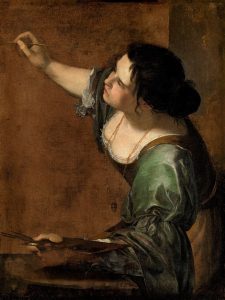
Gentileschi, a rare successful female artist in the male-dominated Baroque era, uses this self-portrait to assert her identity and professional legitimacy. By portraying herself as the allegorical figure of painting itself, she boldly inserts herself into a tradition reserved for men and claims her rightful place within the artistic pantheon. Her intense focus and strong posture defy contemporary expectations of passive femininity.
Understanding the Artwork
Baroque art often used dramatic lighting and dynamic poses. Gentileschi masters this style, but subverts its typical subjects. Historically, women were largely excluded from history painting and allegory. Gentileschi’s choice to embody “Painting” is a direct challenge to this exclusion.
The mask pendant might symbolize the artist’s transformative power or the assumed identities required to navigate her world. The style showcases her undeniable skill, while the content makes an undeniable social claim: “a woman is Painting.”
Artwork 2: Vincent van Gogh, Self-Portrait with Bandaged Ear, 1889. Oil on canvas. Located at the Courtauld Gallery, London.
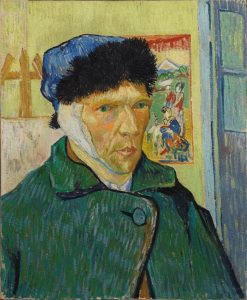
Van Gogh painted this shortly after his infamous self-mutilation following a breakdown. It serves as a stark, unflinching record of his mental anguish and physical vulnerability. Beyond personal trauma, it stands as a profound statement against the stigma surrounding mental illness. His direct, almost confrontational gaze forces the viewer to acknowledge his suffering and humanity, challenging societal tendencies to marginalize or ridicule those struggling psychologically.
Understanding the Artwork
Post-Impressionism emphasized personal expression and emotional intensity over strict realism. Van Gogh’s thick, swirling brushstrokes and intense color palette convey his inner turmoil. Historically, mental illness was poorly understood and often hidden away. Van Gogh’s willingness to depict his fractured state so honestly, using the vibrant, expressive style he pioneered, transforms a private tragedy into a public testament of fragility and resilience, pushing against the era’s silence and shame.
Artwork 3: Frida Kahlo, The Broken Column, 1944. Oil on masonite. Located at Museo Dolores Olmedo, Mexico City
Kahlo’s art is inseparable from her life-long physical suffering after a devastating bus accident. The Broken Column is one of her most visceral depictions of chronic pain and disability. It transcends autobiography by symbolizing the fragility of the human body and spirit under immense strain.
Kahlo uses her broken body to challenge societal norms of beauty, perfection, and the invisibility of chronic pain, particularly the female experience of suffering. It’s a defiant assertion of existence and identity in the face of physical collapse.
Understanding the Artwork
Kahlo’s style blends elements of Mexican folk art, Surrealism, and naive painting. The historical context includes her personal medical history and post-revolutionary Mexico’s embrace of indigenous culture. The crumbling column symbolizes her damaged spine, the nails represent constant pain, the barren landscape her isolation.
Her stoic expression amidst the horror speaks to endurance. This work interweaves personal agony with universal themes of suffering and resilience, challenging viewers to confront physical vulnerability.
Artwork 4: Kehinde Wiley, Napoleon Leading the Army over the Alps, 2005. Oil on canvas. Located at the Brooklyn Museum, New York
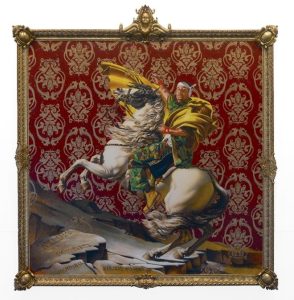
Wiley’s Napoleon is a cornerstone of his practice, perfectly embodying our exhibit’s theme. He takes one of Western art’s most famous images of white male power and conquest; Jacques-Louis David’s portrait of Napoleon, and replaces the emperor with an anonymous young Black man. This bold substitution is an act of defiance against centuries of exclusion.
It forces us to confront who has historically been deemed worthy of such grand, heroic representation and who has been left out. The artwork reclaims this visual language of power and majesty for black men, challenging viewers to question ingrained assumptions about race, history, and who gets to be the “hero” in our cultural narratives.
Understanding the Artwork
Wiley meticulously copies the style and dramatic composition of Jacques-Louis David’s original 1801 Neoclassical. However, he radically changes the content: Napoleon is replaced by a contemporary Black man in streetwear and the stark mountain background becomes a lush, decorative pattern reminiscent of African textiles. The historical context is crucial.
David’s original was propaganda, designed to glorify Napoleon’s military might and leadership. By inserting a black man into this specific, iconic framework of power, Wiley directly confronts the historical erasure and marginalization of black people in art and the broader cultural imagination.
Exit Label
As you leave “Mirrors of Defiance,” we hope these self-portraits linger in your mind. Look beyond the surface likeness. See the defiance in Gentileschi’s professional claim, the raw honesty in van Gogh’s wounded gaze, the unflinching portrayal of pain in Kahlo’s broken body, and the powerful reclamation by Wiley. Each artist, using the intimate canvas of their own image, spoke back to their world.
They remind us that art is not created in a vacuum; it is deeply woven into the fabric of society, reflecting its tensions and inequalities. These artists transformed self-portraiture from a mirror into a megaphone. What aspects of your own identity or experience deserve such a voice?
Works Cited
Fichner-Rathus, Lois. Understanding Art. 11th ed., Cengage Learning, 2016.
Gentileschi, Artemisia. Self-Portrait as the Allegory of Painting (La Pittura). Circa 1638-1639. Royal Collection Trust, www.rct.uk/collection/405551.
Kahlo, Frida. La Columna Rota, the Broken Column, 1944. USEUM, www.useum.org/artwork/La-columna-rota-The-Broken-Column-Frida-Kahlo-1944.
Van Gogh, Vincent. Self-Portrait with Bandaged Ear, 1889. The Courtauld Gallery, courtauld.ac.uk/highlights/self-portrait-with-bandaged-ear/#:~:text=This%20famous%20painting%2C%20Self%2DPortrait,a%20week%20after%20leaving%20hospital.
Wiley, Kehinde. Napoleon Leading the Army over the Alps, 2005. Brooklyn Museum, New York. https://www.brooklynmuseum.org/objects/169803
ORDER A PLAGIARISM-FREE PAPER HERE
We’ll write everything from scratch
Question 
Assignment: Curate an Exhibit Assignment
100 points
Curators of big museums think critically about the way they present their collections to visitors. They may choose to hang artworks chronologically, by theme, by artist, by era, by art movement, etc. Or they can present artworks in a way to get their audience thinking about the works in a new way.
For this assignment you will find three to five artworks on a specific theme that create an interesting dynamic when brought together. Your artworks should be from 3 different eras or style movements.
When considering a theme, think more specifically than generally. Your selected images should be a reflection of the theme, pushing the idea further, encouraging your audience to think critically about that idea.
NOTE: Organize your paper into two sections, clearly marked. Please see below. Do not combine the sections together.SECTION 1: PERSONAL STATEMENT ON YOUR THEME
- State the theme of your exhibit.
- Choose your theme, the main idea your exhibit will explore. Explain why you chose that theme. Be thoughtful and substantive in your statement. This is a personal statement.
SECTION 2: WRITE THE EXHIBITION LABELS:
- Write the main label:
- Include a title for your exhibit.
- This explains the idea behind your exhibit.
- The main label should state your theme, and guide viewers to understand it.
- Write a label for each artwork in your exhibit.
- For each artwork, include identifying information that would be included on a museum placard: artist, title, date, and current location (museum or otherwise) of that artwork. Include an image of the artwork.
- Explain what it is about each artwork that made you include them in this exhibit. What part do they play in the exhibit?
- Help the viewer to understand these artworks based on things you learned in this class about how Style, Content, Historical Context, are interrelated.

Curated Exhibit
Note: Historical context refers to the personal, social, political, cultural, economic, or environmental situations that may influence the work. What was happening at the time the work was made that may influence it?
These are labels for the public to read. They are different from the explanation you write for me (see section above). They should be written for a public that might be unfamiliar with art, or how to look at it. If there is something the public should note or think about in considering these works, include that here.
- Write an exit label:
- This is a wrap up of your ideas and the viewer’s experience. What do you hope they learned about your theme? What do you want them to continue thinking about after they leave?
PLEASE NOTE:
Any research must be cited/referenced. If you use a source or website, you need to include it in your references.
All analysis should be your own.
Your specific collection of images should be your own. Finding a collection that someone has already put together, will result in a 0.
Artificial intelligence (AI), ChatGPT, Gemini, Grammarly, Bard, etc. may not be used.
USE OF PLAGIARISM DETECTION SOFTWARE STATEMENT: The University of Alabama is committed to helping students to uphold the ethical standards of academic integrity in all areas of study. Students agree that their enrollment in this course allows the instructor the right to use electronic devices to help prevent plagiarism. All course materials are subject to submission to Turnitin.com for the purpose of detecting textual similarities.
Turnitin.com will be used as a source document to help you avoid plagiarism in written documents. If you need help using Turnitin, contact CCS Tech Support via the link on our course homepage. Do not wait until the last minute to submit your assignment, as technical difficulties with submissions in the final hours are not an excuse for missed deadlines.
Textbook:
 Complete the order form and upload all of your files, including any instructions, rubrics, or other materials provided by your instructor.
  Complete the order payment after filling in the order form. We’ll receive your order and assign it to a writer.
 The assigned writer will complete your paper and forward it to our Editing Team for review and approval.
 Once approved by the editor, the completed paper will be uploaded to your account for you to download, review and approve.