
Pharmaceutical Treatment Regimen
18-Year-Old Female with Positive Chlamydia and Gonorrhoea Exposure
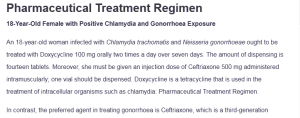
An 18-year-old woman infected with Chlamydia trachomatis and Neisseria gonorrhoeae ought to be treated with Doxycycline 100 mg orally two times a day over seven days. The amount of dispensing is fourteen tablets. Moreover, she must be given an injection dose of Ceftriaxone 500 mg administered intramuscularly; one vial should be dispensed. Doxycycline is a tetracycline that is used in the treatment of intracellular organisms such as chlamydia: Pharmaceutical Treatment Regimen.
In contrast, the preferred agent in treating gonorrhoea is Ceftriaxone, which is a third-generation cephalosporin as antibiotic resistance increases (Gannon-Loew & Holland-Hall, 2020). The non-prescription advice consists of using condoms regularly and avoiding sex until the end of the treatment. Laboratory monitoring encompasses nucleic acid amplification testing in case of symptoms and screening of HIV, syphilis, and hepatitis in case of co-infection. Title X policies and minor permissive state laws provide adolescents with confidential sexual health care and enhance outcomes regarding timely interventions.
A 52-Year-Old Male with a BPH Complaint
In the case of a 52-year-old male with signs and symptoms of benign prostatic hyperplasia, including nocturia and a weak urinary stream, the combination of Tamsulosin 0.4 mg and Finasteride 5 mg in oral intake once daily will be favorable. Thirty capsules of Tamsulosin and thirty tablets of Finasteride should be dispensed. Tamsulosin, an alpha-1 adrenergic blocker, helps to relieve symptoms quickly by relaxing the muscles in the prostate and the bladder neck surfaces.
In contrast, Finasteride, which is a 5-alpha reductase inhibitor, leads to a gradual decrease in the prostate gland size (Ng & Baradhi, 2024). The recommended lifestyle changes include reducing caffeine and fluid consumption during bedtime. Follow-up and baseline levels of the prostate-specific antigen should also be monitored to measure the response to the treatment and to screen for malignancy. Medicare and the Affordable Care Act cover regular screening and access to medication for BPH.
A 68-Year-Old Female with a Urinary Tract Infection
A 68-year-old postmenopausal female patient with urinary frequency, dysuria, and suprapubic pain indicates the presence of an uncomplicated urinary tract infection. The medication should be Nitrofurantoin monohydrate and macro crystals 100 mg orally twice daily, for five days, with ten capsules to be dispensed. Nitrofuran antibiotic Nitrofurantoin would be ideal because of its urinary specificity and reduced resistance pattern among older adults with expected renal functionalities (Squadrito & del Portal, 2023).
Non-prescription options comprise fluid consumption and cranberry supplements in daily doses to lessen the possibility of recurrence. To clarify renal clearance, monitoring labs will consist of urinalysis and urine culture to establish infection and serum creatinine and eGFR. The CMS antimicrobial stewardship policies facilitate reducing fluoroquinolone exposure among geriatric patients. In contrast, safer alternatives such as Nitrofurantoin can be offered to avoid adverse outcomes and guarantee the patient’s response to treatment.
References
Gannon-Loew, K. E., & Holland-Hall, C. (2020). A review of current guidelines and research on the management of sexually transmitted infections in adolescents and young adults. Therapeutic Advances in Infectious Disease, 7, 204993612096066. https://doi.org/10.1177/2049936120960664
Ng, M., & Baradhi, K. M. (2024, October 20). Benign prostatic hyperplasia. PubMed; StatPearls Publishing. https://www.ncbi.nlm.nih.gov/books/NBK558920/
Squadrito, F. J., & del Portal, D. (2023). Nitrofurantoin. Nih.gov; StatPearls Publishing. https://www.ncbi.nlm.nih.gov/books/NBK470526/
ORDER A PLAGIARISM-FREE PAPER HERE
We’ll write everything from scratch
Question 
Create a pharmaceutical treatment regimen for each of the following.
- 18-year-old fmale with positive with chlamydia and gonorrhea exposure
- 52-year-old male with BPH complaint.
- 68-year-old female with a urinary tract infection.
The patient specific details are yours to develop and consider to support your choices.
The non-prescription medication if any, AND the prescription details must be present.
Pharmaceutical Treatment Regimen
You may apply more than one prescription:
- For each the drug name, dose, route, frequency of administration and if prescribed, the quantity to dispense must be present.
- Include the drug class details
- Justify your reasoning
- What labs will you monitor? Why
- Include related health policy content that may impact care or outcomes.
- Provide 3 evidence based support for your stance using standard APA format.
cite in every paragraph.
Text:
 Complete the order form and upload all of your files, including any instructions, rubrics, or other materials provided by your instructor.
  Complete the order payment after filling in the order form. We’ll receive your order and assign it to a writer.
 The assigned writer will complete your paper and forward it to our Editing Team for review and approval.
 Once approved by the editor, the completed paper will be uploaded to your account for you to download, review and approve.