
Common Gynecologic Conditions, Part 2
Case #4 and Description of the Case Chosen
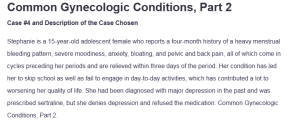
Stephanie is a 15-year-old adolescent female who reports a four-month history of a heavy menstrual bleeding pattern, severe moodiness, anxiety, bloating, and pelvic and back pain, all of which come in cycles preceding her periods and are relieved within three days of the period. Her condition has led her to skip school as well as fail to engage in day-to-day activities, which has contributed a lot to worsening her quality of life. She had been diagnosed with major depression in the past and was prescribed sertraline, but she denies depression and refused the medication: Common Gynecologic Conditions, Part 2.
| Outline Subjective data.
Identify data provided in your chosen case and any additional data needed. |
Outline
Objective findings.
Identify findings provided in your chosen case and any additional data needed. |
Identify diagnostic tests, procedures, laboratory work indicated.
Describe the rationale for each test or intervention with supporting references. |
Distinguish at least three differential diagnoses.
Describe the rationales for your choice of each diagnosis with supporting references. |
Identify appropriate medications, treatments or other interventions associated with each differential diagnosis.
Describe rationales and supporting references for each. |
Explain key
Social Determinants of Heath (SDoH) for your chosen case. |
Describe collaborative care referrals and patient education needs for your chosen case.
Describe rationales and supporting references for each. |
| The subjective data presented in the case of Stephanie emphasizes cyclic premenstrual symptoms, which considerably affect her daily activities. She is a 15-year-old girl who has experienced heavy menstrual periods and mood swings, anxiety, and somatic complaints such as bloating and pelvic and back pain within the last four months.
Symptoms begin a few days prior to the menstrual period and are relieved after three days, making her miss school and leave her usual activities. She denies that she is depressed and refuses to take sertraline, which a psychiatrist had prescribed. To further clarify the diagnostic impression, additional data should consist of a detailed symptom diary of at least two to three menstrual cycles, psychosocial stressors, sleep and appetite patterns, and a family history of psychiatric or gynecologic disorders will be necessary. |
The objective data shows vital signs in the normal range with BP of 122/74 mmHg, HR of 64 bpm, RR of 16, Temp of 97.8°F, and body mass index of 26.2, which classifies her as overweight (Weir & Jan, 2023). A general physical exam shows a well-nourished adolescent without any acute signs of distress, but seems frustrated.
Pelvic examination revealed normal results, such as a non-tender uterus and adnexa, no masses, and intact external genitalia. Although the physical manifestations are non-pathological, additional mental status assessment, investigation of possible hirsutism, acne, or review of growth patterns would provide clues to potential endocrine or mood problems. This supplementary information is crucial for making a conclusive clinical profile that would enable proper diagnosis. |
An extensive diagnostic workup is important to exclude the endocrine and gynaecological causes of Stephanie’s symptoms. A complete blood count (CBC) will be ordered to check anaemia due to heavy menstrual bleeding (Turner et al., 2023).
Thyroid-stimulating hormone (TSH) test is also taken to eliminate hypothyroidism, which can be confused with depressive symptoms and menstrual symptoms.
Complete metabolic panel (CMP) evaluates the problem in the kidney and liver with a disrupted electrolyte balance that may be hindered by prolonged or heavy menses. Some of the hormonal tests should also be ordered to detect any possible hyperandrogenism that accompanies polycystic ovarian syndrome (PCOS), which includes total testosterone, free testosterone, androstenedione, and dehydroepiandrosterone sulfate (DHEAS).
To check the presence of any anatomic abnormalities or a specific polycystic shape of the uterus and ovaries that can be the reason for the abnormal bleeding and hormonal imbalance, a pelvic ultrasound is required.
Insulin resistance should be checked by measuring the hemoglobin A1C level, mainly due to a high BMI and possible PCOS (Eyth et al., 2025). Also, urine tests, such as urinalysis and pregnancy tests, will be necessary to exclude the possibility of urinary tract infections or pregnancy, which are not likely to be present.
Lastly, it would be advisable to screen her against sexually transmitted infections since they can occasionally result in discomfort in the pelvic region. These diagnostic tests give a balanced hormonal, metabolic and gynecologic assessment. |
Premenstrual Dysphoric Disorder
The first differential diagnosis is Premenstrual Dysphoric Disorder (PMDD) because of the timing of the appearance and cyclical nature of the emotional and physical responses to Stephanie’s menstrual cycle. The fact that she experienced severe mood swings and, anxiety and difficulty with functioning months before her period also fits the diagnostic criteria of PMDD (Mishra et al., 2023). These symptoms clear up soon after menstruation begins, and this makes an association with the luteal phase characteristic of PMDD. Her refusal to be considered a depressed person could be caused by her ignorance of the hormonal basis of PMDD. PMDD can also be backed by the high degree of social and academic disruption that occurs during her menstrual periods.
Polycystic Ovary Syndrome (PCOS) The second possible differential diagnosis is polycystic ovary syndrome, which is a possibility given that Stephanie is overweight and has recent irregular menstrual periods. PCOS can be linked to hormone problems where the presence of abnormally high androgen levels can lead to idiosyncratic periods, mood fluctuations as well as insulin resistance (Shukla et al., 2025). Though none of the physical symptoms, such as hirsutism or acne, are noted, a pelvic ultrasound and hormonal analysis may prove the existence of cystic ovaries or biochemical hyperandrogenism. It is important to diagnose the disease as early as possible in adolescents to prevent further complications like infertility or type 2 diabetes. This renders PCOS a significant variable in the entire diagnostic evaluation.
Primary Dysmenorrhea Primary dysmenorrhea is a gynecologic condition that affects teenagers and can justify the prohibitive pain that Stephanie experiences in the pelvis and back during menstruation. Painful uterine cramps mark it as a result of the release of prostaglandins and are usually experienced in the absence of pelvic pathology. Although her symptoms are severe because they involve intense pain, they are also emotional and follow a cycle, which can indicate overlapping with PMDD. The existence of heavy bleeding and the use of two pads, however, alludes to the concurrent diagnosis (Mishra et al., 2023). Primary dysmenorrhea is an issue to consider in adolescents who experience painful and incapacitating menstruation but who do not exhibit anatomical abnormalities. |
Pharmacological Management
The pharmacological management of PMDD involves the use of selective serotonin reuptake inhibitors (SSRIs), such as sertraline, which can be taken daily or limited to the luteal phase. Despite her reluctance to take sertraline, the choice of psychoeducation about sertraline as a hormonal medication, not solely a psychiatric medication, can enhance compliance. Metformin is prescribed in PCOS to enhance insulin sensitivity and stabilize ovulatory cycles (Attia et al., 2023). Oral contraceptives such as ethinyl estradiol and norgestimate control menstruation and minimize androgen synthesis, positively affecting both PCOS and dysmenorrhea. To ease menstrual cramping pains, NSAIDs like ibuprofen can be prescribed to stop the production of prostaglandins. The effectiveness of this pharmacological plan relates to all possible diagnoses. Non-Pharmacological Management Non-pharmacological therapies also contribute to the treatment of Stephanie. According to Hoppe et al. (2025), it is advised that for existing PMDD, cognitive behavioral therapy be applied to help reframe mood distortions and better manage emotional control. In the case of PCOS, dietary change and exercise are key to controlling weight and metabolic health. Yoga and heat therapy can be effective secondary remedies to the distress caused by dysmenorrhea. A menstrual symptom diary can be used to monitor the effectiveness of treatment and trends, thereby improving the accuracy of diagnosis. Family counselling can also help in understanding and observing treatment schedules, which helps create a conducive home environment that aids in healthy living among teenagers. |
Stephanie has had different social determinants of health that influence her health conditions, such as her adolescence, family factors, academic qualifications, and mental health stigma. Being underage, her parents are her only source of healthcare access, emotional support, and decision-making, which can influence treatment adherence (Kalaman et al., 2023).
The potential adverse effects of missing school are long-term educational and psychological implications on her performance. Her noncompliance with medications could be caused by the stigma associated with psychiatry treatment. All these factors are relevant when developing a practical, empathetic, and realistic care plan that is respectful of her stage of development. |
Comprehensive care would necessitate multidisciplinary management involving referrals to an adolescent gynecologist, endocrinologist, and mental health specialist. A school counselor can help with academic issues, and a dietitian can help manage weight if PCOS is diagnosed.
Education of the patient and their family members is needed on the hormonal nature of PMDD, the advantages of SSRI, the necessity of a regular follow-up appointment and compliance adherence. According to Guinaudie et al. (2020), focusing on non-stigmatizing language and shared decision-making can enhance trust and empower adolescents like Stephanie. Education and teamwork are needed to integrate holistic care, respecting Stephanie’s stage of life and her physical and mental needs.
|
References
Attia, G. M., Almouteri, M. M., & Alnakhli, F. T. (2023). Role of metformin in polycystic ovary syndrome (PCOS)-related infertility. Cureus, 15(8), e44493. https://doi.org/10.7759/cureus.44493
Eyth, E., Zubair, M., & Naik, R. (2025, June 2). Hemoglobin A1C. StatPearls – NCBI Bookshelf. https://www.ncbi.nlm.nih.gov/books/NBK549816/
Guinaudie, C., Mireault, C., Tan, J., Pelling, Y., Jalali, S., Malla, A., & Iyer, S. N. (2020). Shared decision making in a youth mental health service design and research project: Insights from the Pan-Canadian ACCESS Open Minds Network. The Patient – Patient-Centered Outcomes Research, 13(6), 653–666. https://doi.org/10.1007/s40271-020-00444-5
Hoppe, J. M., Weise, C., Kleinstaeuber, M., Skalkidou, A., Vegelius, J., Comasco, E., Gröndal, M., Kaltsouni, E., Sundström, F., Sampaio, F., Andersson, G., & Buhrman, M. (2025). Emotion regulation-based internet-delivered cognitive behavioural therapy for premenstrual dysphoric disorder: Study protocol for a randomised controlled trial in Sweden. BMJ Open, 15(1), e091649. https://doi.org/10.1136/bmjopen-2024-091649
Kalaman, C. R., Ibrahim, N., Shaker, V., Cham, C. Q., Ho, M. C., Visvalingam, U., Shahabuddin, F. A., Rahman, F. N. A., Halim, M. R. T. A., Kaur, M., Azhar, F. L., Yahya, A. N., Sham, R., Siau, C. S., & Lee, K. W. (2023). Parental factors associated with child or adolescent medication adherence: A systematic review. Healthcare, 11(4), 501. https://doi.org/10.3390/healthcare11040501
Mishra, S., Elliott, H., & Marwaha, R. (2023, February 19). Premenstrual dysphoric disorder. StatPearls – NCBI Bookshelf. https://www.ncbi.nlm.nih.gov/books/NBK532307/
Shukla, A., Rasquin, L. I., & Anastasopoulou, C. (2025, May 4). Polycystic ovarian syndrome. StatPearls – NCBI Bookshelf. https://www.ncbi.nlm.nih.gov/books/NBK459251/
Turner, J., Parsi, M., & Badireddy, M. (2023, August 8). Anemia. StatPearls – NCBI Bookshelf. https://www.ncbi.nlm.nih.gov/books/NBK499994/
Weir, C. B., & Jan, A. (2023, June 26). BMI classification percentile and cut off points. StatPearls – NCBI Bookshelf. https://www.ncbi.nlm.nih.gov/books/NBK541070/
ORDER A PLAGIARISM-FREE PAPER HERE
We’ll write everything from scratch
Question 
Week 5:Case Study Assignment
COMMON GYNECOLOGIC CONDITIONS, PART 2
Case studies provide the opportunity to simulate realistic scenarios involving patients presenting with various health problems or symptoms. Such case studies enable nurse learners to apply concepts, lessons, and critical thinking to interviewing, screening, diagnostic approaches, as well as to the development of treatment plans.
For this Case Study Assignment you will choose from four case studies to identify a challenging gynecological disease process. You will then explore this case study to determine the diagnosis, diagnostic tests, and treatment options for the patient.
RESOURCES
| Be sure to review the Learning Resources before completing this activity. Click the weekly resources link to access the resources. |
To prepare:
* Review the 4 case studies under this week‘s learning resources. Select one of the cases to prepare your written assignment.
• Review the Learning Resources for this week.
Common Gynecologic Conditions, Part 2
Assignment Instructions:
* Use the Case Study Template from the Learning Resources to complete the assignment. Your submission must include a brief case write–up. followed by the fully completed template, which must be integrated into
the document rather than submitted separately.
* Include a title page, a case summary in your own words, the completed template, and a reference page formatted in APA style.
* Ensure your submission meets all criteria outlined in the template and rubric for completeness and accuracy.
BY DAY 7 OF WEEK 5
Submit your case study assignment by Day 7 of Week 5.
 Complete the order form and upload all of your files, including any instructions, rubrics, or other materials provided by your instructor.
  Complete the order payment after filling in the order form. We’ll receive your order and assign it to a writer.
 The assigned writer will complete your paper and forward it to our Editing Team for review and approval.
 Once approved by the editor, the completed paper will be uploaded to your account for you to download, review and approve.