
The Jury of Art
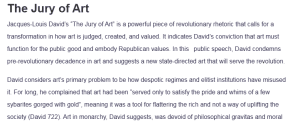
Jacques-Louis David’s “The Jury of Art” is a powerful piece of revolutionary rhetoric that calls for a transformation in how art is judged, created, and valued. It indicates David’s conviction that art must function for the public good and embody Republican values. In this public speech, David condemns pre-revolutionary decadence in art and suggests a new state-directed art that will serve the revolution.
David considers art’s primary problem to be how despotic regimes and elitist institutions have misused it. For long, he complained that art had been “served only to satisfy the pride and whims of a few sybarites gorged with gold”, meaning it was a tool for flattering the rich and not a way of uplifting the society (David 722). Art in monarchy, David suggests, was devoid of philosophical gravitas and moral compass, for it had been enslaved by whim and debauched by crime.
Artists were confined, institutions restricted freedom of movement and access, and artists were not judged on virtue or intellect but on the whims of a handful of elite gatekeepers. This shifting of genius, David believed, not only debased artistic integrity but also discouraged the creation of works that would lift virtue and civic duty. David’s critique has been observed as representative of the more general revolutionary disapproval of ancien régime culture and its institutions.
In addition to the corrupted institutional frameworks, David also critiques how artistic genius was isolated from reason and philosophy. He stresses the need for true art to move in the companionship of philosophy, which proves it by sound and profitable considerations. This connection of tradition and sense in ideas is about the relationship between aesthetics and reason. Art can no longer serve the decorative or self-indulgent function from which it was exempt for too long; it must now assume the task of moral edification.
Artists serve as cultural ambassadors capable of communicating universal ideas and experiences that can touch people regardless of their background, an assertion that underlines David’s conviction that art should be socially inclusive and morally edifying (Al-Zadjali 236). David looks to the remedy to the problem as the regeneration of art and its judges, as he states that only those with philosophical sensibility should act as judges of anything artistic.
In David’s vision, the function of art is not merely aesthetic but has a deep civic and educational purpose. The importance of art, according to him, is to help contribute powerfully to the instruction of the people toward the right by presenting ideal styles that promote liberty, virtue and civic duty. Art can mould people’s character and enhance the revolution’s values by representing moral and heroic topics. Thus, art is a visual philosophy through which the soul, rather than being moved in the direction of the just regime, works to lift it.
Moreover, David assigns art a transformative social function: to electrify the people’s souls and “bring forth in them the passion for glory and devotion to the good of the nation” (David 722). Here, he places art as a doer of moral redemption of society.
It should reflect what humans can be and inspire them to aspire toward civic greatness. The artist is thus a philosopher, imitating not only the external form of nature but also interpreting it through a moral and patriotic lens. Art’s role is therefore redefined not just as imitation but as instruction.
In summary, Jacques-Louis David’s “The Jury of Art” presents art as an engine of revolutionary change and a force for public enlightenment. He critiques the aristocratic past, where art was devoted to wealth and severed from moral reason. Instead, he insists that art must undertake the burden of civic virtue and be judged by individuals of philosophical and ethical depth. In this sense, David imagined an art that would inspire, educate, and uplift the soul of the Republic.
Works Cited
Al-Zadjali, Zahra. “The Significance of Art in Revealing a Culture’s Identity and Multiculturalism.” Open Journal of Social Sciences, vol. 12, no. 1, Jan. 2024, pp. 232–50, https://doi.org/10.4236/jss.2024.121015.
David, Jacques-Louis. “The Jury of Art.”
ORDER A PLAGIARISM-FREE PAPER HERE
We’ll write everything from scratch
Question 
After reading Jacuqes-Louis David’s “The Jury of Art” write a Reading Response that addresses the following question in a minimum of 500 words (in total, not per question).
The Jury of Art
- What does David believe is the problem with art?
- What type of function does art have in David’s text?
 Complete the order form and upload all of your files, including any instructions, rubrics, or other materials provided by your instructor.
  Complete the order payment after filling in the order form. We’ll receive your order and assign it to a writer.
 The assigned writer will complete your paper and forward it to our Editing Team for review and approval.
 Once approved by the editor, the completed paper will be uploaded to your account for you to download, review and approve.