
Pharmaceutical Treatment Regimen
50-Year-Old Russian-Born Female Diagnosed with Atrial Fibrillation
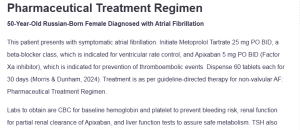
This patient presents with symptomatic atrial fibrillation. Initiate Metoprolol Tartrate 25 mg PO BID, a beta-blocker class, which is indicated for ventricular rate control, and Apixaban 5 mg PO BID (Factor Xa inhibitor), which is indicated for prevention of thromboembolic events. Dispense 60 tablets each for 30 days (Morris & Dunham, 2024). Treatment is as per guideline-directed therapy for non-valvular AF: Pharmaceutical Treatment Regimen.
Labs to obtain are CBC for baseline hemoglobin and platelet to prevent bleeding risk, renal function for partial renal clearance of Apixaban, and liver function tests to assure safe metabolism. TSH also should be obtained to rule out hyperthyroidism as a source of AF. Cultural, language, and health beliefs may affect compliance; education and interpreter services must be part of planning.
62-Year-Old Black Male Diagnosed with Hypertension
This patient has newly diagnosed stage 2 hypertension. Start Amlodipine 10 mg PO daily, a calcium channel blocker, and Chlorthalidone 25 mg PO daily, a thiazide-like diuretic, and prescribe 30 tablets each. These classes of drugs are preferred in Black patients because of enhanced BP response over ACE inhibitors. The combination provides better cardiovascular outcomes and lowers the risk of stroke.
Labs to monitor are electrolytes for the risk of hypokalemia with diuretic therapy, renal function to assess the effect on kidneys, and glucose level, as thiazides can elevate blood sugar (Akbari & Khorasani-Zadeh, 2023). Lifestyle components of high sodium intake and a sedentary lifestyle may worsen hypertension, while access to nutritious food and medication affordability should be assessed and addressed via social services.
83-Year-Old White Male Diagnosed with Heart Failure and a History of 2 MIs
This elderly patient with a history of ischemic cardiomyopathy is stable but requires blood pressure management in the primary setting. Assuming that he is already on Lisinopril 10 mg daily and Metoprolol Succinate 50 mg daily, the addition of Hydralazine 25 mg orally every three hours and Isosorbide Dinitrate 20 mg orally every three hours as a vasodilator is recommended to reduce afterload and preload, especially if systolic BP remains elevated (Greenberg, 2022). Give 90 tablets of each.
These are used in HF patients who are not at BP goal on ACE inhibitors and beta-blockers alone. Labs to monitor are renal function, electrolytes, and CBC since hypotension, renal worsening, or anemia may result. Age, cognitive impairment, and polypharmacy heighten the need for caregiver education and close monitoring to avoid adverse effects.
References
Akbari, P., & Khorasani-Zadeh, A. (2023, January 23). Thiazide diuretics. National Library of Medicine; StatPearls Publishing. https://www.ncbi.nlm.nih.gov/books/NBK532918/
Greenberg, B. (2022). Medical management of patients with heart failure and reduced ejection fraction. Korean Circulation Journal, 52(3), 173. https://doi.org/10.4070/kcj.2021.0401
Morris, J., & Dunham, A. (2024, February 29). Metoprolol. Nih; StatPearls Publishing. https://www.ncbi.nlm.nih.gov/books/NBK532923/
ORDER A PLAGIARISM-FREE PAPER HERE
We’ll write everything from scratch
Question 
Create a pharmaceutical treatment regimen for each of the following.
- 50-year-old Russian born female diagnosed with atrial fibrillation. Recent increase in palpitations
- 62-year-old Black male diagnosed with hypertension. Baseline today 160/100
- 83-year-old White male diagnosed with Heart Failure and a history of 2 MIs. Stable at present. Primary regimen is managed via cardiology. You support oversight of HTN monitoring and provide other primary care.
Directions:
- The patient specific details are yours to develop and consider to support your choices.
- You will have to assume a current regiment, and then make changes/additions.
- The non-prescription medication if any, AND the prescription details must be present.
- For each the drug name, dose, route, frequency of administration and if prescribed, the quantity to dispense must be present

Pharmaceutical Treatment Regimen
- Include the drug class details
- Justify your reasoning
- What labs will you monitor? Why?
- Consider aspects of determinants of health in your response such as individual behavior and genetics.
Notes:
- Provide 3 evidence based references for your stance using standard APA format.
- citation after every paragraph or within using APA format
 Complete the order form and upload all of your files, including any instructions, rubrics, or other materials provided by your instructor.
  Complete the order payment after filling in the order form. We’ll receive your order and assign it to a writer.
 The assigned writer will complete your paper and forward it to our Editing Team for review and approval.
 Once approved by the editor, the completed paper will be uploaded to your account for you to download, review and approve.