
Discussion: Ketamine Use in Older Adults With Depression and Suicidal Ideation
Ketamine is an FDA-approved medication for solo and adjunctive general anesthesia. Several considerations should be made before starting Ketamine on older adults with a history of chronic suicidal ideations and a recent history of substance use. Foremost, the metabolism of the drug is slower among the elderly. This may result in toxicity with standard dosing. Ketamine is known to reduce the frequency of suicidal ideations and tendencies, as well as improve abstinence from commonly abused substances (Xu et al., 2023). However, patients with a history of suicidal ideations and substance use would be assessed for the medications they are using, as Ketamine is known to interact with substances of abuse, such as alcohol.
Persistent depressive disorder compares variedly with substance-induced mood disorders. Both are characterized by a low mood, accompanied by feelings of hopelessness and sadness, among other typical manifestations of depression. Unlike PDD, substance-induced mood disorder is preceded by exposure to substances of abuse (Calarco & Lobo, 2021). PDD may also have a longer duration.
Depression with psychotic features is a disorder marked by major depression alongside psychotic features, such as hallucinations. Cultural factors, such as understanding and interpretation of disease and illness, may influence the healthcare-seeking behavior of Mrs. M. Likewise, generational factors, such as the presence of mental health illnesses along the patient’s family line, predispose her to other psychiatric disorders (Bhugra et al., 2021). Mrs. M may have a depressive disorder with a significant family history of schizophrenia, predisposing her to psychosis. Grief-related factors, such as coping with the loss of a loved one, may also precipitate depressive manifestations in the patients.
Several considerations should be made before initiating SSRIs and antipsychotic medications. Foremost, combining the agents may result in improved clinical outcomes due to superior symptom relief (Wolff et al., 2021). However, it may increase the pill burden on the patient and increase the risk of serotonin syndrome. Some SSRIs may also inhibit the metabolism of specific antipsychotic medications, resulting in toxicity (Wolff et al., 2021).
References
Bhugra, D., Watson, C., & Wijesuriya, R. (2021). Culture and mental illnesses. International Review of Psychiatry, 33(1–2), 1–2. https://doi.org/10.1080/09540261.2020.1777748
Calarco, C. A., & Lobo, M. K. (2021). Depression and substance use disorders: Clinical comorbidity and shared neurobiology. International Review of Neurobiology, 245–309. https://doi.org/10.1016/bs.irn.2020.09.004
Wolff, J., Reißner, P., Hefner, G., Normann, C., Kaier, K., Binder, H., Hiemke, C., Toto, S., Domschke, K., Marschollek, M., & Klimke, A. (2021). Pharmacotherapy, drug-drug interactions and potentially inappropriate medication in depressive disorders. PLoS ONE, 16(7), e0255192. https://doi.org/10.1371/journal.pone.0255192
Xu, R., Pan, Y., Gorenflo, M., Davis, P., Kaelber, D., & De Luca, S. (2023). Suicidal ideation and suicide attempt following ketamine prescription in patients with treatment-resistant depression: A nation-wide cohort study. Research Square (Research Square). https://doi.org/10.21203/rs.3.rs-3207199/v1
ORDER A PLAGIARISM-FREE PAPER HERE
We’ll write everything from scratch
Question 
Discussion: Ketamine Use in Older Adults With Depression and Suicidal Ideation
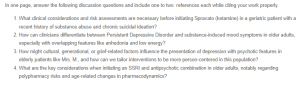
In one page, answer the following discussion questions and include one to two references each while citing your work properly.
- What clinical considerations and risk assessments are necessary before initiating Spravato (ketamine) in a geriatric patient with a recent history of substance abuse and chronic suicidal ideation?

Ketamine Use in Older Adults With Depression and Suicidal Ideation
- How can clinicians differentiate between Persistent Depressive Disorder and substance-induced mood symptoms in older adults, especially with overlapping features like anhedonia and low energy?
- How might cultural, generational, or grief-related factors influence the presentation of depression with psychotic features in elderly patients like Mrs. M., and how can we tailor interventions to be more person-centered in this population?
- What are the key considerations when initiating an SSRI and antipsychotic combination in older adults, notably regarding polypharmacy risks and age-related changes in pharmacodynamics?
 Complete the order form and upload all of your files, including any instructions, rubrics, or other materials provided by your instructor.
  Complete the order payment after filling in the order form. We’ll receive your order and assign it to a writer.
 The assigned writer will complete your paper and forward it to our Editing Team for review and approval.
 Once approved by the editor, the completed paper will be uploaded to your account for you to download, review and approve.