
PICO(T) Question and an Evidence-Based Approach – Sepsis
Sepsis is a rapidly progressing, life-threatening condition that arises from a dysregulated immune response to infection. It continues to be a significant contributor to global morbidity and mortality, particularly in hospitalized adult populations. According to Srzić (2022), prompt identification and treatment of sepsis are essential in preventing complications such as septic shock, multiple organ failure, and death. Despite the availability of guidelines, delayed recognition remains a critical problem in clinical settings. This issue is compounded by the dependence on physician-led diagnoses and treatment orders, which can introduce time lags during high-acuity situations. Registered nurses, particularly those at the baccalaureate level, are at the forefront of patient monitoring and are well-positioned to identify the early signs of sepsis. By empowering nurses to initiate standardized sepsis screening protocols, healthcare systems can potentially improve treatment timelines and outcomes. The current clinical challenge, therefore, revolves around the optimization of early detection processes within nursing practice to reduce mortality and improve efficiency in sepsis care delivery.
The practice issue is represented through the PICO(T) framework as follows:
- P (Population): Adult hospitalized patients at risk for sepsis.
- I (Intervention): Nurse-led early sepsis screening using a standardized protocol.
- C (Comparison): Physician-initiated usual care.
- O (Outcome): Reduced mortality and decreased time to treatment.
- T (Time): Within the first 24 hours of hospital admission.
From this framework, the PICO(T) research question is: In adult hospitalized patients at risk for sepsis, does nurse-led early sepsis screening using a standardized protocol, compared to physician-initiated usual care, reduce mortality and time to treatment within the first 24 hours of hospital admission? This question forms the foundation of an evidence-based inquiry aimed at guiding quality improvement in nursing care.
Relevant and Credible Sources of Evidence
The evaluation of clinical interventions requires the use of current, peer-reviewed, and evidence-based sources. To investigate the research question, multiple databases were identified based on their relevance, authority, and contribution to nursing practice. Among the most credible sources are:
PubMed
A renowned healthcare database, PubMed offers access to the highest quality of evidence-based, peer-reviewed literature, including those of randomized controlled trials and systematic reviews. It is managed by the U.S. National Library of Medicine and is a source of clinical evidence in sepsis.
CINAHL (Cumulative Index to Nursing and Allied Health Literature)
Tailored specifically for nursing and allied health professionals, CINAHL provides peer-reviewed journal articles and practice guidelines, which are particularly useful for understanding nurse-specific interventions (Oermann et al., 2021).
The Cochrane Library
Being comprehensively peer-reviewed and recognized internationally for a high methodological level, this source encompasses systematic reviews and meta-analyses that provide insight into the efficacy of the treatment as well as the clinical results.
Surviving Sepsis Campaign (SSC) Guidelines
These are the international guidelines that provide research-based evidence on the identification of early sepsis, the beginning of its treatment, and further management. They are developed by an expert panel and are supported by critical care societies; hence, they act as a guide to the management of sepsis.
The reason for choosing these sources was their relevance, currency, and practical relevance to clinical practice. As noted in previous evaluations, these platforms provide critical information support that can enable effective evidence-based practice in sepsis care.
Summary of Evidence-Based Findings
Based on the assessment of the role and efficacy of a nurse-led sepsis intervention, two of the sources were selected to be critically reviewed in more detail. Evans et al. (2021) provide international guidelines for sepsis and septic shock management. The guidelines insist on primary identification and a protocol-based approach. Programs that integrate screening procedures conducted by nurses in high-risk patients should be required to be included in sepsis performance improvement programs for the strongest recommendation. This study proves that hospitals with optimal screening and adherence to protocols conduct better treatment bundles and lower sepsis mortality. Significantly, the guidelines also address antibiotics, which should be given within one hour of sepsis identification, and intravenous fluids (30 mL/kg), which should be administered within the first three hours; such procedures are actionable by nurses if protocols exist. Besides, the authors expand on early warning scores and electronic health record alerts as the foster of nurse-led screening; they submit that while tools such as SIRS and NEWS can alert to the presence of complications or deterioration, their implementation must be contextualized within the usual clinical assessment process. There is also positive evidence for using lactate measurement to aid diagnosis and treatment initiation.
Most importantly, the study conducted by Oczkowski et al. 2022 expounds on comprehensive self-sampling by providing a clinician’s guide to the new and most recent 2021 SSC guidelines. These involve highly effective, actionable protocols such as nurse-initiated sepsis screening and the timing of sepsis treatment. They agree that although tools such as the qSOFA tool have low sensitivity, holistic performance optimization initiatives that include the use of nurse screening greatly enhance survival rates. Oczkowski et al. (2022) also noted a low level of recommendation for lactate screening and suggested that it be used as a supporting tool rather than a standalone diagnostic to enhance the judgment of nurses regarding sepsis indicators. Also, the summary emphasizes the importance of early administration of antimicrobials and coordinated action plans. ICU nurses with higher education levels demonstrated an increased ability to identify sepsis features and understand the process of bundling in delivering care to patients with sepsis.
Relevance of Evidence to Clinical Decision-Making
The studies by Evans et al. (2021) and Oczkowski et al. (2022), therefore, can be considered strong evidence of the rationale for the utilization of screening protocols in identifying sepsis. These sources support the “Intervention” component of the PICO(T) question, as the early detection by these nurses ensures that appropriate interventions are carried out rapidly, hence improving the patients’ clinical presentations. The “Outcome” measures are the most related since they are focused on the decrease in mortality and time to receive the treatment. Evans et al. (2021) provide data from observations and meta-analysis stating that structured screening and appropriate response to sepsis harm reduction bundles and mortality are reduced. Similarly, Oczkowski et al. (2022) established the benefits of early antimicrobial administration, an aspect that can be facilitated through preliminary identification by nurses and triggering early protocols.
Consequently, the relevance to the practice of nursing is rather profound. Nurses are a crucial element of patient care and are usually the first to notice variations in a patient’s well-being. Equipping them with tools like sepsis screening checklists and training concerning early indicators of sepsis is consistent with the concepts of safety, patient-centered care, and practice based on evidence. They provide evidence that increases not only patient care and outcomes but also overall communication and productivity within the clinic.
Conclusion
Sepsis continues to represent a core concern in acute care, given the high fatality rates if the condition is not diagnosed and managed at an early stage. Using the PICO(T) format, this paper aims to question whether nurse-led early screening enhances the three facets of the existence of vulnerable hospitalized patients for sepsis. Thus, the developed research question defined an evidence-based search and identified two sources: The updated 2021 Surviving Sepsis Campaign Guidelines and a clinician-focused summary by Oczkowski et al. (2022). These sources of evidence provide a clear indication in favor of the proposed nurse-led screening protocols. That has helped to minimize delays to treatment, enhance compliance with practices and recommended guidelines, and decrease mortality rates among the populations of interest. The concept of assimilating nursing leadership in early sepsis identification is consistent with the current direction of healthcare in safely eliminating harm and increasing value in interprofessional teamwork. Nurses, therefore, are not only capable but are necessary to take primary ownership of any efforts at early sepsis identification. It is possible to educate nurses and enhance their communication skills to follow the required protocols and standards, as well as to constantly support them, which can foster a culture of patient care that will have a positive impact on the results.
References
Evans, L., Rhodes, A., Alhazzani, W., Antonelli, M., Coopersmith, C. M., French, C., Machado, F. R., Mcintyre, L., Ostermann, M., Prescott, H. C., Schorr, C., Simpson, S., Wiersinga, W. J., Alshamsi, F., Angus, D. C., Arabi, Y., Azevedo, L., Beale, R., Beilman, G., . . . Levy, M. (2021). Surviving sepsis campaign: International guidelines for management of sepsis and septic shock 2021. Intensive Care Medicine, 47(11), 1181–1247. https://doi.org/10.1007/s00134-021-06506-y
Oczkowski, S., Alshamsi, F., Belley-Cote, E., Centofanti, J. E., Møller, M. H., Nunnaly, M. E., & Alhazzani, W. (2022). Surviving Sepsis Campaign Guidelines 2021: Highlights for the practicing clinician. Polish Archives of Internal Medicine. https://doi.org/10.20452/pamw.16290
Oermann, M. H., Wrigley, J., Nicoll, L. H., Ledbetter, L. S., Carter-Templeton, H., & Edie, A. H. (2021). Integrity of databases for literature searches in nursing. Advances in Nursing Science, 44(2), 102–110. https://doi.org/10.1097/ANS.0000000000000349
Srzić, I. (2022). Sepsis definition: What’s new in the treatment guidelines. Acta Clinica Croatica, 61(1). https://doi.org/10.20471/acc.2022.61.s1.11
ORDER A PLAGIARISM-FREE PAPER HERE
We’ll write everything from scratch
Question 
PICO(T) Question and an Evidence-Based Approach – Sepsis
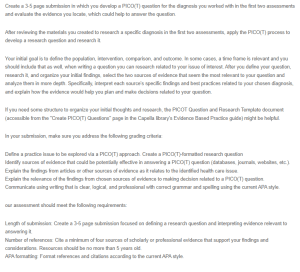
Create a 3-5 page submission in which you develop a PICO(T) question for the diagnosis you worked with in the first two assessments and evaluate the evidence you locate, which could help to answer the question.
PICO(T) Question and an Evidence-Based Approach – Sepsis
After reviewing the materials you created to research a specific diagnosis in the first two assessments, apply the PICO(T) process to develop a research question and research it.
Your initial goal is to define the population, intervention, comparison, and outcome. In some cases, a time frame is relevant and you should include that as well, when writing a question you can research related to your issue of interest. After you define your question, research it, and organize your initial findings, select the two sources of evidence that seem the most relevant to your question and analyze them in more depth. Specifically, interpret each source’s specific findings and best practices related to your chosen diagnosis, and explain how the evidence would help you plan and make decisions related to your question.
If you need some structure to organize your initial thoughts and research, the PICOT Question and Research Template document (accessible from the “Create PICO(T) Questions” page in the Capella library’s Evidence Based Practice guide) might be helpful.
In your submission, make sure you address the following grading criteria:
Define a practice issue to be explored via a PICO(T) approach. Create a PICO(T)-formatted research question
Identify sources of evidence that could be potentially effective in answering a PICO(T) question (databases, journals, websites, etc.).
Explain the findings from articles or other sources of evidence as it relates to the identified health care issue.
Explain the relevance of the findings from chosen sources of evidence to making decision related to a PICO(T) question.
Communicate using writing that is clear, logical, and professional with correct grammar and spelling using the current APA style.
our assessment should meet the following requirements:
Length of submission: Create a 3-5 page submission focused on defining a research question and interpreting evidence relevant to answering it.
Number of references: Cite a minimum of four sources of scholarly or professional evidence that support your findings and considerations. Resources should be no more than 5 years old.
APA formatting: Format references and citations according to the current APA style.
 Complete the order form and upload all of your files, including any instructions, rubrics, or other materials provided by your instructor.
  Complete the order payment after filling in the order form. We’ll receive your order and assign it to a writer.
 The assigned writer will complete your paper and forward it to our Editing Team for review and approval.
 Once approved by the editor, the completed paper will be uploaded to your account for you to download, review and approve.