
Critiquing an E-learning Case Study in an Organization
A Case Study on a DC Motor
What makes this report or case study important?
The study demonstrates an essential application of eLearning in technical environments because it showcases a new educational approach for engineering disciplines. The case illustrates how virtual simulators enable students to gain practical skills during laboratory work without physical attendance (Simoiu et al., 2019). The approach provides organizations with a powerful solution to perform extensive training and lower equipment expenses without compromising learning excellence. The approach functions as a practical solution because it merges conceptual understanding with applied knowledge, representing a common problem in online technical learning systems.
What were the key issues the organization faced?
The primary challenges of remote practical training centered on delivering affordable hands-on training remotely while meeting growth demands. Students face barriers to traditional control system training because physical labs and equipment need access, which many learners find too expensive and inaccessible (Simoiu et al., 2019). The organization required proper maintenance of a realistic learning environment with dependable feedback mechanisms and data acquisition systems to give learners relevant skills for real-world systems. Online platform users needed to consistently experience the same system performance level and learner engagement.
What online model was used for instruction? Was it appropriate?
The educational model applied simulations to remote laboratories through connected real-time operations. Through this design, students gained access to operate an actual DC motor using a web-based interface, allowing them to engage in laboratory experiments and simulated activities (Simoiu et al., 2019). The model was perfectly suited because it focused on technical content while allowing learners to execute control tests in a functional system. The hybrid model substantially supported students in theory-based education and hands-on practice.
How were the trainers prepared to deliver online learning?
The lack of trainer preparation information alongside system characteristics intended for user-friendly operation does not state if instructors need technical expertise to work with the platform (Simoiu et al., 2019). Effective support to learners requires trainers to gain proficiency with the simulator system, the online laboratory setup, and the needed troubleshooting procedures. The complete trainer implementation procedure would have benefited from further information about their professional development and training process.
How was learning assessed?
The assessment method only involved practical work because learners needed to execute control algorithms and monitor live DC motor responses. The method lets instructors determine student comprehension through their adjustments to the system controls and their capability of interpreting system responses. Although performance assessment performed well, the study fell short of discussing conventional evaluation methods such as quizzes or reflective activities to measure entire student learning outcomes (Nurhayati & Bandung, 2019).
What best practices in learning were presented?
The research utilized three optimal teaching methods, including practical student experiences, immediate feedback systems, and independent learner control features. The program enhanced student interaction with actual systems remotely, creating an environment for active participation and enhanced comprehension. Due to its capability of scaling and accessibility, the model has enabled the delivery of advanced training programs to students who do not need to attend physically (Nurhayati & Bandung, 2019). Corporations and technical organizations find these practices valuable when they seek to change and extend their contemporary training delivery systems.
What questions do you have that you would like to see answered?
The program did not address how students received assistance when encountering technical system problems. Did participants receiving training rate both usability and effectiveness positively? A comparison exists between learning outcomes from simulation training alone and real-time experiments. The approach managed learning variations together with accessibility requirements for learners. Research about these elements would demonstrate the model’s performance throughout learner groups with different profiles and workplace settings.
How can the online teaching model described in the case study be implemented in other organizations?
The teaching model suits technical organizations, engineering firms, and vocational training centers that want cost-effective, scalable, practical training programs. Organizations must buy remote access systems while building secure and stable infrastructure and providing instructor training to manage remote laboratory sessions (Nurhayati & Bandung, 2019). An appropriate setup enables organizations to provide high-quality technical training globally, thus enabling workforce development through advanced professional education for intricate systems.
References
Simoiu, M. S., Calofir, V., Fagarasan, I., & Nichiforov, C. (2019). eLearning remote simulator for implementing control systems – A case study on a DC motor. In 2019 10th IEEE International Conference on Intelligent Data Acquisition and Advanced Computing Systems: Technology and Applications (IDAACS) (pp. 1062–1067). IEEE. https://doi.org/10.1109/idaacs.2019.8924324
Nurhayati, A., & Bandung, Y. (2019). Design of eLearning platform for adult learner. In 2019 International Conference of Advanced Informatics: Concepts, Theory and Applications (ICAICTA) (pp. 1–6). IEEE. https://doi.org/10.1109/icaicta.2019.8904243
ORDER A PLAGIARISM-FREE PAPER HERE
We’ll write everything from scratch
Question 
Critiquing an E-learning Case Study in an Organization
Week 6 – Assignment: Critique an E-learning Case Study in an Organization
Instructions
Critiquing an E-learning Case Study in an Organization
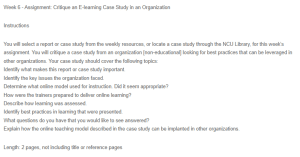
You will select a report or case study from the weekly resources, or locate a case study through the NCU Library, for this week’s assignment. You will critique a case study from an organization [non-educational] looking for best practices that can be leveraged in other organizations. Your case study should cover the following topics:
Identify what makes this report or case study important.
Identify the key issues the organization faced.
Determine what online model used for instruction. Did it seem appropriate?
How were the trainers prepared to deliver online learning?
Describe how learning was assessed.
Identify best practices in learning that were presented.
What questions do you have that you would like to see answered?
Explain how the online teaching model described in the case study can be implanted in other organizations.
Length: 2 pages, not including title or reference pages
References:
Adaptive Workplace E-Learning Model
Pashev, G., Rusenova, L., Totkov, G., & Gaftandzhieva, S. (2020). Adaptive Workplace E-Learning Model. TEM Journal, 9(2), 613–618.
This paper discusses the concepts of adaptive workplace learning to improve employee learning within an organization.
Designing a comprehensive organizational e-learning model using the Meta-Synthesis Method
Seyede Shima Karanjam, Sara Karanjam, & Nahid Zarifsanaiey. (2017). Designing a comprehensive organizational e-learning model using the Meta-Synthesis Method. Interdisciplinary Journal of Virtual Learning in Medical Sciences, 8(3).
This paper applies the meta-synthesis method to the design of organizational e-learning.
Design of eLearning Platform for Adult Learner
Nurhayati, A., & Bandung, Y. (2019). Design of eLearning Platform for Adult Learner. 2019 International Conference of Advanced Informatics: Concepts, Theory and Applications (ICAICTA), Advanced Informatics: Concepts, Theory and Applications (ICAICTA), 2019 International Conference, 1–6.
This paper discusses the importance of applying adult learning principles when training adults. This is not a case study, but the paper provides a general overview of tailoring e-learning for adults that may help you with your case study analysis.
eLearning Remote Simulator for Implementing Control Systems – A Case Study on a DC Motor.
Simoiu, M. S., Calofir, V., Fagarasan, I., & Nichiforov, C. (2019). eLearning Remote Simulator for Implementing Control Systems – A Case Study on a DC Motor. 2019 10th IEEE International Conference on Intelligent Data Acquisition and Advanced Computing Systems: Technology and Applications (IDAACS), Intelligent Data Acquisition and Advanced Computing Systems: Technology and Applications (IDAACS), 2019 10th IEEE International Conference On, 2, 1062–1067.
This paper shows how a high-fidelity simulation can be used to teach concepts that would require a costly laboratory if a simulation were not available.
Integrating a dynamic capabilities framework into workplace e‐learning process evaluations
Costello, J. T., & McNaughton, R. B. (2018). Integrating a dynamic capabilities framework into workplace e‐learning process evaluations. Knowledge & Process Management, 25(2), 108–125.
This paper discusses the use of the dynamic capabilities framework to align organizational e-learning with employee training better.
 Complete the order form and upload all of your files, including any instructions, rubrics, or other materials provided by your instructor.
  Complete the order payment after filling in the order form. We’ll receive your order and assign it to a writer.
 The assigned writer will complete your paper and forward it to our Editing Team for review and approval.
 Once approved by the editor, the completed paper will be uploaded to your account for you to download, review and approve.