
Introduction to Information Technology
Course Overview
Introduction to Information Technology is an introductory, two-unit course that is intended to make students familiar with the fundamental concepts, tools, and practices of Information Technology (IT) as an academic discipline. The course is crafted to cater to students who have no or limited background in technology by providing content that is both inclusive and interactive. The students learn about the foundations of computer systems as well as the industry-wide applications of IT so that they acquire the skills and knowledge necessary for academic, professional, and individual success in an era of technology. The goal of the course is to equip students with essential IT knowledge and digital literacy skills that are critical in today’s technology-driven world.
Unit 1 introduces the hardware and software elements of computer systems, such as hardware, system software, application software, and operating systems (Shelly & Vermaat, 2017). The unit sets the stage for understanding the purpose and relationship between computing devices and software. Unit 2 broadens students’ learning by exposing them to major IT fields: networking, security, data management, and IT’s place within an organization’s operations (Rainer et al., 2020). These are essential for demonstrating how IT specialists use technology to address actual problems and assist business operations.
By course completion, students will have acquired fundamental digital literacy and computer skills that are applicable to academic and workplace settings. The course focuses on active participation and thoughtful analysis while mapping learning objectives to measurable and assessable results.
Unit 1: Foundations of Computer Systems
This unit familiarizes students with the critical elements and functions of contemporary computer systems. The unit offers an overall basis for understanding computer software and hardware interactions, as well as the significant function operating systems perform in managing resources (Laudon & Laudon, 2021). Students will study hardware aspects including the central processing unit, memory, input/output devices, and storage devices, understanding the functionality and interrelation between them. The unit discusses various software types, such as system software and application software, and understanding how they support user interactions with hardware. Particular emphasis is given to operating systems, understanding how they control system resources, support multitasking, and provide interfaces to the user and applications.
Objectives:
- Identify the major hardware components of a computer system and describe their functions.
- Differentiate between system software and application software with real-world examples.
- Describe the role and functions of operating systems in managing hardware and software resources.
- Analyze the basic input, output, processing, and storage processes in a computing environment.
- Evaluate basic troubleshooting strategies for common computer hardware and software issues.
Unit 2: Networking, Cybersecurity and Data Management
This unit familiarizes students with key areas of Information Technology. The unit focuses on hands-on expertise in networking, security, and data management—key areas for any future IT professional (Gao et al., 2022). The students will learn about the fundamentals of computer networking, including types of networks, protocols, and communications models. The unit also covers cybersecurity, with an eye on prevalent threats, prevention methods, and data security practices (Anderson & Moore, 2020). Learners will also study data management concepts, including database structure, storage, and data retrieval. Finally, the unit identifies the purpose of IT to support an organization’s objectives, automate operations, and facilitate decisions. The students receive hands-on experience with how IT systems are used in business environments.
Objectives:
- Explain the elements and operation of fundamental computer networks.
- Identify typical cybersecurity threats and evaluate methods used to counter them.
- Discuss why data management is important and describe the primary concepts of database systems.
- Analyze the way information systems enable business operations and decision-making.
- Evaluate the emerging IT trends and state the possible influence of these trends on industry practices.
References
Anderson, R., & Moore, T. (2020). Information security: Principles and practice. Wiley.
Gao, J., Bashan, A., Shekhtman, L., & Havlin, S. (2022). Introduction to networks of networks. Institute of Physics Publishing.
Laudon, K. C., & Laudon, J. P. (2022). Management information systems: Managing the digital firm, global edition (17th ed.). Pearson Education.
Rainer, R. K., Prince, B., Splettstoesser-Hogeterp, I., Sanchez-Rodriguez, C., & Ebrahimi, S. (2020). Introduction to Information Systems (5th ed.). John Wiley & Sons.
Shelly, G. B., & Vermaat, M. E. (2017). Discovering computers: Technology in a world of computers, mobile devices, and the internet. Cengage Learning.
ORDER A PLAGIARISM-FREE PAPER HERE
We’ll write everything from scratch
Question 
Introduction to Information Technology
Week 2 assignment instructions
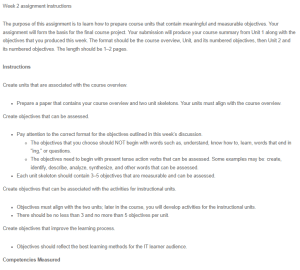
The purpose of this assignment is to learn how to prepare course units that contain meaningful and measurable objectives. Your assignment will form the basis for the final course project. Your submission will produce your course summary from Unit 1 along with the objectives that you produced this week. The format should be the course overview, Unit, and its numbered objectives, then Unit 2 and its numbered objectives. The length should be 1–2 pages.
Introduction to Information Technology
Instructions
Create units that are associated with the course overview.
- Prepare a paper that contains your course overview and two unit skeletons. Your units must align with the course overview.
Create objectives that can be assessed.
- Pay attention to the correct format for the objectives outlined in this week’s discussion.
- The objectives that you choose should NOT begin with words such as, understand, know how to, learn, words that end in “ing,” or questions.
- The objectives need to begin with present tense action verbs that can be assessed. Some examples may be: create, identify, describe, analyze, synthesize, and other words that can be assessed.
- Each unit skeleton should contain 3–5 objectives that are measurable and can be assessed.
Create objectives that can be associated with the activities for instructional units.
- Objectives must align with the two units; later in the course, you will develop activities for the instructional units.
- There should be no less than 3 and no more than 5 objectives per unit.
Create objectives that improve the learning process.
- Objectives should reflect the best learning methods for the IT learner audience.
Competencies Measured
By successfully completing this assignment, you will demonstrate your proficiency in the following course competencies and rubric criteria:
- Competency 1: Analyze the practice fundamentals for professionals in information technology.
- Create objectives that improve the learning process.
- Competency 2: Evaluate best practices of online and classroom instruction.
- Create units that are associated with the course overview.
- Create objectives that can be assessed.
- Competency 4: Examine ways to deliver instruction.
- Create objectives that can be associated with the activities for instructional units.
 Complete the order form and upload all of your files, including any instructions, rubrics, or other materials provided by your instructor.
  Complete the order payment after filling in the order form. We’ll receive your order and assign it to a writer.
 The assigned writer will complete your paper and forward it to our Editing Team for review and approval.
 Once approved by the editor, the completed paper will be uploaded to your account for you to download, review and approve.