
Ectopic Pregnancy – Assessment and Acute Management
Subjective Data
To conclusively assess my client with abdominal pain, additional thorough subjectivity data must be obtained. Some questions I would ask the client include, “Can you describe exactly where the pain is located and whether it radiates to your shoulder or back?” to assess for peritoneal irritation or hemoperitoneum, which are concerning for a ruptured ectopic pregnancy (Mummert & Gnugnoli, 2023). Questions about the intensity and duration of pain, including “Did the pain come on suddenly or gradually?” and “Has it been getting worse?” are crucial to differentiate acute from chronic causes (Dydyk & Grandhe, 2023). On the events of pregnancy, I would ask about any bright red or brownish-reddish vaginal blood, fainting episodes, or dizziness, which could be due to internal bleeding (Jeanmonod et al., 2023). It is imperative to ask her about her sexual history gently and neutrally, but even more so when the patient falls within the adolescent age because some may engage in risky behaviors due to prejudices or panic (Ibnu et al., 2020). I would also ask if she had any history of pelvic infections or if she used contraceptives or had a similar type of pain before. These subjective data indicators are important to identify early an ectopic pregnancy to decrease the morbidity and mortality rate.
Laboratory and Diagnostic Findings
The patient’s urine analysis revealed leukocytes, nitrites, and protein, which are classic indicators of a urinary tract infection (UTI). Leukocytes show the presence of white blood cells, which may imply inflammation or infection in the urinary system, while nitrites imply the presence of nitrate-reducing bacteria such as E. coli (Milani & Jialal, 2023). However, the most important results are the positive urine pregnancy test and the transvaginal ultrasound that revealed an ectopic pregnancy. An ectopic pregnancy, typically implanted in the fallopian tube, is confirmed by a positive pregnancy test in conjunction with the absence of an intrauterine gestational sac on ultrasound. The patient’s tachycardia, suprapubic tenderness, and guarding raise suspicion of possible rupture, which represents a medical emergency. These findings emphasize the need for urgent gynecological intervention to prevent hemorrhagic shock or maternal death (Mummert & Gnugnoli, 2023).
Differential Diagnoses
The primary diagnosis, supported by clinical and diagnostic data, is ectopic pregnancy. The combination of amenorrhea, positive pregnancy test, and adnexal tenderness with confirmatory transvaginal ultrasound findings strongly support this diagnosis (Ali, 2023). Another possible but less likely differential is pelvic inflammatory disease (PID), which can present similarly with lower abdominal pain and dysuria, especially in sexually active adolescents. However, PID is usually accompanied by cervical motion tenderness, vaginal discharge, or fever, which are absent in this case (Jennings & Krywko, 2023). A ruptured ovarian cyst is another differential, especially given her age and reproductive status, but it would not account for a positive pregnancy test and would appear differently on imaging (Mobeen & Apostol, 2023). Appendicitis may present with right lower quadrant pain, but the negative Rovsing and Psoas signs and suprapubic rather than periumbilical or RLQ pain reduce its likelihood (Lotfollahzadeh et al., 2024). Finally, while the urinalysis suggests a UTI, this alone cannot explain the severity and location of her pain, especially in the presence of a confirmed ectopic pregnancy (Bono et al., 2023).
Acute Management Strategies
Given the diagnosis of ectopic pregnancy, immediate stabilization and gynecological consultation are critical. First-line interventions include establishing IV access, administering fluids, and monitoring for signs of hypovolemia (Mummert & Gnugnoli, 2023). If the ectopic pregnancy is unruptured and the patient is hemodynamically stable, methotrexate may be considered as a medical management option. Methotrexate is a folic acid antagonist that halts trophoblastic growth and is a safe and effective option in selected cases (Hanoodi & Mittal, 2023). However, if there is any suspicion of rupture or if the patient is unstable, surgical intervention—typically via laparoscopy—is indicated to control intra-abdominal bleeding. In addition, Rh typing must be performed, and Rho(D) immune globulin must be administered if the patient is Rh-negative to prevent alloimmunization in future pregnancies. Pain management and emotional support are essential components of care, as adolescents facing reproductive emergencies may experience significant psychological distress. Finally, while the UTI is likely a secondary finding, empirical antibiotic treatment should be initiated, such as nitrofurantoin or trimethoprim-sulfamethoxazole, unless contraindicated (Bono et al., 2023).
References
Ali, M. (2023). Ectopic pregnancy. Radiopaedia.org, 89(57). https://doi.org/10.53347/rid-181241
Bono, M. J., Reygaert, W. C., & Leslie, S. W. (2023). Uncomplicated Urinary tract infections. National Library of Medicine; StatPearls Publishing. https://www.ncbi.nlm.nih.gov/books/NBK470195/
Dydyk, A. M., & Grandhe, S. (2023). Pain Assessment. PubMed; StatPearls Publishing. https://www.ncbi.nlm.nih.gov/books/NBK556098/
Hanoodi, M., & Mittal, M. (2023, January 16). Methotrexate. PubMed; StatPearls Publishing. https://www.ncbi.nlm.nih.gov/books/NBK556114/
Ibnu, I. F., Wahyuni, C. U., & Devy, S. R. (2020). Narrative stories of high risk sexual behaviors among adolescents in Makassar City. Journal of Public Health Research, 89(56). https://doi.org/10.4081/jphr.2020.1830
Jeanmonod, R., Skelly, C. L., & Agresti, D. (2023, May 23). Vaginal Bleeding. Nih.gov; StatPearls Publishing. https://www.ncbi.nlm.nih.gov/books/NBK470230/
Jennings, L. K., & Krywko, D. M. (2023, March 13). Pelvic inflammatory disease. National Library of Medicine; StatPearls Publishing. https://www.ncbi.nlm.nih.gov/books/NBK499959/
Lotfollahzadeh, S., Lopez, R. A., & Deppen, J. G. (2024). Appendicitis. National Library of Medicine; StatPearls Publishing. https://www.ncbi.nlm.nih.gov/books/NBK493193/
Milani, D. A. Q., & Jialal, I. (2023, May 1). Urinalysis. PubMed; StatPearls Publishing. https://www.ncbi.nlm.nih.gov/books/NBK557685/
Mobeen, S., & Apostol, R. (2023, June 5). Ovarian cyst. PubMed; StatPearls Publishing. https://www.ncbi.nlm.nih.gov/books/NBK560541/
Mummert, T., & Gnugnoli, D. M. (2023). Ectopic pregnancy. Nih.gov; StatPearls Publishing. https://www.ncbi.nlm.nih.gov/books/NBK539860/
ORDER A PLAGIARISM-FREE PAPER HERE
We’ll write everything from scratch
Question 
Ectopic Pregnancy – Assessment and Acute Management
Chief Complaint: “I’m in so much pain.”
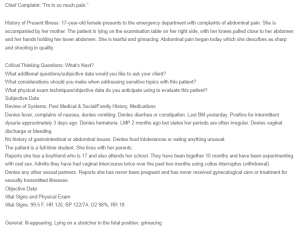
History of Present Illness: 17-year-old female presents to the emergency department with complaints of abdominal pain. She is accompanied by her mother. The patient is lying on the examination table on her right side, with her knees pulled close to her abdomen and her hands holding her lower abdomen. She is tearful and grimacing. Abdominal pain began today which she describes as sharp and shooting in quality.
Ectopic Pregnancy – Assessment and Acute Management
Critical Thinking Questions: What’s Next?
What additional questions/subjective data would you like to ask your client?
What considerations should you make when addressing sensitive topics with this patient?
What physical exam techniques/objective data do you anticipate using to evaluate this patient?
Subjective Data
Review of Systems, Past Medical & Social/Family History, Medications
Denies fever, complains of nausea, denies vomiting. Denies diarrhea or constipation. Last BM yesterday. Positive for intermittent dysuria approximately 3 days ago. Denies hematuria. LMP 2 months ago but states her periods are often irregular. Denies vaginal discharge or bleeding.
No history of gastrointestinal or abdominal issues. Denies food intolerances or eating anything unusual.
The patient is a full-time student. She lives with her parents.
Reports she has a boyfriend who is 17 and also attends her school. They have been together 10 months and have been experimenting with oral sex. Admits they have had vaginal intercourse twice over the past two months using coitus interruptus (withdrawal).
Denies any other sexual partners. Reports she has never been pregnant and has never received gynecological care or treatment for sexually transmitted illnesses.
Objective Data
Vital Signs and Physical Exam
Vital Signs: 99.5 F, HR 120, BP 122/74, O2 98%, RR 18
General: Ill-appearing, Lying on a stretcher in the fetal position, grimacing
CV: S1, S2 clear and regular, no murmurs, rubs, or gallops
Chest: Lungs clear to auscultation
Abdomen: Bowel sounds active x 4, Soft, +Tenderness to suprapubic area, +Guarding, (-) Rovsing & Psoas signs, (-) CVA tenderness
GU: External genitalia without erythema or lesions. Vaginal mucosa and cervix pink without discharge.
Neuro: Alert and oriented x 3, anxious
Skin: Clear, No rashes, bruises, or sores.
Critical Thinking Questions:What’s Next?
What orders do you anticipate for this patient?
What are your differential diagnoses at this time?
Lab Results and Ultrasound
Urine Analysis: positive for leukocytes, nitrites, and protein
Urine pregnancy test positive
Transvaginal U/S + ectopic pregnancy
Discussion Instructions
Consider the subjective and objective data provided in the case and answer the following questions.
What additional subjective data (questions) would you ask of your client? (Provide rationale that includes scholarly sources less than 5 years old.)
What do the laboratory and diagnostic findings indicate?
What are the differential diagnoses for this client’s symptoms? (Provide rationale that includes scholarly sources less than 5 years old.)
What acute management strategies would you anticipate being ordered for this patient? (Provide a rationale that includes scholarly sources less than 5 years old.)
Because this is a discussion, you will want to format your primary post and responses to peers in an organized thought-provoking fashion. Write your answers using paragraphs. Consider using short headings, such as “Subjective Data” and “Objective Data.” Do not copy and paste the question or present lists of bulleted or numbered information.
To receive full credit for this discussion:
You must post the initial primary post on the date that is listed in the due date calendar. The calendar is located in the Start Here Module.
You must show evidence of full engagement in the discussion. Posts in discussion on at least three different days. (One day for the primary post and at least two different days for peer responses.) Each peer response post demonstrates an analysis of others’ posts and extends the discussion by building on previous posts and asking relevant questions, meaningfully extends the discussion. Evidence/research cited in at least 2 peer posts.
The student understands significant ideas relevant to the issue or problem under discussion. This is indicated by the correct use of terminology, a precise selection of the pieces of information required to make a point, correct and appropriate use of examples and counterexamples, demonstrations of which distinctions are important to make, and explanations that are concise and to the point Information and knowledge are accurate The student elaborates statements with accurate explanations, reasons, and evidence Two or more appropriate scholarly sources effectively utilized in the primary post (one source may be a textbook). Do not use WebMD as this is not a scholarly source. StatPearls, UpToDate, Peer-reviewed articles (less than 5 years old), and professional web sources, such as the CDC and NIH are all acceptable sources.
Writing is in paragraph format, has no spelling, grammatical, or significant APA errors, and is organized, clear, and concise.
 Complete the order form and upload all of your files, including any instructions, rubrics, or other materials provided by your instructor.
  Complete the order payment after filling in the order form. We’ll receive your order and assign it to a writer.
 The assigned writer will complete your paper and forward it to our Editing Team for review and approval.
 Once approved by the editor, the completed paper will be uploaded to your account for you to download, review and approve.