
PDCA Analysis – Boeing 737 MAX Production Issues (2024)
I asked ChatGPT to “describe the PDCA cycle,” and it elucidated the model in this manner:
- Plan: Define the problem and create a plan.
- Do: Implement a solution on a small scale.
- Check: Assess the outcomes.
- Act: Standardize the solution or update the plan
Next, I inquired from ChatGPT, “What recent real-world projects have serious problems that can use PDCA analysis?” It led me to recognize that Boeing 737 MAX manufacturing problems, especially subcontractor part quality and varying inspection processes, were among them. I pursued further regarding how the PDCA cycle could address these particular areas.
- Plan
- Issue: Inconsistency in quality control checks for subcontractors’ parts on assembly.
- Objective: Standardize inspection processes and improve digital monitoring.
- Develop: Build an all-new standardized QA checklist for subcontractor components, embrace AI-driven visual inspection tools, and standardize the frequency of inspections for all lines.
- Do
- Pilot the new procedure in one assembly line.
- In real-time, AI-based image recognition software is used to identify problems (e.g., bolt misalignment) and cross-check them with QA personnel reports.
- Support training on new processes and tools before implementing them.
- Check
- Before implementation, review defect reports, error rates, and feedback from staff.
- Compare existing data with past performance indicators to gauge if defect rates decreased.
- Assess tool accuracy and employee satisfaction.
- Act
- If successful: Adopt the standardized inspection and AI tool company-wide and include training modules permanently.
- If unsuccessful: Re-evaluate tool accuracy and employee participation, enhance training, and reimplement the PDCA cycle.
Reflection
AI acted as an intelligent partner by assisting in streamlining research, ascertaining project challenges, and efficiently organizing the PDCA model. AI permitted me to concentrate on decision-making and analysis instead of wasting too much effort on data collection. Ethically, transparency in AI use is crucial, with proper attribution between human and AI efforts being granted (Balasubramaniam et al., 2023). AI outputs must also be verified to avoid biased or defective decision-making. Human judgment can augment AI-based suggestions by adding context, ethic-based reasoning, and real-life experience to data-based recommendations (Bashkirova & Krpan, 2024). This ensures that conclusions are practical, culturally compatible, and aligned with organizational objectives.
References
Balasubramaniam, N., Kauppinen, M., Rannisto, A., Hiekkanen, K., & Kujala, S. (2023). Transparency and explainability of AI systems: From ethical guidelines to requirements. Information and Software Technology, 159, 107197. Sciencedirect. https://doi.org/10.1016/j.infsof.2023.107197
Bashkirova, A., & Krpan, D. (2024). Confirmation bias in AI-assisted decision-making: AI triage recommendations congruent with expert judgments increase psychologist trust and recommendation acceptance. Computers in Human Behavior: Artificial Humans, 2(1), 100066. https://doi.org/10.1016/j.chbah.2024.100066
ORDER A PLAGIARISM-FREE PAPER HERE
We’ll write everything from scratch
Question 
PDCA Analysis – Boeing 737 MAX Production Issues (2024)
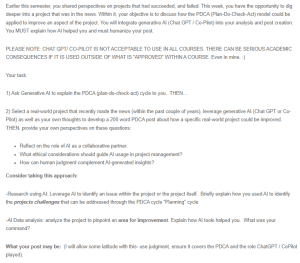
Earlier this semester, you shared perspectives on projects that had succeeded, and failed. This week, you have the opportunity to dig deeper into a project that was in the news. Within it, your objective is to discuss how the PDCA (Plan-Do-Check-Act) model could be applied to improve an aspect of the project. You will integrate generative AI (Chat GPT / Co-Pilot) into your analysis and post creation. You MUST explain how AI helped you and must humanize your post.
PDCA Analysis – Boeing 737 MAX Production Issues (2024)
PLEASE NOTE: CHAT GPT/ CO-PILOT IS NOT ACCEPTABLE TO USE IN ALL COURSES. THERE CAN BE SERIOUS ACADEMIC CONSEQUENCES IF IT IS USED OUTSIDE OF WHAT IS “APPROVED” WITHIN A COURSE. Even in mine. 🙂
Your task:
1) Ask Generative AI to explain the PDCA (plan-do-check-act) cycle to you. THEN….
2) Select a real-world project that recently made the news (within the past couple of years), leverage generative AI (Chat GPT or Co-Pilot) as well as your own thoughts to develop a 200 word PDCA post about how a specific real-world project could be improved. THEN, provide your own perspectives on these questions:
- Reflect on the role of AI as a collaborative partner.
- What ethical considerations should guide AI usage in project management?
- How can human judgment complement AI-generated insights?
Consider taking this approach:
-Research using AI: Leverage AI to identify an issue within the project or the project itself. Briefly explain how you used AI to identify the projects challenges that can be addressed through the PDCA cycle “Planning” cycle.
-AI Data analysis: analyze the project to pinpoint an area for improvement. Explain how AI tools helped you. What was your command?
What your post may be: (I will allow some latitude with this- use judgment, ensure it covers the PDCA and the role ChatGPT / CoPilot played).
Plan: Brief Description of the project and identify a specific challenge, process or component within the project that could benefit from improvement. Suggest a plan on how you could improve it.
Do: Hypothetically, how would you test out the plan small scale?
Check: What metrics would you use to analyze the results from the “DO” phase? How would you know if it worked? What would you compare expected outcomes against?
Act: Assuming your check phase demonstrated it would work, how would you take action? What if your plan didn’t work, what then?
Answer the following questions:
- Reflect on the role of AI as a collaborative partner.
- What ethical considerations should guide AI usage in project management?
- How can human judgment complement AI-generated insights?
 Complete the order form and upload all of your files, including any instructions, rubrics, or other materials provided by your instructor.
  Complete the order payment after filling in the order form. We’ll receive your order and assign it to a writer.
 The assigned writer will complete your paper and forward it to our Editing Team for review and approval.
 Once approved by the editor, the completed paper will be uploaded to your account for you to download, review and approve.