
A Bloated Bureaucracy and an Inclusive Supreme Court
In the United States versus Rahimi case, the Supreme Court ruled that individuals facing domestic violence charges should be denied constitutional access to guns. The case involved Zackey Rahimi, who shot at her girlfriend and injured her. The girlfriend filed for restraining orders on the account that Rahimi had threatened to kill her if she dared report to the police at the Texas State Court. The restraining orders included orders of firearm license cancellation, which Rahimi successfully appealed against at the Appeals Court. However, the Supreme Court ultimately ruled that Rahimi posed a significant threat to his girlfriend, effectively upholding the Texas state court’s ruling that domestic abusers should not possess firearms (Donlon, 2025).
In their ruling, the Supreme Court cited the surety laws and affray laws. Surety laws allow judges to impose a bond or restraining orders on individuals suspected of misbehaving in the future, including those who commit domestic violence (Donlon, 2025). Such bonds or related restraining orders depend on a magistrate’s findings and are temporary. On the other hand, affray laws outlaw riding or being armed with dangerous arms that may harm “the good people of the land” (Donlon, 2025). To that end, I find it appropriate that the Supreme Court imposed firearm ownership restrictions on Rahini because he posed a danger to his girlfriend, having injured her and threatened to shoot her if she reported him to the police.
The Second Amendment is deeply entrenched in the Constitution. In particular, a 2008 ruling cleared the air regarding who should own guns by redefining the meaning of militia and affirming that individual private citizens have a right to possess firearms (Greenberg & Page, 2018). However, there are several limitations that are designed to ensure public safety, including one’s criminal background and state of mental health. Given the never-ending cases of gun misuse, including mass shootings and incidents of domestic violence homicides, there is a need to implement laws to protect good citizens from deranged gun owners.
References
Donlon, J. (2025, January 27). United States v. Rahimi: “We do not resolve any of those questions because we cannot.” Virginia Law Review. https://virginialawreview.org/articles/united-states-v-rahimi-we-do-not-resolve-any-of-those-questions-because-we-cannot/
Greenberg, E. S., & Page, B. I. (2018). Struggle for democracy: 2018 elections and updates edition. Pearson.
ORDER A PLAGIARISM-FREE PAPER HERE
We’ll write everything from scratch
Question 
A Bloated Bureaucracy and an Inclusive Supreme Court
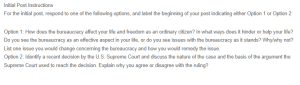
Initial Post Instructions
For the initial post, respond to one of the following options, and label the beginning of your post indicating either Option 1 or Option 2:
A Bloated Bureaucracy and an Inclusive Supreme Court
Option 1: How does the bureaucracy affect your life and freedom as an ordinary citizen? In what ways does it hinder or help your life? Do you see the bureaucracy as an effective aspect in your life, or do you see issues with the bureaucracy as it stands? Why/why not? List one issue you would change concerning the bureaucracy and how you would remedy the issue.
Option 2: Identify a recent decision by the U.S. Supreme Court and discuss the nature of the case and the basis of the argument the Supreme Court used to reach the decision. Explain why you agree or disagree with the ruling?
 Complete the order form and upload all of your files, including any instructions, rubrics, or other materials provided by your instructor.
  Complete the order payment after filling in the order form. We’ll receive your order and assign it to a writer.
 The assigned writer will complete your paper and forward it to our Editing Team for review and approval.
 Once approved by the editor, the completed paper will be uploaded to your account for you to download, review and approve.