
Discussion – e-Learning Modalities
Gamification
Gamification uses game-like elements like points, badges, leaderboards, and levels in non-game educational spaces to enhance student interest and drive learning. The approach creates enjoyable learning activities that help students remain involved through competition. Careful design of gamification elements prevents the creation of barriers to learning objectives. Applying gamification elements creates effective results in corporate training programs, K-12 education systems, and skills development learning programs. Effective gamification requires matching gameplay elements to the learning goals and offering rewarding outcomes to students (TEDx Talks, 2015). Research validates the learning enhancement effect of gamification since motivational and behaviorist theories confirm that gamers typically display higher motivation and greater investment during educational play.
Microlearning
Learning occurs through small, focused content segments, mostly video clips, graphical representations, and quiz-like assessments. The learning format suits mobile learners because it provides quick comprehension with engaging content. The method is ineffective when teaching advanced information, requiring a detailed investigation (Vaz et al., 2020). The system serves three primary functions: preparing new employees, delivering compliance training, and refreshing skills. The key elements of successful microlearning include visual appeal and measurable objectives backed by additional follow-up assignments. The behaviorist principles behind this approach make learners remember facts better through constant practice with automatic performance assessment.
Mobile Learning (mLearning)
Learning delivery through any location occurs through smartphone and tablet devices in mobile learning systems. The benefits of learning through portable devices are access to information anytime and flexibility, but these devices present restricted display size and multiple distractions. The mLearning approach succeeds at developing field instruction, language applications, and shorter challenge tasks (Simoiu et al., 2019). Excellent practice demands designers create content for small displays and provide brief information for easy offline access. Mobile learning is a connectivity method that continuously allows students to learn through external classroom connections to content and communities.
Recommendation: Microlearning + Mobile Learning
Implementing microlearning with mobile learning is strongly advised for creating a new e-learning modality. This methodology delivers interactive capabilities and schedule flexibility, enabling learning when learners need it most. Mobile learning through short-format education enables students to learn efficiently anytime, anywhere while they become more attentive, improve their lessons, and finish coursework faster. The system enables spontaneous learning while enhancing operational results and matches contemporary digital user behavior patterns, working perfectly in high-pressure work environments.
References
Simoiu, M. S., Calofir, V., Fagarasan, I., & Nichiforov, C. (2019). eLearning remote simulator for implementing control systems – A case study on a DC motor. In 2019 10th IEEE International Conference on Intelligent Data Acquisition and Advanced Computing Systems: Technology and Applications (IDAACS), 1062–1067. https://doi.org/10.1109/idaacs.2019.8924324
TEDx Talks. (2015, January 12). Gamification at work | Janaki Kumar | TEDxGraz [Video]. YouTube. https://www.youtube.com/watch?v=6wk4dkY-rV0
Vaz, C. M., Peres, E., Sousa, J., & Reis, M. C. D. S. (2020). A full-stack model proposal to willingly implement e-learning at small universities: The University of Trás-os-Montes and Alto Douro case. Journal of e-Learning and Knowledge Society, 16(2), 01–08. https://doi.org/10.20368/1971-8829/1135029
ORDER A PLAGIARISM-FREE PAPER HERE
We’ll write everything from scratch
Question 
Discussion – e-Learning Modalities
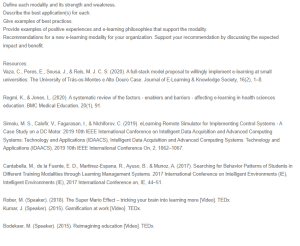
Define each modality and its strength and weakness.
Describe the best application(s) for each.
Give examples of best practices.
Provide examples of positive experiences and e-learning philosophies that support the modality.
Recommendations for a new e-learning modality for your organization. Support your recommendation by discussing the expected impact and benefit.
Discussion – e-Learning Modalities
Resources:
Vaza, C., Peres, E., Sousa, J., & Reis, M. J. C. S. (2020). A full-stack model proposal to willingly implement e-learning at small universities: The University of Trás-os-Montes e Alto Douro Case. Journal of E-Learning & Knowledge Society, 16(2), 1–8.
Regmi, K., & Jones, L. (2020). A systematic review of the factors – enablers and barriers – affecting e-learning in health sciences education. BMC Medical Education, 20(1), 91.
Simoiu, M. S., Calofir, V., Fagarasan, I., & Nichiforov, C. (2019). eLearning Remote Simulator for Implementing Control Systems – A Case Study on a DC Motor. 2019 10th IEEE International Conference on Intelligent Data Acquisition and Advanced Computing Systems: Technology and Applications (IDAACS), Intelligent Data Acquisition and Advanced Computing Systems: Technology and Applications (IDAACS), 2019 10th IEEE International Conference On, 2, 1062–1067.
Cantabella, M., de la Fuente, E. D., Martinez-Espana, R., Ayuso, B., & Munoz, A. (2017). Searching for Behavior Patterns of Students in Different Training Modalities through Learning Management Systems. 2017 International Conference on Intelligent Environments (IE), Intelligent Environments (IE), 2017 International Conference on, IE, 44–51.
Rober, M. (Speaker). (2018). The Super Mario Effect – tricking your brain into learning more [Video]. TEDx.
Kumar, J. (Speaker). (2015). Gamification at work [Video]. TEDx.
Bodekaer, M. (Speaker). (2015). Reimagining education [Video]. TEDx.
 Complete the order form and upload all of your files, including any instructions, rubrics, or other materials provided by your instructor.
  Complete the order payment after filling in the order form. We’ll receive your order and assign it to a writer.
 The assigned writer will complete your paper and forward it to our Editing Team for review and approval.
 Once approved by the editor, the completed paper will be uploaded to your account for you to download, review and approve.