
Practicum Case – Sleep – Awake
Hello. My name is Adele Jones. For today’s case presentation, I’ll discuss a sleep-wake disorder. The case involves an old woman who has chronic insomnia. Welcome.
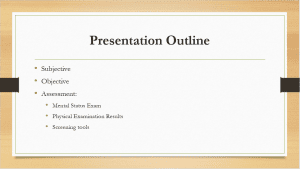
We will start with the subjective findings, explaining the symptoms the patient is presenting and how they have impacted her life. We will then move on to the objective findings, both physical and behavioral findings observed during the psychiatric evaluation. Lastly, the results of the assessment section will come next, with both the mental status exam and physical exam results, including screening scores.
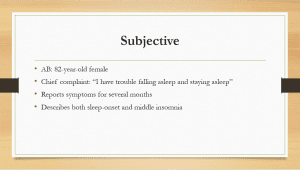
The client, AB, an 82-year-old white woman, had a chief complaint of insomnia. She complains of having difficulty falling asleep (sleep-onset insomnia) and multiple awakenings during the night (middle insomnia). This, she reports, has been happening for a few months and, on occasion, results in a night of one or two hours of sleep—or none at all. She describes lying awake for hours and not being able to relax. In spite of the chronic nature of her symptoms, she denies any suicidal thoughts, hallucinations, or use of substances to fall asleep. Her self-report meets clinical standards for insomnia, and her report emphasizes the distress and chronicity of her symptoms. This subjective report is an essential component of the clinical presentation.
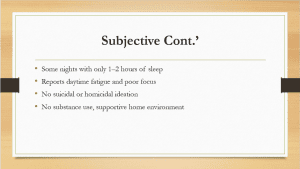
AB shares how her insomnia significantly impacts her life. There are nights when she sleeps for merely an hour or two, and this results in daytime fatigue, low energy, and poor concentration. These have impacted her capacity to do things and join in everyday activities. She reports that she does not consume alcohol, tobacco, or street drugs. AB has social support. She is retired, married, and lives with her husband. She has three grown children with whom she remains close. Her family history is significant for a depressed grandmother, which, when considering potential mood-related contributions to insomnia, is worth noting. Her immaculate psychosocial history and supportive family are a plus, but the functional impairment is evident.
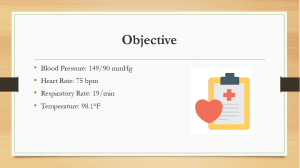
Going by the assessment details, AB has normal clinical vital signs expected for her age group. Her blood pressure was taken as 149/90 mmHg, and her pulse rate was 75 beats per minute. This was in concordance with the normal respiratory rate that was recorded at 19 breaths per minute, accompanied normal body temperature of 98.1°F. The scores of these values were not indicative of any significant physiological symptoms of stress during examination.
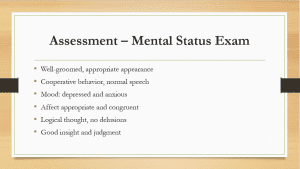
AB’s mental status examination provided a clear impression of her psychological functioning. She was well-groomed and appropriately dressed with evidence of good hygiene and respect for social norms. She was cooperative in her behavior with no agitation or hostility. The rate of her speech was normal with good articulation and logical responses. Her affect was congruent—that is, her emotional expression was appropriate to the mood she reported. Her thought process was logical and consistent, and she did not display any evidence of delusional thinking, paranoia, or hallucinations. Her memory was intact, her attention was focused, and she had no cognitive impairment. Both insight and judgment were good, meaning she is aware of her condition and is able to make appropriate decisions.
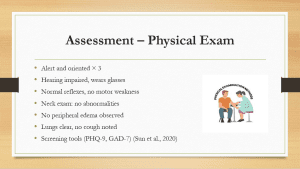
The patient fully cooperated and was oriented to person, place, and time during the physical examination. Her general appearance was stable, and she was not in any form of acute respiratory distress. During the HEENT assessment, it was observed that the patient had bilateral hearing loss and corrected refractive vision. From the neurological point of view, she had no signs of motor problems, and her tremors and reflexes were normal. Muscle tone and coordination were still present in their normal state. There was no swelling or redness of the skin or tender nodules felt at the base of her neck. The peripheral circulation was also seen to be in a stable condition since no signs of peripheral oedema were observed. There was no further abnormality on pulmonary examination, and auscultation of the chest revealed clear lungs and no coughing or respiratory difficulties. These findings add credence to the notion that although AB possesses medical acuity, her core issues are indeed psychiatric.
During the psychiatric assessment, AB filled out screening tools that gave information regarding her moods and anxiety levels. In the primary assessment, her score for the PHQ-9 was 17, which means she had moderate depression (Sun et al., 2020). As for the GAD-7 assessment, which measures anxiety, she scored 12, indicating moderate anxiety. Such standardized tests justify her self-reported symptoms of emotional symptoms and must be used in further evaluations of her mental health.
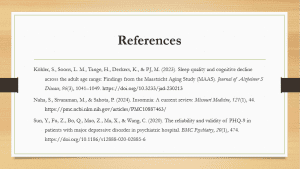
Köhler, S., Soons, L. M., Tange, H., Deckers, K., & P.J, M. (2023). Sleep quality and cognitive decline across the adult age range: Findings from the Maastricht Aging Study (MAAS). Journal of Alzheimer S Disease, 96(3), 1041–1049. https://doi.org/10.3233/jad-230213
Naha, S., Sivaraman, M., & Sahota, P. (2024). Insomnia: A current review. Missouri Medicine, 121(1), 44. https://pmc.ncbi.nlm.nih.gov/articles/PMC10887463/
Sun, Y., Fu, Z., Bo, Q., Mao, Z., Ma, X., & Wang, C. (2020). The reliability and validity of PHQ-9 in patients with major depressive disorder in psychiatric hospital. BMC Psychiatry, 20(1), 474. https://doi.org/10.1186/s12888-020-02885-6
ORDER A PLAGIARISM-FREE PAPER HERE
We’ll write everything from scratch
Question 
Practicum Case – Sleep – Awake
Practicum Case Presentation Video
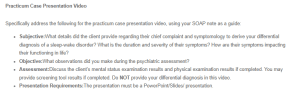
Specifically address the following for the practicum case presentation video, using your SOAP note as a guide:
Practicum Case – Sleep – Awake
- Subjective:What details did the client provide regarding their chief complaint and symptomology to derive your differential diagnosis of a sleep-wake disorder? What is the duration and severity of their symptoms? How are their symptoms impacting their functioning in life?
- Objective:What observations did you make during the psychiatric assessment?
- Assessment:Discuss the client’s mental status examination results and physical examination results if completed. You may provide screening tool results if completed. Do NOT provide your differential diagnosis in this video.
- Presentation Requirements:The presentation must be a PowerPoint/Slides/ presentation.
 Complete the order form and upload all of your files, including any instructions, rubrics, or other materials provided by your instructor.
  Complete the order payment after filling in the order form. We’ll receive your order and assign it to a writer.
 The assigned writer will complete your paper and forward it to our Editing Team for review and approval.
 Once approved by the editor, the completed paper will be uploaded to your account for you to download, review and approve.