
Discussion – Virtual Reality (VR)
Perceived Relative Advantage of the Meditation VR
The meditation VR provides a perceived level of operational advantage to the user and is a major driver that can make the university’s students, faculty, and staff embrace the technology. Relative advantage is defined as the perceived improvement of an innovation over the existing practice or method (Sharma, 2021). In this context, meditation VR offers an experience that traditional meditation techniques cannot achieve. When the participants put on the virtual reality headset, it narrows down the experiences from the surroundings and thus reduces distractions while meditating, leading to a more profound practice of the activity. For many users, this immersive technology is a better way to meditate, given the fact that it is more appealing and different from the normal forms of meditation. Additionally, because VR improves the sensorial and cognitive conditions for relaxation, people who experience difficulty with conventional meditation techniques may benefit from using VR.
Attributes to Promote the Meditation VR
To promote the meditation VR, Molly can leverage several attributes of the innovation. According to the diffusion of innovations theory, attributes such as relative advantage, compatibility, complexity, and cost play a significant role in the adoption process. First, Molly can emphasize the relative advantage of VR, highlighting how it provides a more effective meditation experience compared to conventional methods. Additionally, the VR innovation is highly compatible with the wellness initiatives already in place at the university, which can make it easier for users to accept and integrate into their routines (Sharma, 2021). VR is also relatively simple to use, as it is designed to be intuitive and easy to operate, which reduces the barrier to adoption. Finally, while there are associated costs, the price of the VR headset and the meditation asset is relatively affordable when compared to other wellness programs or fitness memberships. In this way, Molly is able to positively encourage students, faculty, and staff to use the meditation VR and include it in their wellness regimes.
References
Sharma, M. (2021). Theoretical foundations of health education and health promotion. Jones & Bartlett Learning.
ORDER A PLAGIARISM-FREE PAPER HERE
We’ll write everything from scratch
Question 
Discussion – Virtual Reality (VR)
Please review Chapter 9 on Diffusion of Innovations when completing this assignment.
Discussion – Virtual Reality (VR)
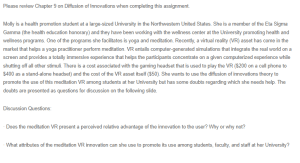
Molly is a health promotion student at a large-sized University in the Northwestern United States. She is a member of the Eta Sigma Gamma (the health education honorary) and they have been working with the wellness center at the University promoting health and wellness programs. One of the programs she facilitates is yoga and meditation. Recently, a virtual reality (VR) asset has come in the market that helps a yoga practitioner perform meditation. VR entails computer-generated simulations that integrate the real world on a screen and provides a totally immersive experience that helps the participants concentrate on a given computerized experience while shutting off all other stimuli. There is a cost associated with the gaming headset that is used to play the VR ($200 on a cell phone to $400 as a stand-alone headset) and the cost of the VR asset itself ($50). She wants to use the diffusion of innovations theory to promote the use of this meditation VR among students at her University but has some doubts regarding which she needs help. The doubts are presented as questions for discussion on the following slide.
Discussion Questions:
· Does the meditation VR present a perceived relative advantage of the innovation to the user? Why or why not?
· What attributes of the meditation VR innovation can she use to promote its use among students, faculty, and staff at her University?
 Complete the order form and upload all of your files, including any instructions, rubrics, or other materials provided by your instructor.
  Complete the order payment after filling in the order form. We’ll receive your order and assign it to a writer.
 The assigned writer will complete your paper and forward it to our Editing Team for review and approval.
 Once approved by the editor, the completed paper will be uploaded to your account for you to download, review and approve.