
Enhancing Newborn Health – A Nursing Perspective on Global Policies and Responsibilities
Newborn health is a critical component of global health, with the World Health Organization (WHO) estimating that 13.4 million babies are born prematurely each year, with nearly 900,000 dying due to complications of preterm birth (WHO, 2023). Improving neonatal health is essential in reducing these alarming statistics. According to the International Council of Nurses (ICN), nurses play a vital role in this effort by providing care, education, and advocacy to ensure better outcomes for both mothers and newborns (Dussi & Giada, 2025). Some of the measures put in place by the WHO and ICN include policies and strategies for the reduction of neonatal mortality. According to the current learning technologies and increase in health facilities, nurses are strategically placed to act as agents of change in enhancing the health status of newborns around the world.
Position on Newborn Health
As a nurse, my position on newborn health directly aligns with the global health priorities set by WHO and ICN. According to WHO, neonatal health remains a critical issue, with most neonatal deaths (75%) occurring during the first week of life, and about 1 million newborns die within the first 24 hours (WHO, 2024). This stark statistic highlights the need for enhanced interventions, particularly in regions with high neonatal mortality rates. The ICN has emphasized the importance of empowering nurses through education to improve neonatal care. Nurses are the first to attend to these mothers and babies, and hence their participation by encouraging correct breastfeeding practices and making critical interventions would reduce risks to their health amongst the newborns.
In line with my specialty track, I believe that nurses should be trained to recognize early signs of complications, including infections and congenital disabilities, and to act quickly to prevent mortality. WHO’s guidelines on neonatal care, such as the Essential Newborn Care (ENC) package, call for nurses to be adequately trained to manage preterm and low-birth-weight infants. Implementing such training across healthcare systems will help bridge the gap in care and improve survival rates for newborns (WHO, n.d.-a).
Nurse’s Social Responsibility to Stakeholders
Nurses hold a fundamental social responsibility toward key stakeholders in newborn health.
Patients (Mothers and Newborns)
Nurses must ensure that mothers and newborns receive compassionate, evidence-based care, including immediate skin-to-skin contact and exclusive breastfeeding. WHO recommends these practices as fundamental for reducing neonatal mortality and promoting healthy newborn development (WHO, n.d.-a). By adhering to these guidelines, nurses can help to reduce the risk of neonatal death drastically.
Families
Nurses contribute to the families through availing information to the caregivers on the appropriate ways through which they can be observing and attending to their newborns. The ICN stresses the need to support families to enhance neonatal health through family-centered care to decrease both morbidity and mortality among neonates (César-Santos et al., 2024). Nurses educate families on how to detect early signs that point towards infant distress and the appropriate next step they should take.
Healthcare Systems and Policymakers
Nurses must advocate for policies that ensure equitable access to essential neonatal care. Core competencies of the ICN include taking into consideration the involvement of nurses in the development of healthcare policies that aim at enhancing the status of the maternal and newborn. Being involved directly with political processes, nurses contribute to changes in the healthcare system that improve families’ access to neonatal care in areas most in need.
Organizations with a Stake in Newborn Health
Several key organizations influence newborn health, including
WHO
WHO provides global leadership in neonatal health, creating evidence-based guidelines such as the Essential Newborn Care (ENC) package. These guidelines help healthcare providers, especially nurses, deliver safe and effective care. WHO also promotes strategies to reduce neonatal mortality, such as improving infection prevention and management.
ICN
ICN is an association that aims to raise the standards of nursing worldwide and nurses’ education to increase the quality of care for newborns. They work with global institutions to enhance the care for newborns, nursing education and policy development.
UNICEF
UNICEF is at the forefront of the delivery of health services for children and child survival, especially involving neonates. Through their efforts, they promote the healthcare rights of communities lacking adequate access to care in order to guarantee proper care, proper nutrition and medical attention for every newborn baby (Unicef, 2022).
Importance of an Interdisciplinary Approach
An interdisciplinary approach is essential in addressing newborn health, as it ensures comprehensive care by integrating diverse expertise. WHO and ICN underscore that cooperation between nurses, pediatricians, midwives, and obstetricians enhances quality outcomes for both the mother and the newborn through medical, emotional, and social perspectives (WHO, n.d.-b). Nurses play a key role in providing day-to-day care, but their work is enhanced when collaborating with specialists. This teamwork ensures timely interventions, such as managing infections or birth complications. Additionally, a multisectoral approach to address factors impacting health across multiple sectors to address such issues as nutrition and health facility access to strengthen rates of neonatal survival worldwide.
Implications for Future Nursing Practice
The global focus on newborn health presents several implications for future nursing practice.
Enhanced Training
Future training programs will involve teaching nurses how to implement evidence-based neonatal care, an update on present knowledge on preterm births, prevention of neonatal infections as well as neonatal resuscitation. WHO opines that proper training will help save the lives of patients; thereby improving the quality of education will prepare nurses to handle complicated procedures.
Global Advocacy for Health Policy Reform
Nurses will remain vigilant in pushing for policies that will enhance the rights of every infant to the best healthcare services. In this regard, WHO and ICN actively assist nurses in advocating for better healthcare systems, especially for full-neonatal healthcare settings in which neonatal mortality is most prevalent.
Global Collaboration
Nurses will seek cooperation with healthcare systems around the globe to exchange experiences and valuable information to counteract pervasive inequalities in newborn health. This collaboration will go a long way in reducing mortality rates in low-income countries and also improving the status of neonates across the globe.
Conclusion
In conclusion, nurses are pivotal in improving newborn health globally. By aligning practice with WHO and ICN guidelines, nurses can play an instrumental role in reducing neonatal mortality and improving health outcomes. The healthcare systems around the world have to produce collective efforts to make all infants receive appropriate care irrespective of the country they are born or the economic status they belong to. Nurses, by being advocates, educators, and members of the interdisciplinary team, will play the most crucial role in the realization of these goals.
References
César-Santos, B., Bastos, F., Dias, A., & Campos, M. J. (2024). Family nursing care during the transition to parenthood: A scoping review. Healthcare, 12(5), 515. https://doi.org/10.3390/healthcare12050515
Dussi, G., & Giada, G. (2025, June 1). The importance of developmental care in neonatology, Italy. ICN – International Council of Nurses. https://icn.ch/news/importance-developmental-care-neonatology-italy
Unicef. (2022). Maternal and newborn health. Unicef.org. https://www.unicef.org/health/maternal-and-newborn-health
WHO. (2023, May 10). Preterm birth. World Health Organization. https://www.who.int/news-room/fact-sheets/detail/preterm-birth
WHO. (2024, March 14). Newborn mortality. World Health Organization. https://www.who.int/news-room/fact-sheets/detail/newborn-mortality
WHO. (n.d.-a). Essential newborn care. World Health Organization. https://www.who.int/teams/maternal-newborn-child-adolescent-health-and-ageing/newborn-health/essential-newborn-care
WHO. (n.d.-b). Midwifery education and care. World Health Organization. https://www.who.int/teams/maternal-newborn-child-adolescent-health-and-ageing/maternal-health/midwifery
ORDER A PLAGIARISM-FREE PAPER HERE
We’ll write everything from scratch
Question 
Enhancing Newborn Health – A Nursing Perspective on Global Policies and Responsibilities
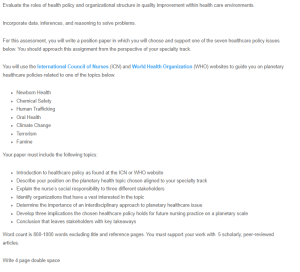
Evaluate the roles of health policy and organizational structure in quality improvement within health care environments.
Incorporate data, inferences, and reasoning to solve problems.
A Nursing Perspective on Global Policies and Responsibilities
For this assessment, you will write a position paper in which you will choose and support one of the seven healthcare policy issues below. You should approach this assignment from the perspective of your specialty track.
You will use the International Council of Nurses (ICN) and World Health Organization (WHO) websites to guide you on planetary healthcare policies related to one of the topics below.
- Newborn Health
- Chemical Safety
- Human Trafficking
- Oral Health
- Climate Change
- Terrorism
- Famine
Your paper must include the following topics:
- Introduction to healthcare policy as found at the ICN or WHO website
- Describe your position on the planetary health topic chosen aligned to your specialty track
- Explain the nurse’s social responsibility to three different stakeholders
- Identify organizations that have a vest interested in the topic
- Determine the importance of an interdisciplinary approach to planetary healthcare issue
- Develop three implications the chosen healthcare policy holds for future nursing practice on a planetary scale
- Conclusion that leaves stakeholders with key takeaways
Word count is 800-1000 words excluding title and reference pages. You must support your work with 5 scholarly, peer-reviewed articles.
Write 4 page double space
5 scholarly references
Citations after every paragraph
APA 7 format
Assessment Requirements
Before finalizing your work, you should:
- be sure to read the assessment description carefully (as displayed above);
- utilize spelling and grammar check to minimize errors.
Your writing assessment should:
- follow the conventions of Standard English (correct grammar, punctuation, etc.);
- be well ordered, logical, and unified, as well as original and insightful;
- display superior content, organization, style, and mechanics; and
- use 7th edition APA formatting and citation style.
 Complete the order form and upload all of your files, including any instructions, rubrics, or other materials provided by your instructor.
  Complete the order payment after filling in the order form. We’ll receive your order and assign it to a writer.
 The assigned writer will complete your paper and forward it to our Editing Team for review and approval.
 Once approved by the editor, the completed paper will be uploaded to your account for you to download, review and approve.