
Focused SOAP Note and Patient Case Presentation – Stress
Subjective:
CC (chief complaint): “I’m worried I won’t be able to handle stress and sleep if I work two jobs.”
HPI:
M.V. is a 24-year-old Caucasian male who presents for follow-up of generalized anxiety disorder (F41.1), major depressive disorder recurrent severe without psychotic features (F33.2), and attention-deficit/hyperactivity disorder, combined type (F90.2). The patient states his current medication regimen has helped significantly, and he is now functioning better at work. However, he is considering adding a part-time seasonal job and is worried that the increased workload may affect his ability to manage stress and sleep. He denies suicidal or homicidal ideation. There is no indication of mood instability, psychosis, or manic symptoms. His pharmacy issue related to prescription refills was resolved after consultation, and he was educated to contact the pharmacy first in future cases.
Substance Current Use:
Denies tobacco, illicit drug use, or marijuana. Drinks 1–2 alcoholic beverages per month socially. Daily caffeine intake is limited to 1–2 cups—no history of substance use disorder.
Medical History:
- Current Medications: He is on Fluoxetine 40 mg PO daily – for GAD/MDD and Amphetamine-Dextroamphetamine 20 mg PO daily – for ADHD
- Allergies: No known drug, food, or environmental allergies.
- Reproductive Hx: Heterosexual, sexually active with one partner, uses condoms, no known sexual dysfunction.
ROS:
- GENERAL: Patient appears well-groomed and in no apparent distress.
- HEENT: No recent headaches, eye strain, nasal dryness or sore throat.
- SKIN: No dryness, peeling, or unusual bruising.
- CARDIOVASCULAR: No chest pain, chest pressure, or chest discomfort. No palpitations or edema.
- RESPIRATORY: No wheezing, sputum production, or pleuritic chest pain.
- GASTROINTESTINAL: No nausea, vomiting, abdominal pain, or changes in bowel movements.
- GENITOURINARY: No dysuria, hematuria, or urinary frequency.
- NEUROLOGICAL: No headaches, dizziness, or focal neurological symptoms.
- MUSCULOSKELETAL: No joint pain, stiffness, or muscle weakness.
- HEMATOLOGIC: No easy bruising, bleeding, or history of anemia.
- LYMPHATICS: No swollen lymph nodes or history of infections.
- ENDOCRINOLOGIC: No polyuria, polydipsia, or recent weight changes.
Objective:
Diagnostic results: Vitals are stable; weight and BMI are within normal limits—no new diagnostic tests were ordered during this visit. Previous lab results, including CBC and TSH, were reviewed and within normal limits.
Assessment:
Mental Status Examination:
M.V. is a 24-year-old Caucasian male who appears his stated age. He is casually dressed and appropriately groomed. He is cooperative with regular eye contact. No psychomotor agitation or retardation. Speech is clear, coherent, and regular in tone. His thought process is logical and goal-directed. He denies hallucinations, delusions, or suicidal/homicidal ideation. Mood is described as “a bit stressed,” and affect is congruent. Insight and judgment are intact. He is oriented to person, place, and time. No cognitive deficits are observed.
Diagnostic Impression:
The primary diagnosis
Generalized Anxiety Disorder (F41.1): M.V. meets DSM-5-TR criteria for generalized anxiety disorder, with excessive worry, difficulty controlling anxiety, restlessness, irritability, and sleep disturbances. His anxiety is exacerbated by the potential stress of taking on an additional job. This condition is impacting his overall functioning despite medication, and he is at risk of a relapse, requiring continued management and stress reduction strategies (Munir & Takov, 2022).
Differential Diagnoses:
- Major Depressive Disorder, Recurrent, Severe, Without Psychotic Features (F33.2): Although M.V. has a history of severe depression, he is currently in remission with no current depressive symptoms, such as anhedonia, feelings of hopelessness, or significant mood changes. Fluoxetine therapy has helped stabilize his mood, and he denies any new depressive episodes or significant mood disturbances, which supports that MDD is not a primary concern at this time. (Bains & Abdijadid, 2023).
- ADHD, Combined Type (F90.2): M.V. has a documented diagnosis of ADHD, which is well-managed with his current stimulant regimen. He denies symptoms of inattention, impulsivity, or hyperactivity during the visit, and his medication regimen of amphetamine-dextroamphetamine 20 mg daily has been effective in controlling ADHD symptoms. No concerns about impaired focus or impulsive behavior were reported, making this less of a problem. (Magnus et al., 2023).
- Adjustment Disorder with Anxiety (F43.22): While M.V. experiences anxiety related to potential job stress, the anxiety predates his job-related concerns, and his symptoms have been chronic. Given his history of generalized anxiety disorder, the diagnosis of adjustment disorder is less likely as the primary issue. The symptoms are more consistent with his long-standing anxiety disorder, and adjustment disorder is considered less likely due to the chronic nature of his condition.
Reflections:
This case reinforced the importance of integrating medication management with psychosocial and behavioral support. While M.V. is clinically stable, his ongoing anxiety about job-related stress signals a potential relapse risk, highlighting the need for continuous monitoring. If I could redo the visit, I would incorporate a structured assessment like a stress inventory to quantify his perceived stress better and assess his risk of burnout. I also realized that medication compliance can be hindered by logistical barriers such as pharmacy issues, emphasizing the importance of proactively addressing these during visits to prevent gaps in treatment. I would schedule more frequent follow-ups in future sessions, especially when patients anticipate significant life changes or additional stressors. Ethically, ensuring the patient is not overburdened by work and maintaining a work-life balance is part of patient advocacy. Holistic care should not only address medication but also incorporate lifestyle counseling, stress management techniques, and ensuring access to therapy services. I can provide more comprehensive care and support M.V.’s long-term well-being by addressing these aspects.
Case Formulation and Treatment Plan:
No labs were ordered during this visit, but previous CBC and TSH results were reviewed and found to be expected. A referral for psychotherapy was made, specifically for Cognitive Behavioral Therapy (CBT), to help address anxiety, stress management, and sleep regulation. The patient will continue on Fluoxetine 40 mg daily and Amphetamine-Dextroamphetamine 20 mg daily, with ongoing monitoring for side effects such as gastrointestinal upset, sleep disturbances, appetite changes, irritability, and cardiovascular symptoms (Shoar et al., 2023). Education was provided on the importance of medication adherence, recognizing side effects, avoiding abrupt discontinuation, and avoiding drug interactions, substance use, and excessive alcohol consumption (Aremu et al., 2022). The patient was also educated on stress management, sleep hygiene, and healthy routines. The patient is stable and will continue outpatient care with a follow-up in 4 weeks, using the GAD-7 for symptom reassessment. If symptoms worsen, an earlier visit will be scheduled. The risks and benefits of pharmacologic therapy, including potential side effects and the importance of continued monitoring, were discussed, and the patient verbalized understanding. An emergency plan was provided, including 911 and the National Suicide Prevention Lifeline (1-800-273-8255).
PRECEPTOR VERIFICATION:
I confirm the patient used for this assignment is seen and managed by the student at their Meditrek-approved clinical site during this quarter’s learning course.
Preceptor signature: ________________________________________________________
Date: ________________________
References
Aremu, T. O., Oluwole, O. E., Adeyinka, K. O., & Schommer, J. C. (2022). Medication adherence and compliance: Recipe for improving patient outcomes. Pharmacy, 10(5), 106. https://doi.org/10.3390/pharmacy10050106
Bains, N., & Abdijadid, S. (2023, April 10). Major depressive disorder. StatPearls – NCBI Bookshelf. https://www.ncbi.nlm.nih.gov/books/NBK559078/
Magnus, W., Anilkumar, A. C., & Shaban, K. (2023, August 8). Attention deficit hyperactivity disorder. StatPearls – NCBI Bookshelf. https://www.ncbi.nlm.nih.gov/books/NBK441838/
Munir, S., & Takov, V. (2022, October 17). Generalized anxiety disorder. StatPearls – NCBI Bookshelf. https://www.ncbi.nlm.nih.gov/books/NBK441870/
Shoar, N. S., Marwaha, R., & Molla, M. (2023, May 23). Dextroamphetamine-amphetamine. StatPearls – NCBI Bookshelf. https://www.ncbi.nlm.nih.gov/books/NBK507808/
ORDER A PLAGIARISM-FREE PAPER HERE
We’ll write everything from scratch
Question 
Focused SOAP Note and Patient Case Presentation – Stress
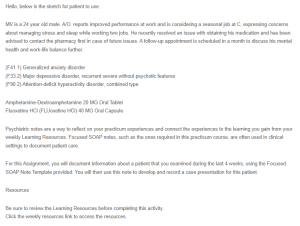
Hello, below is the sketch for patient to use .
MV is a 24 year old male. A/O. reports improved performance at work and is considering a seasonal job at C, expressing concerns about managing stress and sleep while working two jobs. He recently resolved an issue with obtaining his medication and has been advised to contact the pharmacy first in case of future issues. A follow-up appointment is scheduled in a month to discuss his mental health and work-life balance further.
Focused SOAP Note and Patient Case Presentation
(F41.1) Generalized anxiety disorder
(F33.2) Major depressive disorder, recurrent severe without psychotic features
(F90.2) Attention-deficit hyperactivity disorder, combined type
Amphetamine-Dextroamphetamine 20 MG Oral Tablet
Fluoxetine HCl (FLUoxetine HCl) 40 MG Oral Capsule
Psychiatric notes are a way to reflect on your practicum experiences and connect the experiences to the learning you gain from your weekly Learning Resources. Focused SOAP notes, such as the ones required in this practicum course, are often used in clinical settings to document patient care.
For this Assignment, you will document information about a patient that you examined during the last 4 weeks, using the Focused SOAP Note Template provided. You will then use this note to develop and record a case presentation for this patient.
Resources
Be sure to review the Learning Resources before completing this activity.
Click the weekly resources link to access the resources.
WEEKLY RESOURCES
To Prepare
Review the Kaltura button from the Classroom Support Center (accessed via the Help button) for help creating your self-recorded Kaltura video.
Select an adult patient that you examined during the last 4 weeks who presented with a disorder other than the disorder present in your Week 3 Case Presentation.
Create a Focused SOAP Note on this patient using the template provided in the Learning Resources. There is also a completed Focused SOAP Note Exemplar provided to serve as a guide to assignment expectations.
Please Note:
All SOAP notes must be signed, by your Preceptor.
Note: Electronic signatures are not accepted.
When you submit your note, you should include the complete focused SOAP note as a Word document and PDF/images of the completed assignment signed by your Preceptor.
You must submit your SOAP note using Turnitin.
Note: If both files are not received by the due date, faculty will deduct points per the Walden Grading Policy.
Then, based on your SOAP note of this patient, develop a video case study presentation. Take time to practice your presentation before you record.
Include at least five scholarly resources to support your assessment, diagnosis, and treatment planning.
Ensure that you have the appropriate lighting and equipment to record the presentation.
The Assignment
Record yourself presenting the complex case for your clinical patient.
Do not sit and read your written evaluation! The video portion of the assignment is a simulation to demonstrate your ability to succinctly and effectively present a complex case to a colleague for a case consultation. The written portion of this assignment is a simulation for you to demonstrate to the faculty your ability to document the complex case as you would in an electronic medical record. The written portion of the assignment will be used as a guide for faculty to review your video to determine if you are omitting pertinent information or including non-essential information during your case staffing consultation video.
In your presentation:
Dress professionally and present yourself in a professional manner.
Display your photo ID at the start of the video when you introduce yourself.
Ensure that you do not include any information that violates the principles of HIPAA (i.e., don’t use the patient’s name or any other identifying information).
Present the full complex case study. Include chief complaint; history of present illness; any pertinent past psychiatric, substance use, medical, social, family history; most recent mental status exam; current psychiatric diagnosis including differentials that were ruled out; and plan for treatment and management.
Report normal diagnostic results as the name of the test and “normal” (rather than specific value). Abnormal results should be reported as a specific value.
Be succinct in your presentation, and do not exceed 8 minutes. Specifically address the following for the patient, using your SOAP note as a guide:
Subjective: What details did the patient provide regarding their chief complaint and symptomology to derive your differential diagnosis? What is the duration and severity of their symptoms? How are their symptoms impacting their functioning in life?
Objective: What observations did you make during the psychiatric assessment?
Assessment: Discuss patient mental status examination results. What were your differential diagnoses? Provide a minimum of three possible diagnoses and why you chose them. List them from highest priority to lowest priority. What was your primary diagnosis, and why? Describe how your primary diagnosis aligns with DSM-5 diagnostic criteria and supported by the patient’s symptoms.
Plan: In your video, describe your treatment plan using clinical practice guidelines supported by evidence-based practice. Include a discussion on your chosen FDA-approved psychopharmacologic agents and include alternative treatments available and supported by valid research. All treatment choices must have a discussion of your rationale for the choice supported by valid research. What were your follow-up plan and parameters? What referrals would you make or recommend as a result of this treatment session?
In your written plan include all the above as well as include one social determinant of health according to the HealthyPeople 2030 (you will need to research) as applied to this case in the realm of psychiatry and mental health. As a future advanced provider, what are one health promotion activity and one patient education consideration for this patient for improving health disparities and inequities in the realm of psychiatry and mental health? Demonstrate your critical thinking.
Reflection notes: What would you do differently with this patient if you could conduct the session over? If you are able to follow up with your patient, explain whether these interventions were successful and why or why not. If you were not able to conduct a follow up, discuss what your next intervention would be.
By Day 7 of Week 7
Submit your Video and Focused SOAP Note Assignment. You must submit two files for the note, including a Word document and scanned pdf/images of completed assignment signed by your Preceptor.
submission information – Part 1: Video Submission
To submit your video response entry:
Click on Start Assignment near the top of the page.
Next, click Text Entry and then click the Embed Kaltura Media button.
Select your recorded video under My Media.
Check the box for the End-User License Agreement and select Submit Assignment for review.
submission information – Part 2: Focused SOAP Note Submission
To submit Part 2 of this Assignment, click on the following link:
Week 7 Assignment 2, Part 2
 Complete the order form and upload all of your files, including any instructions, rubrics, or other materials provided by your instructor.
  Complete the order payment after filling in the order form. We’ll receive your order and assign it to a writer.
 The assigned writer will complete your paper and forward it to our Editing Team for review and approval.
 Once approved by the editor, the completed paper will be uploaded to your account for you to download, review and approve.