
Environmental Scanning and Workforce Planning
Environmental scanning is a crucial component of any organizational process related to strategy. Organizations scan their environment to gather information about current trends and competitors’ practices. The process helps organizations maneuver strategic change and innovate to keep up with the dynamic business environment. Most organizations embrace environmental scanning as part of wider organizational learning and a core component exploiting an organization’s dynamic business opportunities. Environmental scanning has become particularly vital in an era when businesses face global competition.
Technological Environment
Among others, the technological environment is one of the top-priority considerations as organizations access their external environment. Technology has become an important component of environmental scanning because it is key to revolutionizing products and services and bringing better versions to the market (Schuh et al., 2016). Today, Netflix is a leader in the streaming and entertainment industry, owing to the company’s willingness to scan the environment and improve its services. Initially, Netflix came to the limelight as a DVD rental business. However, following Internet adoption, the company was quick to scan the environment and respond appropriately by introducing online movie streaming. Today, Netflix has overtaken earlier industry entrants due to its willingness to respond to environmental changes.
Also, technology scanning facilitates businesses to identify disruptive technologies that can significantly affect business outcomes. By understanding emerging trends in the market, whether positive or negative, businesses will avoid the element of surprise that may throw them off balance (Schuh et al., 2016). For instance, as e-commerce penetrates different industries, so has organizational data become threatened. Large global retail stores such as Walmart have faced customer data theft due to inadequate cybersecurity measures. In one such incident, critical customer information, including social security numbers and physical addresses, landed in unauthorized hands. Businesses that operate e-commerce platforms can borrow a leaf from such experiences and improve their operations, and that is only possible through external environmental scanning.
Political Environment
Scanning the political environment is crucial because politics have a significant influence on business processes. The political environment is associated with the legal environment because it is the political class that formulates the laws that affect business. Apart from exerting influence on an organization’s performance, politics pose risks that could threaten a business. Companies seeking to expand into other countries should first analyze the political environment to determine if there are patterns that may hinder business. Since a peaceful environment is crucial for business success, organizations should avoid environments that experience repetitive political violence.
Besides, the political class determines economic policies. A business needs to understand the economic priorities of the current regime before investing capital (Onoriode & Agbele, 2015). For instance, countries facing debt burdens tend to impose huge taxes on foreign companies in the hope that they will cash in and reduce their debt. Organizations may avoid investing in such countries if the taxes imposed will make it hard for businesses to break even.
Economic Environment
According to Dvorský et al. (2020), analyzing the economic environment is crucial to determining whether it is economically viable to start a business or implement expansion strategies. Businesses are concerned by, among others, prevailing macroeconomic factors. For instance, employment levels are a core determinant of the citizens’ disposable income. If a country where a business is expanding to faces acute unemployment, expanding there may not be the best decision as citizens have less disposable income to spend. In particular, organizations in the hospitality industry may perform well in such areas since low-income earners do not spend much on luxury.
Approaches to Fill Current Gaps Between Current Resources and Future Needs
Gap analysis can help a business bridge the considerable gap between the current state and the desired state. One approach that may help a business bridge such a gap is a SWOT analysis. A SWOT analysis offers a business insights into its internal and external environment. After conducting a SWOT analysis, a business should explore strategies to leverage strengths, cushion the business from the impact of weaknesses, utilize opportunities, and reduce the effect of external threats (Ward, 2005). Also, PESTEL analysis can help a business understand its external environment by offering insights into the political, economic, social, technological, and legal environments.
Businesses may also leverage scenario planning to bridge the gap between the current state and future needs. This approach is effective in helping businesses deal with uncertainty. Instead of trying to predict the future, scenario planning involves ‘what if’ scenarios, helping organizations prepare for diverse business outcomes. This method can offer insights into indicators of a change process.
Also, critical factors analysis may come in handy since it helps a business understand elements that are crucial to accomplishing a goal. By determining critical factors, a business can determine customer needs and produce quality products or offer quality services that align with their needs. For instance, in the food service industry, critical factors may include enhanced marketing, improved quality of menu items, and better customer service.
Finally, analyzing Porter’s five forces is critical to understanding factors that affect competition. The five factors that affect competition examined under this approach include potential new entrants, existing competition, customers, suppliers, and the availability of substitute products. By using this model, a business can plan and stay ahead.
Steps Associated with Successful Workforce Planning
Defining an organization’s strategic direction is key to successful workforce planning. A good strategic plan comprises an organization’s mission and the strategies that will be pursued to help the organization achieve desirable outcomes (Cotten, 2007). As an organization plans for the future, it faces some challenges, including allocating the required financial resources and aligning employees with the overall organizational objectives. The workplace planning cycle of an organization begins here, as the organization must hire employees with the requisite skills and determine the corresponding financial needs.
Secondly, modeling the current workforce will come in handy in workforce planning. It helps businesses understand the distribution, capabilities, and features of the workforce (Cotten, 2007). Organizations should conduct a data inventory that provides details of these employees, which the company will compare against its objectives. For instance, if business leaders note that some employees lack the requisite skills to help the company accomplish some goals, training programs may be provided.
Thirdly, assessing workforce needs and determining future workforce supply is pertinent. Since an organization has stated its mission, there is a better idea of functions that are core to achieving this objective (Cotten, 2007). The organization should determine the type of employees that will help it achieve critical mission objectives. For instance, employees working in the mining sector understand that employees value safety. By understanding the workforce safety demands, the organization will avail the requisite protective gear that will help the workforce perform their functions optimally.
Conclusion
In summary, environmental analysis helps businesses understand factors beyond their control that will affect business outcomes. Some of the core external environmental components that a business should scan include technology, political, and economic factors. Some of the approaches used to scan the external environment include PESTEL analysis, SWOT analysis, critical factors analysis, Porter’s five forces, and scenario planning. The approaches to workforce planning include defining an organization’s strategic direction, modeling the current workforce, and conducting a workforce needs assessment.
References
Cotten, A. (2007). Seven Steps of Effective Workforce Planning Human Capital Management Series providing cutting-edge knowledge to government leaders. https://www.businessofgovernment.org/sites/default/files/CottenReport.pdf
Dvorský, J., Gavurová, B., Čepel, M., & Červinka, M. (2020). Impact Of Selected Economic Factors On The Business Environment: The Case Of Selected East European Countries. Polish Journal of Management Studies, 22(2), 96–110. https://doi.org/10.17512/pjms.2020.22.2.07
Onoriode, H., & Agbele, G. (2015). Effect Of Political Environment On Organizational Performance: A Study Of Selected Small And Medium Scale Enterprises In Delta State. International Journal of Advanced Academic Research, 1–19. https://doi.org/10.46654/ij.24889849.s692
Schuh, G., Kabasci, P., Drescher, T., Ryschka, S., & Wetterney, T. (2016). Identifying and evaluating disruptive technologies using technology scanning. In International Association for Management of Technology, IAMOT 2016 Conference Proceeding.
Ward, D. (2005). An overview of strategy development models and the Ward-Rivani model. Economics Working Papers, 6, 1-24.
ORDER A PLAGIARISM-FREE PAPER HERE
We’ll write everything from scratch
Question 
Environmental Scanning and Workforce Planning
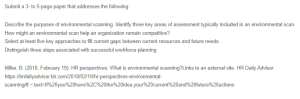
Submit a 3- to 5-page paper that addresses the following:
Environmental Scanning and Workforce Planning
Describe the purposes of environmental scanning. Identify three key areas of assessment typically included in an environmental scan. How might an environmental scan help an organization remain competitive?
Select at least five key approaches to fill current gaps between current resources and future needs.
Distinguish three steps associated with successful workforce planning
Miller, B. (2018, February 19). HR perspectives: What is environmental scanning?Links to an external site. HR Daily Advisor. https://hrdailyadvisor.blr.com/2018/02/19/hr-perspectives-environmental-scanning/#:~:text=If%20you%20have%2C%20the%20idea,your%20current%20and%20future%20actions
 Complete the order form and upload all of your files, including any instructions, rubrics, or other materials provided by your instructor.
  Complete the order payment after filling in the order form. We’ll receive your order and assign it to a writer.
 The assigned writer will complete your paper and forward it to our Editing Team for review and approval.
 Once approved by the editor, the completed paper will be uploaded to your account for you to download, review and approve.