
Individual and Team Psychology Differentiation Presentation
Hello, welcome to this presentation on individual and team psychology differentiation.
Welcome to our first team meeting. Today, we will discuss several important ideas we need to know to work optimally as individuals and as a group. First, we will briefly examine the basic psychological needs profile required for personal and organizational success and focus on how each of us can finally have an opportunity to realize ourselves and achieve our full potential. Next, we will explore the concept of emotional intelligence and its significance for us as individuals and our team. We will also distinguish between individual work and teamwork, emphasizing the advantages. Lastly, we will conduct an icebreaker to get to know each other better.
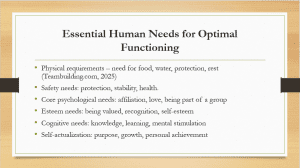
To achieve effective functionality, people have several fundamental psychological needs manifest through what is known as Maslow’s Hierarchy. On a fundamental level, humans require the amenities of life, which include food, water, and sleep (Teambuilding.com, 2025). Having achieved these, humans look for safety—be it physical or psychological. The third level includes the concepts of interpersonal relatedness, such as networks of healthy relationships and social support. Third, humans pursue approval through recognition and appreciation. In this context, meaningful cognitive activities like learning and curiosity are critical for higher processes. Lastly, self-actualization propels humans to achieve their full potential and to seek and explore meaning. Satisfying these needs provides a stable and efficient framework for the team.
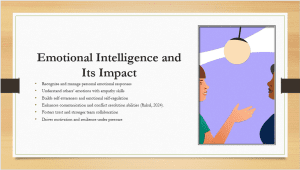
Emotional intelligence can be defined as a person’s capacity to effectively identify, understand, and control one’s own emotions, as well as the emotions exhibited by others. As individuals, a high EQ leads to better self-awareness, emotional control, and stronger decision-making under stress. Emotional intelligence in teamwork helps people learn about each other, avoid using force to address any concerns and engage in proper communication (Rahul, 2024). It’s particularly valuable for team members to emphasize EQ because it helps them build trust and function effectively in group activities. In conclusion, implementing emotional intelligence improves work output and enhances relationships between work teams.
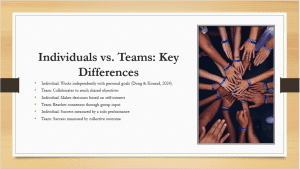
Understanding the difference between individuals and teams is essential for effective collaboration. Individuals work in their self-interest; they know what they want and want to achieve (Dong & Konrad, 2024). In contrast, a team is a set of people with different qualities situated in one team for a coordinated effort to achieve a common objective. While decision-making is done individually, team decision-making implies contribution, discussion, and consensus. Furthermore, individual performance is a self-generated amount of effort or production, while organizational performance is the overall output of the whole group. Understanding these differences allows team members to move away from focusing solely on personal victories and enhances cooperation between the team.
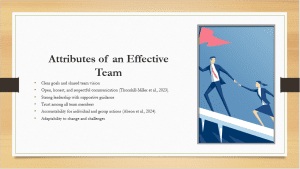
Every good team should possess certain qualities. Having well-defined and enunciated goals helps maintain focus with the team and keeps everyone on board. Communication is crucial, as team members should be able to share thoughts and concerns without fear of confrontation (Thornhill-Miller et al., 2023). Leadership delivers orders and direction, facilitates engagement and offers support. Another important aspect is trust since people cannot work together effectively when it is gone. The concept of accountability helps any working group or institution to ensure those involved are held responsible for the tasks assigned to them (Abson et al., 2024). Flexibility is crucial once there are challenges or the project changes course. Whenever these attributes are observed, the teams function optimally, remain motivated and yield better results.
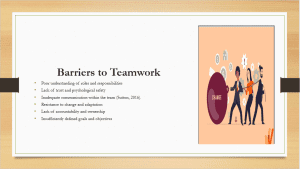
Teamwork is crucial in organizational development, but obstacles hinder efficiency and engagement. A significant concern is the lack of clarity of roles and responsibilities, which creates confusion and work inefficiency. Also, when employees and team members do not trust each other or the organizational culture does not promote psychological safety, workers may not report ideas, skills, or concerns. Poor communication may thus lead to misunderstandings and misalignment of interests, resulting in conflict (Sutton, 2016). Teams also experience some challenges in cases where there is resistance to change, which slows down the progress and change. Inadequate responsibility and result in ownership lead to low motivation for team members, while imprecise goals and objectives demotivate the members due to a lack of clear direction. These barriers can have detrimental impacts on team dynamics and productivity.
To kick off team building, we will start with the “Two Truths and a Lie” icebreaker. This activity helps interact and allows team members to share small stories about themselves. This is a game where everyone must say three things about themselves, two of which are true, and the third is a lie, and then the group predicts which statement is false. This activity aims to have the participants familiarize themselves with each other and encourage interaction and rapport. It is always refreshing when people learn new things about their colleagues because this fosters teamwork and understanding. It helps create an atmosphere of familiarity immediately, making people comfortable.
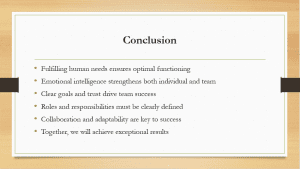
In conclusion, satisfying our basic needs as people and developing our emotional intelligence as the critical factors that define individual and team performance is crucial. Effective cooperation is based on clear objectives, trust, and role definitions. Accountability and flexibility are two other essential ways we can foster the notion of powerful team ownership. In that regard, by practicing these concepts as we advance, we shall be in a better position to get the desired results for our project and clients.
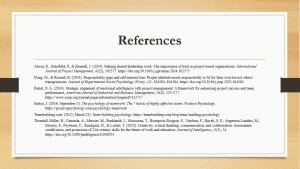
Abson, E., Schofield, P., & Kennell, J. (2024). Making shared leadership work: The importance of trust in project-based organisations. International Journal of Project Management, 42(2), 102575. https://doi.org/10.1016/j.ijproman.2024.102575
Dong, M., & Konrad, B. (2024). Responsibility gaps and self-interest bias: People attribute moral responsibility to AI for their own but not others’ transgressions. Journal of Experimental Social Psychology (Print), 111, 104584–104584. https://doi.org/10.1016/j.jesp.2023.104584
Rahul, N. A. (2024). Strategic alignment of emotional intelligence with project management: A framework for enhancing project success and team performance. American Journal of Industrial and Business Management, 14(4), 553–577. https://www.scirp.org/journal/paperinformation?paperid=132717
Sutton, J. (2016, September 5). The psychology of teamwork: The 7 habits of highly effective teams. Positive Psychology. https://positivepsychology.com/psychology-teamwork/
Teambuilding.com. (2025, March 23). Team building psychology. https://teambuilding.com/blog/team-building-psychology
Thornhill-Miller, B., Camarda, A., Mercier, M., Burkhardt, J., Morisseau, T., Bourgeois-Bougrine, S., Vinchon, F., Hayek, S. E., Augereau-Landais, M., Mourey, F., Feybesse, C., Sundquist, D., & Lubart, T. (2023). Creativity, critical thinking, communication, and collaboration: Assessment, certification, and promotion of 21st century skills for the future of work and education. Journal of Intelligence, 11(3), 54. https://doi.org/10.3390/jintelligence11030054
ORDER A PLAGIARISM-FREE PAPER HERE
We’ll write everything from scratch
Question 
Individual and Team Psychology Differentiation Presentation
Scenario
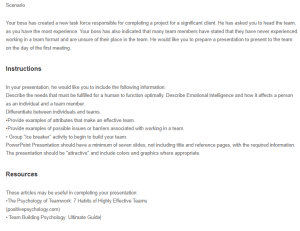
Your boss has created a new task force responsible for completing a project for a significant client. He has asked you to head the team, as you have the most experience. Your boss has also indicated that many team members have stated that they have never experienced working in a team format and are unsure of their place in the team. He would like you to prepare a presentation to present to the team on the day of the first meeting.
Individual and Team Psychology Differentiation Presentation
Instructions
In your presentation, he would like you to include the following information:
Describe the needs that must be fulfilled for a human to function optimally. Describe Emotional intelligence and how it affects a person as an individual and a team member.
Differentiate between individuals and teams.
•Provide examples of attributes that make an effective team.
•Provide examples of possible issues or barriers associated with working in a team.
• Group “ice breaker” activity to begin to build your team.
PowerPoint Presentation should have a minimum of seven slides, not including title and reference pages, with the required information. The presentation should be “attractive” and include colors and graphics where appropriate.
Resources
These articles may be useful in completing your presentation:
•The Psychology of Teamwork: 7 Habits of Highly Effective Teams
(positivepsychology.com)
• Team Building Psychology: Ultimate Guide
 Complete the order form and upload all of your files, including any instructions, rubrics, or other materials provided by your instructor.
  Complete the order payment after filling in the order form. We’ll receive your order and assign it to a writer.
 The assigned writer will complete your paper and forward it to our Editing Team for review and approval.
 Once approved by the editor, the completed paper will be uploaded to your account for you to download, review and approve.