
Digital Identity Formation – Exploring The Impact of Social Media on Self-Concept
Digital Interactions
Ross and Kristina Brown use platforms like Facebook, Instagram and TikTok as part of everyday interactions and social lives, thus constructing an identity through these spaces. Kristina, who uses her phone to check the weather and order food through applications, likely posts her family stories or food diary on Instagram, as this platform emphasizes visual experience as a factor in establishing identity and relatedness. A productivity tool like Google Calendar may allow Ross, who works remotely and communicates through social networks, to navigate his work-life balance. At the same time, Facebook may help him stay connected with his family and co-workers, thus constructing the image of a devoted family man and a knowledgeable employee. Their children, Nate and Samantha, are in a unique generation that uses e-books and online learning tools. They can freely interact with applications like TikTok, contributing to their social growth and self-identity. Specifically, the Looking Glass Self suggests that an individual develops one’s image concerning other people’s reactions, further amplified by the incessant feedback system regarding likes, comments, and shares (Teplitsky & Yair, 2024). In this case, the adoption of digital media by the Brown family not only makes life easier but also shapes their social identities each day through these technologies.
Impact on Identity
The Brown family’s digital lives occupy a significant portion of their lives, as shown through the various scenes, and their online lives also extend and intersect with their offline lives. Ross, who uses technology for work, probably leads a formal, orderly life through platforms like Facebook, where he works from home. On the other hand, the use of apps that enable Kristina to check the weather, order food, and help her children with their school assignments reveals a modern, proactive mom figure that she may present in her Instagram image. However, this picture can be attributed to societal pressure and trending aesthetics, which may present a somewhat more accurate picture of her true persona. Nate and Samantha, who were born and raised in the digital era and are familiar with TikTok, are developing identities influenced by their peers and trends and appearing to portray idealized or theatrical performances of themselves to conform to social media requirements. Thus, through social interactions and the perception of what others think of the individual comes a realization of the self (Zahavi & Dominik Želinský, 2023). Altogether, their online participation mirrors and reconstructs their subjectivities within the social media paradigm.
Use of Digital Communication
The Browns probably use text and emojis in their daily conversations to convey emotions and messages swiftly and conveniently. These instruments enable a more informal, specific, and affectionate communication, especially among the family members, thus strengthening their connections through a standard language. In their interactions with people outside the household, particularly through texting, Ross and Kristina use emojis and shorthand, which influence how they communicate while keeping in mind the expectations of the other person in the conversation. Furthermore, mediated interaction can influence how people build impressions and define themselves in personal and social spaces (Karel Kreijns et al., 2024).
Application of Sociological Theories
From George Herbert Mead’s symbolic interactionism theory and Charles Coody’s Looking Glass Self, the digital interactions of the Brown family can be analyzed in terms of their continual effects on self-formation. According to Mead’s theory, individuals develop their sense of self through social interactions and the symbols they share with others (Dansu, 2024). Facebook and Instagram serve as highly feedback-dependent arenas where the Browns can constantly receive reactions and adjust their marketing definition of the self. Cooley’s Looking Glass Self sheds light on how Kristina, Ross, and their children probably modify their avatars depending on how they expect others to see them, maybe as caring parents or efficient employees. These theories help explain how each of the family members’ identity is shaped and expressed through technological interactions and social responses.
Conclusion
Examining the case of the Brown family and the family’s communication with social media, such as Facebook, Instagram, and TikTok, identify the role of technology both in the communication process and in the construction of the subject. The ways they interact with themselves and the world are through technologies that embody their identities. Mead’s symbolic interactionism and Cooley’s looking-glass self show how people build their self-images based on the comments they hear and the signals they use in their communication. Therefore, the Browns represent the modern family in the construction process and postmodern identities in the context of technological advancement and globalization.
References
Dansu, M. A. (2024). Virtual Peer Support: Impact of Online Social Interactions Among Members of a Japanese Single Mothers’ Community. VOLUNTAS: International Journal of Voluntary and Nonprofit Organizations. https://doi.org/10.1007/s11266-024-00681-4
Karel Kreijns, Yau, J., Weidlich, J., & Weinberger, A. (2024). Towards a comprehensive framework of social presence for online, hybrid, and blended learning. Frontiers in Education, 8. https://doi.org/10.3389/feduc.2023.1286594
Teplitsky, D., & Yair, G. (2024). Israeli scientists in an American looking glass: Habitus, self-awareness and identity formation. International Journal of Intercultural Relations, 104, 102108. https://doi.org/10.1016/j.ijintrel.2024.102108
Zahavi, D., & Dominik Želinský. (2023). Experience, Subjectivity, Selfhood: Beyond a Meadian Sociology of the Self. Journal for the Theory of Social Behaviour. https://doi.org/10.1111/jtsb.12396
ORDER A PLAGIARISM-FREE PAPER HERE
We’ll write everything from scratch
Question 
Digital Identity Formation – Exploring The Impact of Social Media on Self-Concept
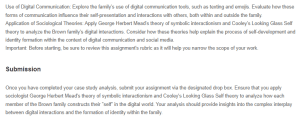
Use of Digital Communication: Explore the family’s use of digital communication tools, such as texting and emojis. Evaluate how these forms of communication influence their self-presentation and interactions with others, both within and outside the family.
Application of Sociological Theories: Apply George Herbert Mead’s theory of symbolic interactionism and Cooley’s Looking Glass Self theory to analyze the Brown family’s digital interactions. Consider how these theories help explain the process of self-development and identity formation within the context of digital communication and social media.
Important: Before starting, be sure to review this assignment’s rubric as it will help you narrow the scope of your work.
Exploring The Impact of Social Media on Self-Concept
Submission
Once you have completed your case study analysis, submit your assignment via the designated drop box. Ensure that you apply sociologist George Herbert Mead’s theory of symbolic interactionism and Cooley’s Looking Glass Self theory to analyze how each member of the Brown family constructs their “self” in the digital world. Your analysis should provide insights into the complex interplay between digital interactions and the formation of identity within the family.
 Complete the order form and upload all of your files, including any instructions, rubrics, or other materials provided by your instructor.
  Complete the order payment after filling in the order form. We’ll receive your order and assign it to a writer.
 The assigned writer will complete your paper and forward it to our Editing Team for review and approval.
 Once approved by the editor, the completed paper will be uploaded to your account for you to download, review and approve.