
The DNP-Prepared Nurse and Their Communities of Practice
The community I have chosen for this discussion is an elderly outpatient community health clinic. One of the most challenging issues within this community is the increasing demand for accessible, comprehensive diabetes education suitable for older adults. Diabetes is a chronic and common illness in the elderly, and inadequate control frequently leads to complications like neuropathy, cardiovascular disease, and repeated hospital readmission. Deficits in ongoing individualized education in most community health clinics are present that permit older patients’ capacity to successfully self-manage their illness. These deficits are also compounded by universal barriers in the form of cognitive impairment, impaired mobility, health literacy, and limited transportation availability, all of which jeopardize the capacity of elderly individuals to maintain regular in-person appointments or even to adequately grasp complicated treatment routines.
Significance of the Issue from a DNP Perspective
As a DNP-prepared nurse in my future practice, I will tackle this problem in order to enhance patient outcomes and decrease healthcare disparities in older adults. With a growing older population, chronic disease management—primarily for chronic diseases like diabetes—ought to be a priority in outpatient care models. This subject is particularly deserving of attention because many older patients are disproportionately affected by complications that would be preventable with the proper education and ongoing support, as noted by Duda-Sikuła and Kurpas (2024). I have, for example, had patients return to the clinic with extremely poorly controlled blood glucose levels simply because they had no idea how to adjust insulin based on what they ate or their activity level. In one instance, a patient was twice readmitted to the hospital within a month for hypoglycemia, a circumstance that might have been prevented by clear, continuous instruction and accessible resources. Unnecessary complications increase healthcare expenses and adversely impact quality of life. I would be ideally positioned as a DNP-prepared nurse to interpret systems-level solutions to this issue through the incorporation of evidence-based practice, policy influence, and interprofessional leadership to improve care continuity.
Evidence-Based Practice Changes
To bridge the gap in knowledge regarding geriatric diabetes care, I recommend implementing two key practice changes based on available evidence. Firstly, the inclusion of Certified Diabetes Educators (CDEs) within the outpatient team has been shown to have a significant effect on health outcomes. Rodriguez et al. (2022) identified that the patients with the CDE reinforcement had enhanced medication compliance, HbA1c levels, and self-care competence. These educators gave systematic information on glycemic control, nutrition, medication schedules, and signs and symptoms of diabetes complications, which are crucial to diabetes self-management, especially in the aging population. The second potential reform includes increasing the share of in-person diabetes education and using telehealth for follow-up sessions. According to Tourkmani et al. (2024), these older patients reported improved glycemic control as a result of the original hybrid approach, and the participants expressed a high satisfaction rate regarding both the convenience and effectiveness of telehealth, particularly those patients who are mobility-impaired or live in the rural or remote region. Furthermore, Flores-Luevano et al. (2020) asserted that culturally and linguistically appropriate diabetes education interventions should be used. Their research found that when these interventions were conducted in the community, noncompliance and hospital admissions lowered. This can be further enhanced by using culturally appropriate teaching and learning resources and involving family caregivers.
Alignment with AACN Essentials
The suggested practice changes are consistent with a number of essential domains of the AACN Essentials (2021). They come under Domain 1: Knowledge for Nursing Practice, as they encompass the use of knowledge and evidence by nurses to consult and develop new paradigms in the care of patients. They also meet Domain 3: Population Health, for they treat a chronic disease, which is sensitive to the target group and meets health equity. These strategies are consistent with Domain 6: Interprofessional Partnerships, as it involves cooperation with CDEs, social workers and also primary care clinicians in a practical form in order to fully care for patients with comprehensive care. These domains are relevant to the DNP role and meet the goals or organizational objectives: Enhancing direct care practice, advancing healthcare outcomes, and promoting systems redesign to advance nursing practice in healthcare systems.
References
Duda-Sikuła, M., & Kurpas, D. (2024). Enhancing chronic disease management: Personalized medicine insights from rural and urban general practitioner practices. Journal of Personalized Medicine, 14(7), 706. https://doi.org/10.3390/jpm14070706
Flores-Luevano, S., Pacheco, M., Shokar, G. S., Dwivedi, A. K., & Shokar, N. K. (2020). Impact of a culturally tailored diabetes education and empowerment program in a Mexican American population along the US/Mexico border: A pragmatic study. Journal of Clinical Medicine Research, 12(8), 517–529. https://doi.org/10.14740/jocmr4273
Rodriguez, K., Ryan, D., Dickinson, J. K., & Phan, V. (2022). Improving quality outcomes: The value of diabetes care and education specialists. Clinical Diabetes, 40(3), 356–365. https://doi.org/10.2337/cd21-0089
Tourkmani, A. M., Alharbi, T. J., Rsheed, A. M. B., Alotaibi, A. F., Aleissa, M. S., Alotaibi, S., Almutairi, A. S., Thomson, J., Alshahrani, A. S., Alroyli, H. S., Almutairi, H. M., Aladwani, M. A., Alsheheri, E. R., Sati, H. S., Aljuaid, B., Algarzai, A. S., Alabood, A., Bushnag, R. A., Ghabban, W., . . . Alrasheedy, A. A. (2024). A hybrid model of in-person and telemedicine diabetes education and care for management of patients with uncontrolled type 2 diabetes mellitus: Findings and implications from a multicenter prospective study. Telemedicine Reports, 5(1), 46–57. https://doi.org/10.1089/tmr.2024.0003
ORDER A PLAGIARISM-FREE PAPER HERE
We’ll write everything from scratch
Question 
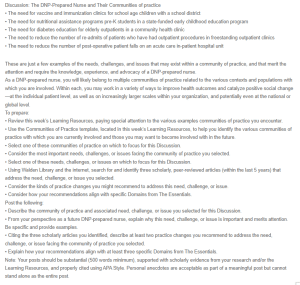
The DNP-Prepared Nurse and Their Communities of Practice
• The need for vaccine and immunization clinics for school age children with a school district
• The need for nutritional assistance programs pre-K students in a state-funded early childhood education program
• The need for diabetes education for elderly outpatients in a community health clinic
• The need to reduce the number of re-admits of patients who have had outpatient procedures in freestanding outpatient clinics
• The need to reduce the number of post-operative patient falls on an acute care in-patient hospital unit
The DNP-Prepared Nurse and Their Communities of Practice
These are just a few examples of the needs, challenges, and issues that may exist within a community of practice, and that merit the attention and require the knowledge, experience, and advocacy of a DNP-prepared nurse.
As a DNP-prepared nurse, you will likely belong to multiple communities of practice related to the various contexts and populations with which you are involved. Within each, you may work in a variety of ways to improve health outcomes and catalyze positive social change—at the individual patient level, as well as on increasingly larger scales within your organization, and potentially even at the national or global level.
To prepare:
• Review this week’s Learning Resources, paying special attention to the various examples communities of practice you encounter.
• Use the Communities of Practice template, located in this week’s Learning Resources, to help you identify the various communities of practice with which you are currently involved and those you may want to become involved with in the future.
• Select one of these communities of practice on which to focus for this Discussion.
• Consider the most important needs, challenges, or issues facing the community of practice you selected.
• Select one of these needs, challenges, or issues on which to focus for this Discussion.
• Using Walden Library and the internet, search for and identify three scholarly, peer-reviewed articles (within the last 5 years) that address the need, challenge, or issue you selected.
• Consider the kinds of practice changes you might recommend to address this need, challenge, or issue.
• Consider how your recommendations align with specific Domains from The Essentials.
Post the following:
• Describe the community of practice and associated need, challenge, or issue you selected for this Discussion.
• From your perspective as a future DNP-prepared nurse, explain why this need, challenge, or issue is important and merits attention. Be specific and provide examples.
• Citing the three scholarly articles you identified, describe at least two practice changes you recommend to address the need, challenge, or issue facing the community of practice you selected.
• Explain how your recommendations align with at least three specific Domains from The Essentials.
Note: Your posts should be substantial (500 words minimum), supported with scholarly evidence from your research and/or the Learning Resources, and properly cited using APA Style. Personal anecdotes are acceptable as part of a meaningful post but cannot stand alone as the entire post.
 Complete the order form and upload all of your files, including any instructions, rubrics, or other materials provided by your instructor.
  Complete the order payment after filling in the order form. We’ll receive your order and assign it to a writer.
 The assigned writer will complete your paper and forward it to our Editing Team for review and approval.
 Once approved by the editor, the completed paper will be uploaded to your account for you to download, review and approve.