
Causes of Low Representation of Women in Congress
Cultural, structural, and institutional barriers can explain the low number of women in Congress. Politics in the United States has been a preserve of male candidates over the years, which has had a knock-on effect on US politics of today. Ideologically, women have a significantly harder time fundraising and securing party support, which are important in running a successful campaign. Moreover, gender prejudice and societal expectations may dissuade women from engaging in political processes or make voters doubt their competencies (Greenberg & Page, 2018). The lack of women in senior political positions also poses potential constraints to women’s political aspirations. The gender-skewed composition in Congress is evidence of fundamental imbalances that call for consistent policies and changes in mindset.
Women remain notably underrepresented in Congress as they occupy only 28 percent of seats in the 119th Congress, the same as in the previous Congress (Conroy & Marriner, 2024). Projections indicate that, at the current rate of progress, gender parity may not be achieved until 2108, meaning that there might not be any tremendous change over my lifetime. This slow advancement can be attributed to the structural and cultural barriers women still face in accessing political positions. For instance, there has been some progress in the recent election of two black women to the Senate, but they are exceptional cases that mark gradual change rather than a breakthrough.
Still, up to a certain point, expanded political roles and the focus on desegregation may produce a progressive shift in the future. Measures such as endorsements of women and female-friendly policies must be adopted alongside new societal norms that move away from the traditional male political leadership (Murray et al., 2021). However, the mere token representation of women in legislative chambers, for example, indicates that the goal of quantitative parity cannot be attained without radical changes to institutional arrangements. Thus, while gradual changes are conceivably possible, shaping a radical change in Women’s representation in Congress during my lifetime seems highly unlikely.
References
Conroy, M., & Marriner, K. (2024, December 4). Has the number of women in Congress hit a ceiling? ABC News. https://abcnews.go.com/538/number-women-congress-hit-ceiling/story?id=116373093
Greenberg, E. S., & Page, B. I. (2018). The struggle for democracy: 2018 elections and updates edition (12th ed.). Pearson.
Murray, R., Muriaas, R., & Wang, V. (2021). Editorial introduction: Gender and political financing. International Political Science Review, 44(1), 019251212110409. https://doi.org/10.1177/01925121211040961
ORDER A PLAGIARISM-FREE PAPER HERE
We’ll write everything from scratch
Question 
Causes of Low Representation of Women in Congress
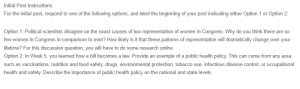
Initial Post Instructions
For the initial post, respond to one of the following options, and label the beginning of your post indicating either Option 1 or Option 2:
Causes of Low Representation of Women in Congress
Option 1: Political scientists disagree on the exact causes of low representation of women in Congress. Why do you think there are so few women in Congress in comparison to men? How likely is it that these patterns of representation will dramatically change over your lifetime? For this discussion question, you will have to do some research online.
Option 2: In Week 5, you learned how a bill becomes a law. Provide an example of a public health policy. This can come from any area, such as vaccinations, nutrition and food safety, drugs, environmental protection, tobacco use, infectious disease control, or occupational health and safety. Describe the importance of public health policy on the national and state levels.
 Complete the order form and upload all of your files, including any instructions, rubrics, or other materials provided by your instructor.
  Complete the order payment after filling in the order form. We’ll receive your order and assign it to a writer.
 The assigned writer will complete your paper and forward it to our Editing Team for review and approval.
 Once approved by the editor, the completed paper will be uploaded to your account for you to download, review and approve.