
Pharmacologic Management of Depression in a Middle-Aged Widow
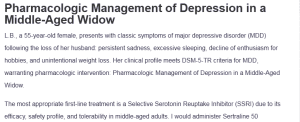
L.B., a 55-year-old female, presents with classic symptoms of major depressive disorder (MDD) following the loss of her husband: persistent sadness, excessive sleeping, decline of enthusiasm for hobbies, and unintentional weight loss. Her clinical profile meets DSM-5-TR criteria for MDD, warranting pharmacologic intervention: Pharmacologic Management of Depression in a Middle-Aged Widow.
The most appropriate first-line treatment is a Selective Serotonin Reuptake Inhibitor (SSRI) due to its efficacy, safety profile, and tolerability in middle-aged adults. I would administer Sertraline 50 mg per day orally, morning, whether or not you eat. Dispense 30 tablets with 2 refills (Bains & Abdijadid, 2023).
Sertraline is a well-established SSRI with a low risk for sedation, weight gain, and cardiovascular effects, making it suitable given L.B.’s comorbid hypertension and hyperlipidemia. Compared to other SSRIs, it also has fewer drug-drug interactions, which is especially important with her existing medication regimen. Additionally, sertraline is effective in treating grief-related depressive symptoms and is available in a low-cost generic formulation, which increases accessibility and adherence. Non-pharmacologic options such as cognitive behavioral therapy (CBT) or bereavement counseling may be introduced alongside pharmacotherapy for a comprehensive approach (Singh & Saadabadi, 2023).
To evaluate treatment success, I would use the PHQ-9 depression screening tool at 4–6 weeks post-initiation. Targeted improvements include enhanced mood, energy, appetite, and engagement in daily activities. Side effects to monitor include nausea, insomnia, or anxiety, especially during the initial weeks.
If minimal improvement is observed and tolerated, titration to 100 mg daily may be considered. Long-term monitoring should include ongoing assessments of function and emotional stability (Siniscalchi et al., 2020).
Ethically, L.B. must be fully informed about treatment benefits, risks, and alternatives. Legally, the APRN must follow state-specific prescriptive authority laws. Regulatory considerations include prescribing only FDA-approved indications, maintaining accurate documentation, and adhering to practice guidelines. Lastly, cost-effective care involves selecting effective generics and ensuring therapy aligns with insurance formularies to reduce patient burden (Zhang & Patel, 2023).
References
Bains, N., & Abdijadid, S. (2023, April 10). Major depressive disorder. StatPearls – NCBI Bookshelf. https://www.ncbi.nlm.nih.gov/books/NBK559078/
Singh, H. K., & Saadabadi, A. (2023, February 13). Sertraline. StatPearls – NCBI Bookshelf. https://www.ncbi.nlm.nih.gov/books/NBK547689/
Siniscalchi, K. A., Broome, M. E., Fish, J., Ventimiglia, J., Thompson, J., Roy, P., Pipes, R., & Trivedi, M. (2020). Depression screening and measurement-based care in primary care. Journal of Primary Care & Community Health, 11. https://doi.org/10.1177/2150132720931261
Zhang, P., & Patel, P. (2023, November 13). Practitioners and prescriptive authority. StatPearls – NCBI Bookshelf. https://www.ncbi.nlm.nih.gov/books/NBK574557/
ORDER A PLAGIARISM-FREE PAPER HERE
We’ll write everything from scratch
Question 
Case Study from Chapter 39 in your text:
L.B.’s medical history is significant for hypothyroidism, hypercholesterolemia, and recently diagnosed hypertension. Her medications are levothyroxine 0.075 mg daily, simvastatin 20 mg daily, hydrochlorothiazide 25 mg daily, lisinopril 10 mg daily, multivitamins 1 tab daily, and aspirin 81 mg daily. In the office today, L.B.’s blood pressure is 138/88 mm Hg.
Pharmacologic Management of Depression in a Middle-Aged Widow
- Address non-prescription and prescription therapy for this patient.
- What drug class would you prescribe?
- Provide exact details. Drug name, dose, frequency, route and quantity to dispense in the prescription.
- Justify your choice.
- What are the parameters for monitoring success of the therapy?
- Reflect on the 1) ethical, 2) legal, 3) regulatory aspects and 4) cost-effective considerations of prescribing practices in mental health care for the APRN.
Notes:
- Complete your response and paste it into the text box for the journal assignment. Achieve approximately a 250 word count. Provide at least two evidence based resource.
- One double space page
- Cite after every paragraph.
- APA formatting should be used for in-text citations and references list at the bottom of your Journal entry.
- No AI Use At All
 Complete the order form and upload all of your files, including any instructions, rubrics, or other materials provided by your instructor.
  Complete the order payment after filling in the order form. We’ll receive your order and assign it to a writer.
 The assigned writer will complete your paper and forward it to our Editing Team for review and approval.
 Once approved by the editor, the completed paper will be uploaded to your account for you to download, review and approve.