
Speak Up to Prevent Falls
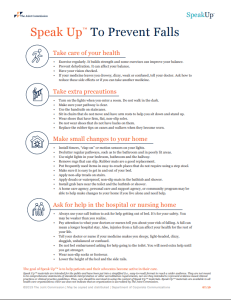
The brochure used for this review is called Speak Up to Prevent Falls, which The Joint Commission published on July 24, 2019. It offers useful information to patients and carers regarding fall prevention for patients in healthcare facilities and at home. The brochure is to raise awareness of the general public, particularly older persons, physically challenged, and people with various medical conditions, on how they can avoid or reduce fall hazards (Speak up TM to Prevent Falls, n.d.). The campaign is aimed at patients, caregivers, and other workers in the healthcare facility so that all those who are involved will have an insight into the need to prevent falls.
Summary of Brochure
The brochure focuses on the role of patients in the process of preventing falls. It describes cases like medication side effects, visual problems, and unsafe settings as serious hazards. It emphasizes that patients should be free to discuss anything concerning them with the healthcare providers, especially anything that has to do with falling. Measures such as employing the use of walking aids, avoiding obstacles on the floor, and the use of appropriate footwear are highlighted in the brochure. These interventions are based on current and effective nursing practices and are useful in the prevention of falls. This is an important topic to me as it affects the most vulnerable groups, such as older people. This brochure aims to encourage patients and providers to work together to avoid the occurrence of injuries secondary to falls.
Evaluation of Brochure
The highlighted points in the brochure provide comprehensive, practical tips regarding fall prevention that can easily be incorporated into patient counseling. The information provided in the paper is logically arranged and thus would be easy for patients, caregivers, and various other healthcare personnel to comprehend. According to Hoonakker, J et al. (2023), clarity of the language used is, therefore, important, and visuals are used to help present key points. A possible improvement that can be made is to add more specific patient experiences in the form of proper narratives or real-life accounts to make them more personal and relatable. This way, the content of the material reaches everybody’s consciousness, regardless of the level of health literacy. According to Heng et al. (2020), patient education is considered to be an important strategy in fall prevention. The brochure is useful to the elderly, post-surgery patients, and patients diagnosed with chronic illness. It is ideal for parents, relatives, and caregivers who are directly responsible for the lives of the patients to use the information in order to prevent any dangers caused by falls. In conclusion, the brochure avails patient safety in many ways through awareness, patient engagement, and evidence-informed protection.
Patient Communication
Communication between patients and healthcare workers is a key issue in the brochure. People need to ask questions, report their concerns about dizziness or any difficulty in making movements, and seek advice on the use of assistive devices. The importance of communication between the patient and healthcare provider is that healthcare professionals elaborate proposals for fall prevention and address patient needs individually (Kwame & Petrucka, 2021). Encouraging the patients to participate in their safety needs through the use of the brochure improves patient outcomes while the incidence of falls in healthcare facilities and at home decreases.
Personal Reflection
Incorporating this topic in my reflection is important in my clinical practice. As a nursing student, I understand that patients’ involvement in safety measures results in their enhanced health status. By engaging the patients on the topics of fall risks, they are made to feel that they are in control and are responsible for their care (Ojo & Thiamwong, 2022). Seeing the effects of fall incidents on patients and how they hinder their progress strengthens the need for preventive teachings; thus, this brochure is a valuable resource for patient care.
Evidence Review and Application
The strategies mentioned in the brochure are in congruence with the existing literature on fall prevention among patients. Literature highlights the importance of risk evaluation measures, individual education, and environmental changes in preventing fall occurrences. For example, As stated by Appeadu and Bordoni (2023), educational interventions and a safe environment to reduce fall risk factors have been proven to reduce the level of falls among older people. The recommendations that are presented in the brochure are based on these principles, which means that the data provided in the brochure is quite valuable as educational material. In clinical practice, this involves evaluating the risk factors for falls among patients, educating patients on measures that would reduce the chances of falling, and guaranteeing that all the measures to prevent falls have been put into practice. This integration improves patient education practices, thus having a positive impact on patient safety in the healthcare system.
Conclusion
The Speak Up to Prevent Falls is one of the informative brochures that can be used to educate patients on how to prevent falls and involve them in their care processes. The conveyed messages are precise and based on facts; therefore, the patient and the healthcare practitioners can effectively reduce the risks of falling. Implementing the information provided in the brochure is vital for patients at risk since it enhances their safety, mobility, and general well-being. Since the issue of fall prevention continues to be high on any healthcare institution’s agenda, such resources as this brochure improve the safety of patients.
References
Appeadu, M., & Bordoni, B. (2023, June 4). Falls and fall prevention in older adults. PubMed; StatPearls Publishing. https://www.ncbi.nlm.nih.gov/books/NBK560761/
Heng, H., Jazayeri, D., Shaw, L., Kiegaldie, D., Hill, A., & Morris, M. E. (2020). Hospital falls prevention with patient education: A scoping review. BMC Geriatrics, 20(1). https://doi.org/10.1186/s12877-020-01515-w
Hoonakker, J., Adeline-Duflot, F., Orcel, V., Grudzinski, M., Cognet, M., & Renard, V. (2023). Use of visual aids in general practice consultations: A questionnaire-based survey. PEC Innovation, 2, 100159. https://doi.org/10.1016/j.pecinn.2023.100159
Kwame, A., & Petrucka, P. (2021). A literature-based study of patient-centered care and communication in nurse-patient interactions: Barriers, facilitators, and the way forward. BMC Nursing, 20(158). https://bmcnurs.biomedcentral.com/articles/10.1186/s12912-021-00684-2
Ojo, E. O., & Thiamwong, L. (2022). Effects of nurse-led fall prevention programs for older adults: A systematic review. Pacific Rim International Journal of Nursing Research, 26(3), 417. https://pmc.ncbi.nlm.nih.gov/articles/PMC9432804/
Speak Up TM To Prevent Falls. (n.d.). https://www.jointcommission.org/-/media/tjc/documents/resources/speak-up/speak-ups/to-prevent-falls/speak-up-falls-85-x-11.pdf
ORDER A PLAGIARISM-FREE PAPER HERE
We’ll write everything from scratch
Question 
Speak Up to Prevent Falls
Purpose
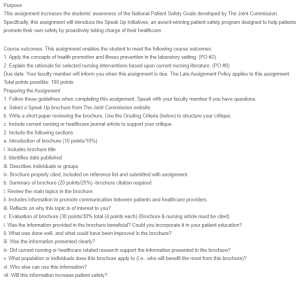
This assignment increases the students’ awareness of the National Patient Safety Goals developed by The Joint Commission. Specifically, this assignment will introduce the Speak Up Initiatives, an award-winning patient safety program designed to help patients promote their own safety by proactively taking charge of their healthcare.
Speak Up to Prevent Falls
Course outcomes: This assignment enables the student to meet the following course outcomes:
1. Apply the concepts of health promotion and illness prevention in the laboratory setting. (PO #2)
2. Explain the rationale for selected nursing interventions based upon current nursing literature. (PO #8)
Due date: Your faculty member will inform you when this assignment is due. The Late Assignment Policy applies to this assignment.
Total points possible: 100 points
Preparing the Assignment
1. Follow these guidelines when completing this assignment. Speak with your faculty member if you have questions.
a. Select a Speak Up brochure from The Joint Commission website.
b. Write a short paper reviewing the brochure. Use the Grading Criteria (below) to structure your critique.
c. Include current nursing or healthcare journal article to support your critique.
2. Include the following sections
a. Introduction of brochure (10 points/10%)
i. Includes brochure title
ii. Identifies date published
iii. Describes individuals or groups
iv. Brochure properly cited, included on reference list and submitted with assignment
b. Summary of brochure (20 points/20%) -brochure citation required
i. Review the main topics in the brochure.
ii. Includes information to promote communication between patients and healthcare providers.
iii. Reflects on why this topic is of interest to you?
c. Evaluation of brochure (30 points/30% total (4 points each) (Brochure & nursing article must be cited)
i. Was the information provided in the brochure beneficial? Could you incorporate it in your patient education?
ii. What was done well, and what could have been improved in the brochure?
iii. Was the information presented clearly?
iv. Did current nursing or healthcare related research support the information presented in the brochure?
v. What population or individuals does this brochure apply to (i.e., who will benefit the most from this brochure)?
vi. Who else can use this information?
vii. Will this information increase patient safety?
d. Clarity of Writing (20 points/20%)
i. Information presented in a logical progression.
ii. Section headers used:
iii. Summary of Brochure
iv. Patient Communication
v. Personal Reflection
vi. Evaluation of Brochure
vii. Evidence Review and Application
viii. Conclusion
e. Conclusion (10 points/10%)
i. Restates the purpose of the paper.
ii. Summarizes the main points of the paper.
iii. Summarizes the benefits of following the brochure’s advice to a person at risk.
f. APA style and structure (10 points/10%)
i. Uses appropriate APA format and is free of errors.
ii. Paper is no longer than three (3) pages, excluding title page, reference page, and copy of brochure.
iii. Evidence from a recent (5 years) scholarly nursing journal article was integrated within the Evaluation of Brochure section to support your answers.
iv. Grammar and mechanics are free of errors.
For writing assistance, visit the Writing Center.
Please note that your instructor may provide you with additional assessments in any form to determine that you fully understand the concepts learned in the review module.
 Complete the order form and upload all of your files, including any instructions, rubrics, or other materials provided by your instructor.
  Complete the order payment after filling in the order form. We’ll receive your order and assign it to a writer.
 The assigned writer will complete your paper and forward it to our Editing Team for review and approval.
 Once approved by the editor, the completed paper will be uploaded to your account for you to download, review and approve.