
Conceptual Project Outline – Mental Health Services for Low-Income and Homeless People
Population
The target population is the low-income population in Stockton City, CA, who are homeless. According to the U.S. Census Bureau (2023), the poverty rate in Stockton City, CA, is 18% higher than the national average. The housing burden is over 30% of the total income spent on rent. The city has a diverse ethnicity, but a significant population are made up of the Hispanic population. The main challenges are limited access to healthcare services, systemic barriers and stigma.
Identified Problem
The main health issue in this case is the limited access to mental health services for low-income and homeless people (San Joaquin Continuum of Care, 2024). The health gaps, on the other hand, include a lack of immediate mental support and crisis intervention approaches. There is also a gap in the existing services because even though they exist, they are inaccessible, fragmented, and underfunded.
Discuss Project
The proposed intervention is the establishment of a Community Mental Health Access Task Group (CMHATG). The goals of this group are to reduce barriers like transport, bureaucracies and stigma. They will also broaden partnerships and outreach to connect the target groups with services (Reisch, 2020). The group will also advocate for policy changes and ensure funding towards healthcare for this population. The team will also develop strategies, the short-term strategy being implementing crisis intervention teams and mobile mental health clinics. The long-term strategy is the implementation of policy advocacy and streamlined service coordination (Reisch, 2020). The expected outcomes are enhanced collaboration among stakeholders, increased service utilization, improved community awareness, and elimination of stigma.
Identify Stakeholders
The key stakeholders in this initiative are healthcare providers, specifically San Joaquin County Behavioral Health Services and Stockton Medical Center. The local government will also be a stakeholder represented by the Stockton City Council and the San Joaquin County Health and Human Services. Other groups of stakeholders include educational institutions like the San Joaquin Delta College and the University of the Pacific, as well as community faith-based organizations, homeless shelters like Mary’s Dining Room, and food banks. The other stakeholders are residents, specifically individuals who have life experiences of homelessness.
Cost Evaluation
Some of the sources of funding for this initiative are grants from groups like California Mental Health Services Act (MHSA) funds and SAMHSA grants. Support will also come from partnerships with others, like resource sharing with churches and clinics, for instance, getting free spaces for workshops. The estimated cost for the initiative is a total of $80,000 annually. The mobile clinic set-up will cost $50,000, policy advocacy and data collection will cost $10,000, and outreach materials and staff training will cost $20,000.
Evaluation of Project
- Metrics:
- Quantitative: Number of individuals served, reduction in emergency room visits for mental health crises.
- Qualitative: Stakeholder feedback and client satisfaction surveys.
- Frequency: Quarterly reviews, annual comprehensive evaluation.
- Longevity: Designed as an ongoing initiative with phased scaling (e.g., expanding mobile clinics to neighboring areas).
References
Reisch, M. (2020). Macro social work practice: Working for change in a multicultural society. Pearson.
San Joaquin Continuum of Care. (2024). San Joaquin County 2024 homelessness point-in-time count and report. http://www.sanjoaquincoc.org/wp-content/uploads/2024/09/2024-San-Joaquin-County-Point-In-Time-Count-Report.pdf
U.S. Census Bureau. (2023). QuickFacts: Stockton, California. https://www.census.gov/quickfacts/fact/table/stocktoncitycalifornia/PST045223
ORDER A PLAGIARISM-FREE PAPER HERE
We’ll write everything from scratch
Question 
Conceptual Project Outline – Mental Health Services for Low-Income and Homeless People
Outline
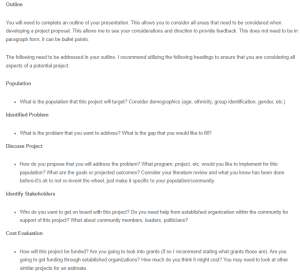
You will need to complete an outline of your presentation. This allows you to consider all areas that need to be considered when developing a project proposal. This allows me to see your considerations and direction to provide feedback. This does not need to be in paragraph form, it can be bullet points.
Mental Health Services for Low-Income and Homeless People
The following need to be addressed in your outline. I recommend utilizing the following headings to ensure that you are considering all aspects of a potential project.
Population
- What is the population that this project will target? Consider demographics (age, ethnicity, group identification, gender, etc.)
Identified Problem
- What is the problem that you want to address? What is the gap that you would like to fill?
Discuss Project
- How do you propose that you will address the problem? What program, project, etc. would you like to implement for this population? What are the goals or projected outcomes? Consider your literature review and what you know has been done before-it’s ok to not re-invent the wheel, just make it specific to your population/community.
Identify Stakeholders
- Who do you want to get on board with this project? Do you need help from established organization within the community for support of this project? What about community members, leaders, politicians?
Cost Evaluation
- How will this project be funded? Are you going to look into grants (if so I recommend stating what grants those are). Are you going to get funding through established organizations? How much do you think it might cost? You may need to look at other similar projects for an estimate.
Evaluation of Project
- How are you planning on evaluating the effectiveness of this project? Is it meeting the stated goals? How often will you evaluate? Is this a one-time project or an ongoing one?
 Complete the order form and upload all of your files, including any instructions, rubrics, or other materials provided by your instructor.
  Complete the order payment after filling in the order form. We’ll receive your order and assign it to a writer.
 The assigned writer will complete your paper and forward it to our Editing Team for review and approval.
 Once approved by the editor, the completed paper will be uploaded to your account for you to download, review and approve.