
A Specific Cognitive Challenge or Issue – Alzheimer’s Disease
Alzheimer’s disease is a common cognitive challenge in late adulthood, affecting memory and reasoning. Age, genetic factors, and lifestyle choices influence it. This reflection will look into the causes of Alzheimer’s disease, the most challenging aspects of the disease, and research-based recommendations. Moreover, it will show the educational qualifications related to Alzheimer’s care and their educational details.
Identification
A specific cognitive issue that might occur throughout late adulthood is Alzheimer’s disease, a progressive neurodegenerative disease that particularly affects memory, thinking, and reasoning skills. This condition occurs among the elderly, usually beyond the age of 65, and is the leading cause of dementia in this population. Alzheimer’s affects the cognitive part of the human brain, causing a decrease in abilities and making patients unable to live a normal life as they get lost, confused, and have a hard time speaking (Hong et al., 2024). Alzheimer’s, for instance, is not only a health challenge for the patient but is also a concern in terms of the emotional and financial burden it brings to caregivers and their families.
Examination
Several factors contribute to the development of Alzheimer’s disease, including advanced age, which is the greatest known risk factor. Another factor is genetic, where the APOE-e4 gene, in particular, contributes to the development of Alzheimer’s disease (Perks et al., 2025). Some risk factors associated with an increased risk include poor diet, lack of exercise, and mental inactivity. Besides, certain diseases like cardiovascular diseases, diabetes, and a history of head trauma can cause or worsen the effects of cognitive decline as well.
Hardest Aspect(s)
The most challenging aspect of Alzheimer’s disease is depersonalization and helplessness since the patients cannot even recognize their family members or make decisions on their own. On an ethical level, this becomes a question of informed consent and the rights of a person to make choices regarding their health and daily existence. Coping with long-term care placement, the use of life-sustaining treatments, and financial issues might be difficult for the families. A progressive realization of the changing mental capabilities leads to fear, frustration, and depression in the individual. These challenges demonstrate the necessity of compassion, legal preparation, and ethical consideration when addressing persons fighting this disease.
Recommendation
One of the recommendations that can be made concerning Alzheimer’s disease is the routine administration of diagnostic tests, which can be useful in detecting this disease at an early stage before memory impairment sets in strongly. Cognitive training and physical activity, such as regular exercise and mental stimulation, can slow the progression of Alzheimer’s disease and improve quality of life (Ribarič, 2022). Furthermore, offering more education sessions and support programs may also reduce the burden on families by making caregiving less exhausting to caregivers. This promotes community mobilization and allows intervention at the individual and familial levels.
Career Connection
A profession that can be associated with Alzheimer’s disease is that of a neuropsychologist, whose roles include the identification and management of diseases like Alzheimer’s. Neuropsychologists are obliged to complete the assessments aimed at defining a patient’s needs to create a treatment plan. Education requirements range from a master’s degree in psychology to a doctorate specializing in neuropsychology. Licensing requirements may include board certification from organizations like the American Board of Professional Psychology (ABPP). This position is essential in the promotion of evidence-based practice and also in researching cognitive health.
Conclusion
In conclusion, Alzheimer’s disease is a cognitive illness that affects people in their late years of life and damages the brain by impairing major functions such as memory and reasoning. Various causes include age, genetics, lifestyle, and other diseases. The most difficult aspects include the loss of autonomy and the ethical dilemmas patients and caregivers face. Alzheimer’s needs early identification, improvement of cognitive functioning, and carers who can enhance the quality of the patient’s life.
References
Hong, S., Baek, S.-H., Lai, M. K. P., Arumugam, T. V., & Jo, D.-G. (2024). Aging-associated sensory decline and Alzheimer’s disease. Molecular Neurodegeneration, 19(1). https://doi.org/10.1186/s13024-024-00776-y
Perks, C. M., Barker, R. M., Alhadrami, M., Alkahtani, O., Gill, E., Grishaw, M., Harland, A. J., Henley, P., Li, H., O’Sullivan, E., Stone, G., Su, X., & Kehoe, P. G. (2025). Curious dichotomies of apolipoprotein e function in Alzheimer’s disease and cancer—One explanatory mechanism of inverse disease associations? Genes, 16(3), 331. https://doi.org/10.3390/genes16030331
Ribarič, S. (2022). Physical exercise, a potential non-pharmacological intervention for attenuating neuroinflammation and cognitive decline in Alzheimer’s disease patients. International Journal of Molecular Sciences, 23(6), 3245. https://doi.org/10.3390/ijms23063245
ORDER A PLAGIARISM-FREE PAPER HERE
We’ll write everything from scratch
Question 
A Specific Cognitive Challenge or Issue – Alzheimer’s Disease
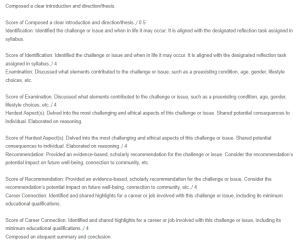
Composed a clear introduction and direction/thesis.
Score of Composed a clear introduction and direction/thesis.,/ 0.5
Identification: Identified the challenge or issue and when in life it may occur. It is aligned with the designated reflection task assigned in syllabus.
A Specific Cognitive Challenge or Issue
Score of Identification: Identified the challenge or issue and when in life it may occur. It is aligned with the designated reflection task assigned in syllabus.,/ 4
Examination: Discussed what elements contributed to the challenge or issue, such as a preexisting condition, age, gender, lifestyle choices, etc.
Score of Examination: Discussed what elements contributed to the challenge or issue, such as a preexisting condition, age, gender, lifestyle choices, etc.,/ 4
Hardest Aspect(s): Delved into the most challenging and ethical aspects of this challenge or issue. Shared potential consequences to individual. Elaborated on reasoning.
Score of Hardest Aspect(s): Delved into the most challenging and ethical aspects of this challenge or issue. Shared potential consequences to individual. Elaborated on reasoning.,/ 4
Recommendation: Provided an evidence-based, scholarly recommendation for the challenge or issue. Consider the recommendation’s potential impact on future well-being, connection to community, etc.
Score of Recommendation: Provided an evidence-based, scholarly recommendation for the challenge or issue. Consider the recommendation’s potential impact on future well-being, connection to community, etc.,/ 4
Career Connection: Identified and shared highlights for a career or job involved with this challenge or issue, including its minimum educational qualifications.
Score of Career Connection: Identified and shared highlights for a career or job involved with this challenge or issue, including its minimum educational qualifications.,/ 4
Composed an eloquent summary and conclusion.
 Complete the order form and upload all of your files, including any instructions, rubrics, or other materials provided by your instructor.
  Complete the order payment after filling in the order form. We’ll receive your order and assign it to a writer.
 The assigned writer will complete your paper and forward it to our Editing Team for review and approval.
 Once approved by the editor, the completed paper will be uploaded to your account for you to download, review and approve.