
Option 2: Media Bias
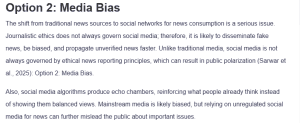
The shift from traditional news sources to social networks for news consumption is a serious issue. Journalistic ethics does not always govern social media; therefore, it is likely to disseminate fake news, be biased, and propagate unverified news faster. Unlike traditional media, social media is not always governed by ethical news reporting principles, which can result in public polarization (Sarwar et al., 2025): Option 2: Media Bias.
Also, social media algorithms produce echo chambers, reinforcing what people already think instead of showing them balanced views. Mainstream media is likely biased, but relying on unregulated social media for news can further mislead the public about important issues.
The news is often biased, with media outlets choosing what facts and opinions to report, which can influence public opinion. It is difficult to determine what an ‘unbiased’ story would be like (Greenberg & Page, 2018). Journalists must decide what facts to report, which can result in ideological bias.
Media outlets also use language that is more in tune with conservative or liberal ideology, which reinforces political fault lines. People’s political affiliations control how they perceive news bias; therefore, objectivity is challenging. Typically, news media aim for objectivity, but absolute neutrality is challenging.
There should be some level of accountability for news stations, but excessive regulation would jeopardize freedom of the press. While misinformation and bias exist, excessive regulation could limit alternative views and investigative journalism. Instead of imposing more restrictions, transparency and fact-checking would be more effective in ensuring the correctness of reports. Independent organizations can play a role in verifying information and holding media accountable.
Media literacy education in public also helps people differentiate between misinformation and bias. Government regulation of news content would lead to censorship and limit free speech. There should, however, be punishment for intentionally spreading falsehoods that risk the public. The best solution is a balanced approach that promotes ethical journalism but maintains free expression.
References
Greenberg, E. S., & Page, B. I. (2018). Struggle for democracy- 2018 elections and updates edition. Pearson.
Sarwar, B., Zulfiqar, S., Huo, C., Chandia, K. E., & Aziz, S. (2025). Constructivism in the digital age: How celebrity influence and social media richness impact youth’s perceived absorption capacity and societal polarization. Sustainable Futures, 100501. https://doi.org/10.1016/j.sftr.2025.100501
ORDER A PLAGIARISM-FREE PAPER HERE
We’ll write everything from scratch
Question 
Week 2 Discussion
Read/review the following resources for this activity:
- Textbook: Chapter 5, 6
- Lesson: Read this Week’s Lesson which is located in the Modules tab
- Initial Post: minimum of 2 scholarly sources (must include your textbook for one of the sources). Follow-Up Post: minimum of 1 scholarly source for your Follow-Up Post.

Option 2: Media Bias
Initial Post Instructions
For the initial post, respond to one of the following options, and label the beginning of your post indicating either Option 1 or Option 2:
- Option 1: Briefly discuss your state’s laws regarding gun control and its impact on healthcare.
- Option 2: Many experts see the media as biased and more like infotainment. In fact, many people have turned to social networks as an outlet for news instead of CBS, NBC, FOX, CNN and other news stations. Do you see this as an issue? Do you see the news as biased or unbiased? Should there be more restrictions on the news stations?
Be sure to make connections between your ideas and conclusions and the research, concepts, terms, and theory we are discussing this week.
Note:
- If needed, the client is from Silver Spring in Maryland
 Complete the order form and upload all of your files, including any instructions, rubrics, or other materials provided by your instructor.
  Complete the order payment after filling in the order form. We’ll receive your order and assign it to a writer.
 The assigned writer will complete your paper and forward it to our Editing Team for review and approval.
 Once approved by the editor, the completed paper will be uploaded to your account for you to download, review and approve.