
PROTECTING HUMAN RESEARCH PARTICIPANTS
Investigators involved in clinical research should protect the welfare of human subjects. To accomplish this, they should adhere to the provisions of Good Clinical Practice and Clinical Trials (UCI.edu, n.d.). Also, they should ensure that their research protocols are approved by relevant committees such as the Institutional Review Board (UCI.edu, n.d.). This paper discusses various aspects of research involving human participants.
Historical Background of Human Subjects Protection
The research’s principles of protecting human subjects have developed over the past few decades. To begin with, the Nuremberg Code was formulated in 1948 (UNLV.edu, n.d.). It advocates for obtaining voluntary informed consent from participants involved in research (UNLV.edu, n.d.). Secondly, in 1962, the Kefauver Amendments were established. These amendments direct all manufacturers to prove the efficacy and safety of a drug before it is marketed or used in human subjects (UNLV.edu, n.d.). Thirdly, in 1964, the Declaration of Helsinki was formulated (UNLV.edu, n.d.). According to this declaration, human research should be guided by findings from animal studies and other laboratory tests (UNLV.edu, n.d.). Also, an independent committee should review and approve research protocols before they are implemented. Furthermore, voluntary informed consent must be sought from the participant (UNLV.edu, n.d.). In addition, the researchers should be competent and qualified in the medical or scientific field. Lastly, the benefits of the research should outweigh the risks (UNLV.edu, n.d.). Fourthly, in 1974, the Belmont Report was drafted. The report advocates for ethical principles to protect human subjects in research. Examples of these principles include respect for persons, justice, and beneficence (UNLV.edu, n.d.).
Historical Incident of Human Subject Abuse
Cases of abuse of the rights of humans involved in research are well documented. The first case involves German physicians and authorities. These physicians and authorities subjected prisoners to medical experiments without obtaining their voluntary informed consent (UNLV.edu, n.d.). The experiments resulted in mortalities and lifetime impairments of the subjects. This case breaches the provisions of informed consent and beneficence. The second case is the Tuskegee Syphilis Study. This study targeted low-income participants from the African American community (UNLV.edu, n.d.). 399 out of the 600 participants were suffering from syphilis (UNLV.edu, n.d.). The researchers did not inform participants of their diagnoses. Also, they intentionally withheld medication from the participants. As such, many participants succumbed to the disease. This case breaches the provisions of informed consent, beneficence, and justice.
Minimizing Risks on Human Subjects
Various approaches can be used to reduce risks to human subjects. Firstly, informed consent should be obtained from human participants (UCSF.edu, 2023). Informed consent should be voluntary and based on the provision and comprehension of pertinent facts about the research (UCSF.edu, 2023). Secondly, the benefits accrued from the research should outweigh the potential risks. This can be accomplished via an independent review of research protocols (UCSF.edu, 2023).
Furthermore, the confidentiality of participants should be upheld using strategies such as assigning codes to participants, using passcodes, and data encryption. Also, the researchers involved in the study should be qualified, competent, and adhere to good clinical practice guidelines (UCSF.edu, 2023). Thirdly, nondiscriminatory approaches should be embraced when dealing with human participants. The inclusion criteria of participants should avoid individuals with diminished autonomy. In addition, the potential merits and risks should be distributed equally among the participants.
Vulnerable Populations
Vulnerable populations should be protected because they have diminished autonomy. Examples of vulnerable populations include children, prisoners, people with terminal illnesses, and mentally handicapped individuals (Gordon, 2020). This population is vulnerable because their decisions are likely to be made by other parties. Children are considered a vulnerable population because they are unlikely to comprehend the purpose of a study and the potential risks and benefits of participating in research (Gordon, 2020). Similarly, mentally disabled people are unlikely to comprehend the purpose and potential risks and benefits of participating in research (Gordon, 2020). People with terminal illnesses have diminished autonomy because they are likely to be desperate for survival. Lastly, the decisions of prisoners are likely to be made by prison staff.
Recruiting Subjects
UCI.edu (n.d.) reports that researchers should describe their recruitment method and submit it to the Institutional Review Board (IRB) for approval. Recruitment should be dependent on voluntary informed consent (UCI.edu, n.d.). Examples of strategies that can be used to recruit participants include advertisements via flyers or posters and random recruitment (UCI.edu, n.d.). Random recruitment is accomplished using snowball sampling (UCI.edu, n.d.). An IRB-approved letter describing the study, its purpose, procedure, inclusion and exclusion criteria, funding, incentives, potential risks, and dissemination of findings should be provided (UCI.edu, n.d.). Participants who fulfill the inclusion criteria should give their voluntary consent to participate in the study.
Obtaining Consent
Three consecutive steps should be used to obtain consent from participants. The first step is providing information (UCSF.edu, 2023). During this step, the researcher should describe the study and identify its purpose, methodology, potential benefits and risks, and the rights of the participants (UCSF.edu, 2023). The second step entails assessing the comprehension of the participant (UCSF.edu, 2023). The researcher should evaluate whether or not the subject has comprehended pertinent details about the study. This can be accomplished by probing the participant to ask any questions or concerns. The third step entails voluntary consent. The researcher should not coerce participants to take part in the study (UCSF.edu, 2023). Both written and verbal consent should be obtained from the participants.
A Properly Executed Consent
As earlier stated, three major elements are involved in obtaining consent. Firstly, the research should be verbally explained (UCSF.edu, 2023). This is achieved by providing a brief description of the study. The verbal explanation succeeded by providing consent and allowing the participant to read the information (UCSF.edu, 2023). After that, the researcher should address any concerns raised by the participant. It is with noting that special consideration should be provided for people with diminished autonomy. Secondly, participants’ comprehension should be assessed (UCSF.edu, 2023). Open-ended questions can be used to evaluate the comprehension of the study. Closed-ended questions should be avoided because they limit the type of feedback obtained from participants (UCSF.edu, 2023). Thirdly, informed consent should be documented and obtained voluntarily. The participant or legal representative should append his or her signature and date on the consent form (UCSF.edu, 2023). A copy of the consent form should be provided to the participant, whereas the researcher should retain the original signed copy.
Committees
The Institutional Review Board (IRB) is an example of a committee that monitors research involving human participants. The IRB is established and acknowledged by the provisions of the FDA (FDA.gov, 2019). It protects the rights and safety of human subjects by approving, modifying or disapproving research (FDA.gov, 2019). It reviews the research protocol before the study is initiated and periodically during the study. The IRB ensures that the study complies with the provisions of Good Clinical Practice and Clinical Trials (FDA.gov, 2019). By so doing, IRB minimizes potential risks and maximizes benefits accrued from research.
References
FDA.gov. (2019). Institutional Review Boards (IRBs) and Protection of Human Subjects in Clinical Trials. https://www.fda.gov/about-fda/center-drug-evaluation-and-research-cder/institutional-review-boards-irbs-and-protection-human-subjects-clinical-trials
Gordon, B. G. (2020). Vulnerability in research: Basic ethical concepts and general approach to review. Ochsner Journal, 20(1), 34–38. https://doi.org/10.31486/toj.19.0079
UCI.edu. (n.d.). Subject Enrollment. https://research.uci.edu/human-research-protections/research-subjects/#:~:text=Use%20of%20advertisements%2C%20notices%2C%20and,form)%20require%20prior%20IRB%20approval.
UCSF.edu. (2023). Obtaining and Documenting Informed Consent. https://irb.ucsf.edu/obtaining-and-documenting-informed-consent#:~:text=Obtaining%20consent%20involves%20explaining%20the,verbal%20explanation%20of%20the%20study.
UNLV.edu. (n.d.). History of Research Ethics. https://www.unlv.edu/research/ORI-HSR/history-ethics
ORDER A PLAGIARISM-FREE PAPER HERE
We’ll write everything from scratch
Question 
Week 6: Assignment – Human Subjects Protection
Assignment Prompt
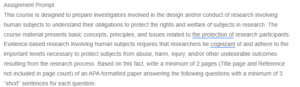
This course is designed to prepare investigators involved in the design and/or conduct of research involving human subjects to understand their obligations to protect the rights and welfare of subjects in research. The course material presents basic concepts, principles, and issues related to the protection of research participants.
Evidence-based research involving human subjects requires that researchers be cognizant of and adhere to the important tenets necessary to protect subjects from abuse, harm, injury, and/or other undesirable outcomes resulting from the research process. Based on this fact, write a minimum of 2 pages (Title page and Reference not included in page count) of an APA formatted paper answering the following questions with a minimum of 3 “short” sentences for each question:
PROTECTING HUMAN RESEARCH PARTICIPANTS
a. Historical background of human subjects protection? (10 points)
b. Find and discuss at least one historical incident of human subjects abuse in research and what human rights were violated. (10 points)
c. What steps will you take to minimize risks on human subjects? (10 points)
d. What populations are considered vulnerable populations and why? (10 points)
e. What are appropriate ways to recruit subjects? (10 points)
f. How would you properly obtain consent? (10 points)
g. What are the elements of a properly executed consent? (10 points)
h. What committees are responsible for monitoring the protection of human subjects? (10 points)
Scoring Scheme:
• Total points for questions/content: 80 points
• Title page and a minimum of 2 References: 10 points
• Minimum of 3 “short” sentences to answer each question: 10 points
• TOTAL POINTS: 100 (the grade book will re-weight this total as 50 points or 5% of the course grade)
NOTE: This is a written APA formatted assignment and “NOT” a YES or NO answer assignment. You are expected to answer each question with at least three short sentences; points will be deducted for using a single sentence. Title and Reference pages are required.
Expectations
• Length: a minimum of 2 pages, title page, and references not included in page count
• Citations: a minimum of 2
 Complete the order form and upload all of your files, including any instructions, rubrics, or other materials provided by your instructor.
 Complete the order payment after filling in the order form. We’ll receive your order and assign it to a writer.
 The assigned writer will complete your paper and forward it to our Editing Team for review and approval.
 Once approved by the editor, the completed paper will be uploaded to your account for you to download, review and approve.