
Making the Best Nursing Decisions
Effective communication and adherence to professional responsibilities are critical in the provision of safe and quality care. Inefficiencies in communication among care providers are the leading cause of delayed care, preventable medical errors, wastage of resources, increased costs of care, patient harm, and even death (Ambwani et al., 2019). It is also an aspect of conflict among hospital staff and reduced productivity (Tosanloo et al., 2019). This paper reviews a case scenario involving two patients, one of which had negative outcomes due to errors. I will describe how and why the errors occurred and unexpected client outcomes. I will also identify appropriate actions to avoid the identified errors and reduce the risks of unexpected outcomes. Do you need help in your nursing assignment?
Description of the Errors and Why They Occurred
Various major errors occurred that can be identified from the scenario. The first two errors are patient safety errors. They include the failure to inspect whether the nasogastric (NG) tube was well placed and documenting whether the NG tube was in place without confirmation. These errors occurred because of the nurse’s ignorance of a medical situation of concern. The nurse had noticed the NG tube was not securely placed in the patient’s nose but did not take any actions to inspect if it had been rightfully placed after the client noted that she had pushed it back in without any pain. Without carrying out an intragastric inspection as required to confirm placement (Sigmon & An, 2022), the nurse documented the NG tube was in place.
Poor coordination error occurred in the scenario when the physician came to check on the bariatric client and found that she had left for her bariatric group support. At the same time, the nurse did not report the earlier NG tube incident and noted no concerns.
Negligence error risking patient safety occurred when the 25-year-old bariatric client returned from the support group meeting, and the nurse noticed that the NG tube was missing. The nurse documented that the client removed the tube accidentally; however, she failed to report it immediately for further examination. Consistently, chaotic discharge error is also evident in the case of the 46-year-old client. The error occurred due to the failure of the nurse to be present during the time of the client’s discharge to ensure an effective transition of care. The nurse also failed to follow up on the client’s discharge. Another error identified was the failure of the nurse to check and confirm medication compatibility during the administration of Lopressor and Protonix. The nurse administered both medications on the day of discharge.
A serious medical error due to negligence was the failure to diagnose the bariatric patient. The error occurred when the Certified Nursing Assistant reported that the 25-year-old client had complained of fatigue and that vital signs, including blood pressure, were 90/40, heart rate 112, and respiratory rate 28. The preceptor did not take advice for any action to take but regarded that such signs were common in bariatric patients and that the patient was probably depressed and needed rest only.
Errors and Unexpected Client Outcomes
The unexpected client outcomes in the scenario include the removed and missing NG tube, distended stomach, and death of the 25-year-old bariatric client. These unexpected outcomes are due to professional negligence. The nurse failed to confirm the NG tube placement the first time it was dislodged and when the client reported that they had pushed it back with pain. The risk of introducing the NG tube to the lungs is high, even when done professionally. The tube could also have been obstructed or malfunctioned when the patient pushed it back. Inserting the NG tube into the bronchi risks pneumothorax, a condition that increases the risk of death (Lim et al., 2019). Additionally, when the patient pushed the NG tube back, she may have caused puncturing of the sphincter or injured the walls of the throat and the stomach, leading to intra-abdominal bleeding and abdominal distention, which caused the client’s death.
Strategies for Appropriate Actions to Avoid Errors Identified and Reduce Risk of Unexpected Outcomes
All of the errors and unexpected outcomes identified in the scenario stem from medical negligence and miscommunication. Medical negligence is the failure of healthcare professionals to fulfill their professional responsibility and care for patients. Miscommunication in the scenario resulted from the failure to report on the dislodged NG tube. The appropriate actions to avoid these errors and reduce the risk of unexpected outcomes are to establish a well-designed policy for patient management procedures and task execution and to promote communication about medical errors.
A well-designed policy to guide procedures and patient management will ensure that the nurses and other medical and clinical staff adhere to their professional responsibilities as per the outlined procedures. This policy will ensure that nurses and physicians respond to client calls on time without making assumptions or delays. The applicable theory in the development of procedural policies to guide patient care and error communication is Watson’s theory of human caring. The other strategy of promoting error communication and reporting has been noted to improve patient trust, acknowledgment of errors and potential harm, and commitment to patient safety behaviors (Kaldjian, 2021). It can also help reduce the progression of errors and the occurrence of adverse outcomes.
Watson’s theory helps understand nurses and care providers the wholeness of the patient, their duty to care for their patients, and the need to adhere to their duties of care (Gönen Şentürk & Küçükgüçlü, 2021). Heydari et al. (2020) argue that nurses’ perceptions of caring behaviors significantly influence their professional ethics. Therefore, policies based on Watson’s theory can lead to improving adherence to professional responsibilities, error communication and reporting, and improved ethics of care.
References
Ambwani, S., Misra, A. K., & Kumar, R. (2019). Medication Errors: Is it the Hidden Part of the Submerged Iceberg in Our Healthcare System? International Journal of Applied and Basic Medical Research, 9(3), 135. https://doi.org/10.4103/IJABMR.IJABMR_96_19
Gönen Şentürk, S., & Küçükgüçlü, Ö. (2021). Bridging Healing and Therapy: A Mixed-Methods Study on Support Group Intervention Based on Watson’s Theory of Human Caring. Holistic Nursing Practice, 35(2), 81–91. https://doi.org/10.1097/HNP.0000000000000435
Heydari, N., Torkaman, M., & Torabizadeh, C. (2020). The Relationship Between Nurses’ Perceptions of Caring Behaviors based on Watson’s Theory and of Professional Ethics: A Cross-Sectional Study. https://doi.org/10.21203/rs.3.rs-31487/v1
Kaldjian, L. C. (2021). Communication about medical errors. Patient Education and Counseling, 104(5), 989–993. https://doi.org/10.1016/J.PEC.2020.11.035
Lim, J. Y., Yong, E., Basheer, D., Aneez, A., & Tham, C. H. (2019). A simple procedure went wrong: pneumothorax after inadvertent transbronchial nasogastric tube insertion necessitating operative management. Journal of Surgical Case Reports, 2019(6), 1–3. https://doi.org/10.1093/JSCR/RJZ186
Sigmon, D. F., & An, J. (2022). Nasogastric Tube. A Medication Guide to Internal Medicine Tests and Procedures, 195–197. https://doi.org/10.1016/B978-0-323-79007-9.00042-8
Tosanloo, M. P., Adham, D., Ahmadi, B., Foroshani, A. R., & Pourreza, A. (2019). Causes of conflict between clinical and administrative staff in hospitals. Journal of Education and Health Promotion, 8(1). https://doi.org/10.4103/JEHP.JEHP_54_19
ORDER A PLAGIARISM-FREE PAPER HERE
We’ll write everything from scratch
Question 
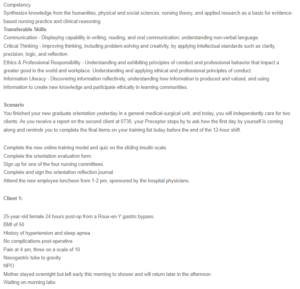
Making the Best Nursing Decisions
Competency
Synthesize knowledge from the humanities, physical and social sciences, nursing theory, and applied research as a basis for evidence-based nursing practice and clinical reasoning.
Transferable Skills
Communication – Displaying capability in writing, reading, and oral communication; understanding non‐verbal language.
Critical Thinking – Improving thinking, including problem‐solving and creativity, by applying intellectual standards such as clarity, precision, logic, and reflection.
Ethics & Professional Responsibility – Understanding and exhibiting principles of conduct and professional behavior that impact a greater good in the world and workplace. Understanding and applying ethical and professional principles of conduct.
Information Literacy – Discovering information reflectively, understanding how information is produced and valued, and using information to create new knowledge and participate ethically in learning communities.
Scenario
You finished your new graduate orientation yesterday in a general medical-surgical unit, and today, you will independently care for two clients. As you receive a report on the second client at 0730, your Preceptor stops by to ask how the first day by yourself is coming along and reminds you to complete the final items on your training list today before the end of the 12-hour shift.
Complete the new online training model and quiz on the sliding insulin scale.
Complete the orientation evaluation form.
Sign up for one of the four nursing committees.
Complete and sign the orientation reflection journal.
Attend the new employee luncheon from 1-2 pm, sponsored by the hospital physicians.
Client 1:
25-year-old female 24 hours post-op from a Roux-en-Y gastric bypass
BMI of 50
History of hypertension and sleep apnea
No complications post-operative
Pain at 4 am, three on a scale of 10
Nasogastric tube to gravity
NPO
Mother stayed overnight but left early this morning to shower and will return later in the afternoon.
Waiting on morning labs
Physician orders:
Dietary Consult
Bariatric Behavioral Therapist Consult
0.45% NS intravenous infusion post-op
Client 2:
A 46-year-old male was admitted 72 hours prior with severe GERD and difficulty swallowing
History of alcoholism, hypertension
Smoked two packs per day for 22 years
Endoscopy for Barrett’s Esophagus was negative on the day of admission
Pain at 4 am, two on a scale of 10
Due to resuming a clear liquid diet this morning
Potential discharge later today home with family
The ex-wife has stayed in a room with a client and has been disruptive at times, demanding pain medication and food.
Waiting on morning labs
Medications:
Protonix 40 mg once daily, intravenous infusion
Switch to oral Protonix 40mg on the day of discharge
IV infusion 0.9% NS 50 ml/hour
Resume 50mg Lopressor (metoprolol) PO twice daily after ruling out Barrett’s Esophagus
1-2mg Morphine Sulfate IV PRN q 4-6 hours for pain greater than 6 out of 10
TIME: 0800
EVENT: You prioritize assessing the 46-year-old male first since he has 0900 medications, and the physician is rounding and should order discharge today. Assessment and vital signs reveal no concerns, and the ex-wife is not present. A physician writes an order to discharge this client today. The client asks you to return in 30 minutes and go over discharge when the ex-wife is present to hear instructions. You administer Lopressor and Protonix.
TIME: 0830
EVENT: You assess the 25-year-old post-bariatric surgery client. Vital signs and morning labs are within acceptable limits, and the client reports pain two on a scale of 10. While assessing for bowel sounds, you notice the nasogastric (NG) tube is not secured to the nose, and the client reports the tube partially came out when she blew her nose, but she could push it back in with no pain. You document the NG tube in place and assist the client in going to the bathroom.
TIME: 0900
EVENT: You return to the 46-year-old client and review discharge instructions with the client and ex-wife, discontinue the IV infusion, remove the intravenous catheter, and complete the discharge summary.
TIME: 0945
EVENT: Transport stops by to take the 25-year-old client to meet with a support group for bariatric surgery clients — Are you okay with transport?
TIME: 1000
EVENT: The physician stops to see a bariatric client and is upset you let her leave for the support group before rounding. You report no concerns, and the physician reviews the chart and writes a discharge order for later in the afternoon if there is no vomiting or pain. The Nurse Practitioner can remove the NG tube at noon, and a diet of clear liquids can be resumed at 6 pm if there is no vomiting or gastric distention. Call immediately if any vomiting or signs of gastric distention occur.
TIME: 1030
EVENT: You take a break to complete the orientation reflection journal, orientation evaluation, and online sliding insulin scale training module and quiz.
TIME: 1130
EVENT: The 25-year-old bariatric client returns from the support group; you see her ambulating in the hallway, and you notice the NG tube is missing. The client states the tube fell from her nose when she stood up to introduce herself. She has no complaints of nausea and no evidence of gastric distention. You documented that the client accidentally removed the NG tube.
TIME: 1200
EVENT: A 46-year-old male client calls and expresses frustration at the time of discharge. He wants to be home by 3 pm for his son’s birthday party. You call transport, which assures you and the client they will arrive before 1 pm to discharge the client.
TIME: 1215
EVENT: Morning documentation is complete, all orders are in the system, and both clients are stable. You are amazed at how smooth the first day is going. You head to the new employee luncheon with your Preceptor.
TIME: 1330
EVENT: You return from lunch and find the 46-year-old client discharged, and you must prepare for a new admission from the emergency room to rule out pancreatitis. You feel apprehension since this will be your first admission, so you reach out to your Preceptor to review the policy and procedure for new admissions.
TIME: 1345
EVENT: While working with your Preceptor, the Certified Nursing Assistant stops by and reports the 25-year-old client refused an afternoon visit from a member of the bariatric support group, complaining of fatigue. Her noon vital signs were blood pressure 90/40, heart rate 112, and respiratory rate 28. Your Preceptor assures you these vital signs and fatigue often occur with this type of client. She suggests that the client is probably depressed and ready to go home and suggests letting her rest for the afternoon.
TIME: 1415
EVENT: The new admit from the emergency department arrives with two pages of physician orders and a communication challenge since he speaks and understands only Spanish. He has pain in the abdomen and begins vomiting. Seeing that you are now very busy, the Preceptor offers to “look in” on your 25-year-old client and will take care of any concerns. Also, she will order a translator to assist with the new admission while you focus on taking care of the physician’s orders.
TIME: 1730
EVENT: Finally, all orders for the new admit are in the system; the pain has decreased, no further vomiting, and he is resting comfortably. While waiting for lab results, you check on the 25-year-old client.
TIME: 1745
EVENT: On the way to the client’s room, the Nurse Manager stops and asks you to take a moment to fill out a volunteer form for one of the four nursing committees on the Unit.
TIME: 1815
EVENT: You return to the 25-year-old client’s room and find her unresponsive, pale, with no heartbeat or respiration. The abdomen is distended and hard. Attempts are made for resuscitation but are not successful. The client is deceased.
TIME: 1900
EVENT: You prepare to leave to go home. The Nurse Manager stops you and asks to debrief the situation. After reviewing the chart and discussing the situation, she is concerned and sees errors in your judgment and actions. She is sure the client’s death will be a sentinel event and warrant a review by the Internal Review Board.
Instructions
To prepare for debriefing with the Internal Review Board, the Nurse Manager asks you to submit an internal memo with your analysis and perceptions of the events that occurred, including:
Description of the errors and why they occurred.
Align to unexpected client outcomes.
Support choices with rationales.
Strategies for avoiding errors are identified and reduce the risk of unexpected outcomes.
Support strategies with rationales, nursing theory, and evidence from the literature.
Ideas stated with professional language and attribution for credible sources with correct APA citation, spelling, and grammar
 Complete the order form and upload all of your files, including any instructions, rubrics, or other materials provided by your instructor.
 Complete the order payment after filling in the order form. We’ll receive your order and assign it to a writer.
 The assigned writer will complete your paper and forward it to our Editing Team for review and approval.
 Once approved by the editor, the completed paper will be uploaded to your account for you to download, review and approve.