
Analyzing a Current Health Care Problem or Issue – Limited Access to Healthcare
Limited healthcare access is a problem facing patients and other consumers in the USA and globally. Limited access to healthcare impedes the management of both acute and chronic medical conditions (Coombs et al., 2022). As such, this problem should be addressed adequately. This paper analyzes the problem of limited access to healthcare, proposes solutions to the problem, and explains ethical principles when implementing these solutions.
Elements of the Problem/Issue
The problem of concern is limited access to healthcare services. This problem is associated with delayed screening, diagnosis, and management of diseases (Coombs et al., 2022). Furthermore, it impedes health promotion and disease prevention. As such, limited access to healthcare increases morbidity and mortality rates, lowers the quality of life, and increases the burden of diseases (Tulimiero et al., 2021). Increased burden of diseases increases healthcare costs because extra costs are incurred in managing poorly controlled diseases.
Various factors propagate limited access to healthcare. Firstly, transport and distance barriers limit access to healthcare (Ruralhealthinfo.org, 2022). Notably, rural areas are likely to have poor transport systems and services that delay access to healthcare. The other factor is provider availability. In this context, shortages of healthcare practitioners lower their productivity and restrict the delivery of healthcare services (Ruralhealthinfo.org, 2022). Ruralhealthinfo.org (2022) reports that rural areas account for about 65 percent of regions with primary healthcare provider shortages. The third factor is the lack of health insurance. Tolbert et al. (2022) report that more than 27 million people are uninsured in the USA. This population has limited access to healthcare and, thus, high treatment costs (Ruralhealthinfo.org, 2022). The fourth factor is low health literacy, which impedes the ability of patients to understand medical information and advice (Ruralhealthinfo.org, 2022). Also, low health literacy cultivates fear and frustration and limits access to healthcare (Ruralhealthinfo.org, 2022).
Analysis
Setting or Context for the Problem
According to Tolbert et al. (2022), limited access to healthcare is prevalent among the low-income population. This population is likely to be uninsured and lack access to affordable healthcare services. Furthermore, Tolbert et al. (2022) report that undocumented immigrants have limited access to healthcare. This population is restricted from accessing Medicaid services, limiting access to affordable healthcare. Butkus et al. (2020) report that this problem is prevalent among racial and ethnic minorities, sexual minorities, the incarcerated population, and populations living in rural areas. Similarly, as earlier mentioned, Ruralhealthinfo.org (2022) reports that rural areas account for about 65 percent of regions with primary healthcare provider shortages. Also, the problem is common in facilities that do not offer culturally sensitive care. As earlier stated, the other factors associated with limited access to healthcare include low health literacy, shortages of healthcare providers, and poor transport systems (Ruralhealthinfo.org, 2022).
Why the Problem is Important
Limited access to healthcare is relevant to my practice. As a clinician, I significantly mitigate this problem by educating patients and their families. Patient and family education increases health literacy and improves access to healthcare. In addition, I am involved in advocacy for championing policies that increase healthcare coverage for minority communities and immigrants.
Groups of People Affected by the Problem or Issue
As already mentioned, Butkus et al. (2020) report that this problem is prevalent among racial and ethnic minorities, sexual minorities, the incarcerated population, and populations living in rural areas. Furthermore, the problem is prevalent in low-income populations, those living in rural areas, and those with physical disabilities (Butkus et al., 2020; Ruralhealthinfo.org, 2022; Tolbert et al., 2022).
Considering Options
Stakeholders should explore various strategies to address limited access to healthcare. To begin with, they should embrace telemedicine. Telemedicine eliminates in-person interactions with healthcare providers and facilitates remote patient monitoring (USC.edu, n.d.). People can access timely healthcare services from any location. By so doing, it creates flexibility and allows timely access to healthcare services (USC.edu, n.d.). Notably, this technique addresses the transportation and location problems that impede healthcare access. Telemedicine technology commonly includes videoconferencing, wearable devices, and mobile health (USC.edu, n.d.).
Secondly, insurance should be expanded to cover more people. For instance, KFF.org (2023) reports that some states, such as Texas, Kansas, Florida, and Alabama, have not adopted Medicaid expansion directed by the Affordable Care Act. This expansion will increase the number of people who access affordable healthcare services. Furthermore, Tolbert et al. (2022) report that most members of the uninsured population lack employer-provided insurance. This should be addressed through policy formulation to direct all employers to avail health coverage for their employees. Also, Medicaid restricts both lawful (for five years) and undocumented immigrants (ineligible) from accessing timely, affordable healthcare (Tolbert et al., 2022). These restrictions should be expunged to allow access to affordable healthcare.
Thirdly, public education should be adopted to increase health literacy levels. Education will equip the public with relevant health information. Health literacy is associated with timely access to healthcare because people understand various aspects of the disease process. Furthermore, education will enable the public to identify and leverage community resources. As such, they will have timely access to healthcare services.
Solution
Telemedicine is a plausible solution that should be adopted to increase access to healthcare. As earlier stated, telemedicine eliminates in-person interactions with healthcare providers and facilitates remote patient monitoring (USC.edu, n.d.). People can access timely healthcare services from any location. As a result, telemedicine creates flexibility and allows timely access to healthcare services. Notably, this technique addresses the transportation and location problems that impede healthcare access (USC.edu, n.d.). Commonly used telemedicine technology includes videoconferencing, wearable devices, and mobile health. Real-time sessions between patients and healthcare providers are achieved via videoconferencing (USC.edu, n.d.). Also, remote monitoring of the patient’s prognosis is achieved via wearable devices. Mobile health promotes healthcare access through text and audio messages (USC.edu, n.d.). Factors limiting telemedicine use include lack of quality internet access and low digital literacy (Ruralhealthinfo.org, 2022).
Implementation
The implementation of telemedicine requires concerted efforts among various stakeholders, which is accomplished in three phases. The first phase entails assessing the current situation (WHO, 2022). During this phase, a multidisciplinary team is established, and the goals and objectives of telemedicine are established. Also, this phase is marked by developing a road map, budgeting, and resource allocation. Furthermore, factors that promote the implementation and potential barriers are established during this phase. Resource allocation is essential to facilitate the acquisition of hardware and software and training members of the interdisciplinary team and patients. The second phase is implementing telemedicine. The implementation is based on the road map and standard operating procedures established in the first phase (WHO, 2022). The third phase is monitoring and evaluation. Monitoring and evaluation determine the success of implementing telemedicine (WHO, 2022). Furthermore, monitoring and evaluations form the basis for developing continuous improvement plans. In this context, the desired outcome is increased access to healthcare.
Ethical Implications
Ethical principles will guide the implementation of telemedicine. To begin with, patient autonomy will be upheld. Autonomy acknowledges the importance of patients in the decision-making process (Varkey, 2021). As such, healthcare practitioners will collaborate with patients when formulating treatment plans. Furthermore, patients will be involved in the selection of the most appropriate form of telemedicine used in care delivery. Secondly, justice will be upheld. This ethical principle advocates fairness when delivering healthcare services (Varkey, 2021). It prohibits a discriminatory approach to healthcare. Patients will be treated fairly when telemedicine is implemented. Telemedicine services will be provided to all patients regardless of their sociodemographic characteristics. Thirdly, beneficence advocates for practices that benefit patients, whereas non-maleficence advocates for practices that don’t harm patients (Varkey, 2021). The use of telemedicine will focus on improving access to health care, providing timely diagnosis, and improving patient outcomes. Healthcare providers will be trained on the provisions of the Health Insurance Portability and Accountability Act. They will be required to uphold the privacy and confidentiality of patients (Moore & Frye, 2019). Furthermore, the security of patients’ data will be upheld.
Conclusion
The problem of limited access to healthcare can be addressed by embracing concerted efforts among various stakeholders. This is a significant problem because it increases morbidity and mortality rates, increases healthcare costs, and lowers patients’ quality of life. Telemedicine is an example of a plausible solution to this problem. Notably, telemedicine improves access to healthcare by allowing remote patient monitoring. This flexibility is key to improving access to healthcare services. All stakeholders should uphold the principles of healthcare ethics when implementing telemedicine.
References
Butkus, R., Rapp, K., Cooney, T. G., & Engel, L. S. (2020). Envisioning a Better U.S. Health Care System for All: Reducing Barriers to Care and Addressing Social Determinants of Health. Annals of Internal Medicine, 172(November 2019), S50–S59. https://doi.org/10.7326/M19-2410
Coombs, N. C., Campbell, D. G., & Caringi, J. (2022). A qualitative study of rural healthcare providers’ views of social, cultural, and programmatic barriers to healthcare access. BMC Health Services Research, 22(1), 1–16. https://doi.org/10.1186/s12913-022-07829-2
KFF.org. (2023). Status of State Medicaid Expansion Decisions: Interactive Map. https://www.kff.org/medicaid/issue-brief/status-of-state-medicaid-expansion-decisions-interactive-map/
Moore, W., & Frye, S. (2019). Review of HIPAA, Part 1: History, protected health information, and privacy and security rules. Journal of Nuclear Medicine Technology, 47(4), 269–272. https://doi.org/10.2967/JNMT.119.227819
Ruralhealthinfo.org. (2022). Healthcare Access in Rural Communities. https://www.ruralhealthinfo.org/topics/healthcare-access
Tolbert, J., Drake, P., & Damico, A. (2022). Key Facts about the Uninsured Population. https://www.kff.org/uninsured/issue-brief/key-facts-about-the-uninsured-population/
Tulimiero, M., Garcia, M., Rodriguez, M., & Cheney, A. M. (2021). Overcoming Barriers to Health Care Access in Rural Latino Communities: An Innovative Model in the Eastern Coachella Valley. Journal of Rural Health, 37(3), 635–644. https://doi.org/10.1111/jrh.12483
USC.edu. (n.d.). How to Improve Access to Health Care: Current Issues and Potential Solutions. https://healthadministrationdegree.usc.edu/blog/how-to-improve-access-to-health-care/
Varkey, B. (2021). Principles of Clinical Ethics and Their Application to Practice. Medical Principles and Practice, 30(1), 17–28. https://doi.org/10.1159/000509119
WHO. (2022). Consolidated telemedicine implementation guide. https://www.who.int/publications/i/item/9789240059184
ORDER A PLAGIARISM-FREE PAPER HERE
We’ll write everything from scratch
Question 
In your healthcare career, you will be confronted with many problems that demand a solution. You can learn what others are doing and saying about similar problems using research skills. Then, you can analyze the problem and the people and systems it affects. You can also examine potential solutions and their ramifications. This assessment allows you to practice this approach with a real-world problem.
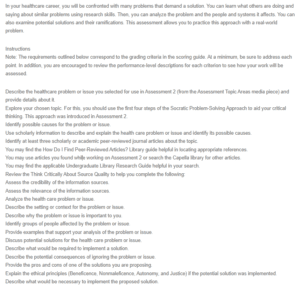
Analyzing a Current Health Care Problem or Issue – Limited Access to Healthcare
Instructions
Note: The requirements outlined below correspond to the grading criteria in the scoring guide. At a minimum, be sure to address each point. In addition, you are encouraged to review the performance-level descriptions for each criterion to see how your work will be assessed.
Describe the healthcare problem or issue you selected for use in Assessment 2 (from the Assessment Topic Areas media piece) and provide details about it.
Explore your chosen topic. For this, you should use the first four steps of the Socratic Problem-Solving Approach to aid your critical thinking. This approach was introduced in Assessment 2.
Identify possible causes for the problem or issue.
Use scholarly information to describe and explain the health care problem or issue and identify its possible causes.
Identify at least three scholarly or academic peer-reviewed journal articles about the topic.
You may find the How Do I Find Peer-Reviewed Articles? Library guide helpful in locating appropriate references.
You may use articles you found while working on Assessment 2 or search the Capella library for other articles.
You may find the applicable Undergraduate Library Research Guide helpful in your search.
Review the Think Critically About Source Quality to help you complete the following:
Assess the credibility of the information sources.
Assess the relevance of the information sources.
Analyze the health care problem or issue.
Describe the setting or context for the problem or issue.
Describe why the problem or issue is important to you.
Identify groups of people affected by the problem or issue.
Provide examples that support your analysis of the problem or issue.
Discuss potential solutions for the health care problem or issue.
Describe what would be required to implement a solution.
Describe the potential consequences of ignoring the problem or issue.
Provide the pros and cons of one of the solutions you are proposing.
Explain the ethical principles (Beneficence, Nonmaleficence, Autonomy, and Justice) if the potential solution was implemented.
Describe what would be necessary to implement the proposed solution.
Explain the ethical principles that need to be considered (Beneficence, Nonmaleficence, Autonomy, and Justice) if the potential solution is implemented.
Provide examples from the literature to support the points you are making.
 Complete the order form and upload all of your files, including any instructions, rubrics, or other materials provided by your instructor.
  Complete the order payment after filling in the order form. We’ll receive your order and assign it to a writer.
 The assigned writer will complete your paper and forward it to our Editing Team for review and approval.
 Once approved by the editor, the completed paper will be uploaded to your account for you to download, review and approve.