
Alterations in Cardiovascular Functioning
Coronary heart disease, also known as coronary artery disease (CAD), is one of the most common heart disorders. The narrowing of the coronary arteries causes this disease as a result of a buildup of plaque (cholesterol, calcium, fibrin, and waste products) on the arteries’ inner lining (Center for Disease Control and Prevention. (2021). Unfortunately, CAD rarely has clinical manifestations because the plaque can take decades to build up. However, when the clinical manifestations appear, they usually include chest pain (angina), heart attack, nausea, light-headedness, fast heartbeat, sweating, and shortness of breath. Notably, coronary arteries supply blood to the heart muscles.
As the buildup continues, the amount of blood that reaches the heart muscles becomes limited, leaving these muscles oxygen depleted. With time, the oxygen-deprived heart muscles give out, and the organ can stop, leading to a cardiac arrest. Some more alterations that coronary heart diseases bring about in the cardiovascular lining include an irregular heartbeat, also known as arrhythmia (Michniewicz et al., 2018). With differing diameters due to plaque in the arteries, the heart ends up having irregularities in the speed or the rhythm. Secondly, plaque buildup on the arteries leads to their hardening. The hardening of the arteries, also known as atherosclerosis, increases the risk of blood clots. Third, suppose a plaque was to break off; it would alter the blood flow in that artery. Fourth, with a weakened heart, the amount of blood pumped around the body is lower than the normal amount a healthy heart pumps in a day. This could eventually lead to congestive heart failure or cardiogenic shock.
In conclusion, coronary heart disease, which is caused by the narrowing and hardening of coronary arteries due to plaque buildup, reduces the heart’s functioning capability. Most, if not all, of the alterations in the cardiovascular system caused by this disease are based on a weakened heart.
References
Center for Disease and Control and Prevention. (2021). Coronary Artery Disease (CAD). Accessed from: https://www.cdc.gov/heartdisease/coronary_ad.htm
Michniewicz, E., Mlodawska, E., Lopatowska, P., Tomaszuk-Kazberuk, A., & Malyszko, J. (2018). Patients with atrial fibrillation and coronary artery disease–double trouble. Advances in medical sciences, 63(1), 30-35.
ORDER A PLAGIARISM-FREE PAPER HERE
We’ll write everything from scratch
Question 
Alterations in Cardiovascular Functioning
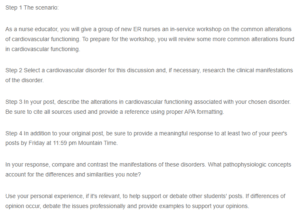
Step 1 The scenario:
As a nurse educator, you will give a group of new ER nurses an in-service workshop on the common alterations of cardiovascular functioning. To prepare for the workshop, you will review some more common alterations found in cardiovascular functioning.
Step 2 Select a cardiovascular disorder for this discussion and, if necessary, research the clinical manifestations of the disorder.
Step 3 In your post, describe the alterations in cardiovascular functioning associated with your chosen disorder. Be sure to cite all sources used and provide a reference using proper APA formatting.
Step 4 In addition to your original post, be sure to provide a meaningful response to at least two of your peer’s posts by Friday at 11:59 pm Mountain Time.
In your response, compare and contrast the manifestations of these disorders. What pathophysiologic concepts account for the differences and similarities you note?
Use your personal experience, if it’s relevant, to help support or debate other students’ posts. If differences of opinion occur, debate the issues professionally and provide examples to support your opinions.
 Complete the order form and upload all of your files, including any instructions, rubrics, or other materials provided by your instructor.
 Complete the order payment after filling in the order form. We’ll receive your order and assign it to a writer.
 The assigned writer will complete your paper and forward it to our Editing Team for review and approval.
 Once approved by the editor, the completed paper will be uploaded to your account for you to download, review and approve.