
Identifying Framework-Knowledge as a Component of the socio-cultural Orientation Basic Conditioning Factor Enhances the Prevention of Hazards
Knowledge of Socio-Cultural Orientation in the Prevention of Hazards
In general nursing practice, it is believed that knowledge of socio-cultural orientation is key in protecting patients from potential hazards. The theory, “Knowledge as a component of the socio-cultural orientation basic conditioning factor enhances the prevention of hazards,” was developed under the framework of cultural competency. The theory was developed by Jacqueline Faucett while discussing the nursing theory of socio-cultural orientation. The current nursing training encourages teaching cultural orientation for better healthcare services (Luquis & Perez, 2021). The theory emphasizes the role of cultural competency in the prevention of hazards. For instance, the hazards that may be associated with socio-cultural activities in the community include falls among the elderly. Generally, the elderly tend to be left alone and unattended. For this reason, they end up sustaining injuries due to falls. The theory above can be applied in the explanation of this concept of falls among the elderly. Nevertheless, the theory may also be applied in other healthcare professions.
For the concept of prevention of falls among the elderly. It is important for nurses to recognize and acknowledge that in some communities, the elderly are left to live independently and care for themselves without much assistance. For this reason, it is important to ensure that while addressing the issues, the nurses consider that some older adults prefer taking care of themselves or being independent. To ensure they are protected from falls, the elderly may be assessed for risk of falls. This assessment can be done using a tool known as the Falls Risk Assessment Tool, abbreviated FRAT. This tool enables the identification of factors that may predispose the elderly to falls (Chen et al., 2022). For instance, the tool captures the history of previous falls, use of ambulatory aid, mental status, and the client’s gait. Having identified the factors that may lead to falls among the elderly living alone, it is easy to come up with strategies for preventing falls. This may include modifying certain things, such as their walking aid and the floor of the house in which they live.
References
Luquis, R. R., & Pérez, M. A. (Eds.). (2021). Cultural competence in health education and health promotion. John Wiley & Sons.
Chen, L. C., Shen, Y. C., Ho, L. H., & Shih, W. M. (2022, March). The Fall Risk Screening Scale Is Suitable for Evaluating Adult Patient Fall. In Healthcare (Vol. 10, No. 3, p. 510). MDPI. https://doi.org/10.3390/
ORDER A PLAGIARISM-FREE PAPER HERE
We’ll write everything from scratch
Question 
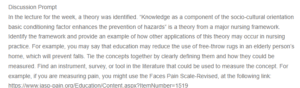
Discussion Prompt
In the lecture for the week, a theory was identified. “Knowledge as a component of the socio-cultural orientation basic conditioning factor enhances the prevention of hazards” is a theory from a major nursing framework. Identify the framework and provide an example of how other applications of this theory may occur in nursing practice.
Identifying Framework-Knowledge as a Component of the socio-cultural Orientation Basic Conditioning Factor Enhances the Prevention of Hazards
For example, you may say that education may reduce the use of free-throw rugs in an elderly person’s home, which will prevent falls. Tie the concepts together by clearly defining them and how they could be measured. Find an instrument, survey, or tool in the literature that could be used to measure the concept. For example, if you are measuring pain, you might use the Faces Pain Scale-Revised, at the following link: https://www.iasp-pain.org/Education/Content.aspx?ItemNumber=1519
 Complete the order form and upload all of your files, including any instructions, rubrics, or other materials provided by your instructor.
 Complete the order payment after filling in the order form. We’ll receive your order and assign it to a writer.
 The assigned writer will complete your paper and forward it to our Editing Team for review and approval.
 Once approved by the editor, the completed paper will be uploaded to your account for you to download, review and approve.