
Merging Hospital Cultures
The main challenges identified during and after the merging of the two hospital cultures included the employees’ concerns over their future in the merged hospital system, risking increased intentions to leave, concerns over overburdening the available professional and other staff, and reduced work and growth opportunities due the hospital’s market consolidation after the merger. Various strategies to manage the challenges have been proposed, including reassigning extra resources to support the integration of the two cultures, involving the staff throughout the merger process, and renegotiating the terms of employment, including roles, wages, and other compensations and benefits. However, the original strategy to work with the identified challenges in merging the two workplace cultures included using effective communication and applying change management approaches to manage the merger best.
Internal and external communication during and after the merger was chosen as the best strategy to work toward managing and overcoming the challenges associated with merging the two workplace cultures. The leadership adopted a multi-tiered communication approach to inform the staff, the patients, the communication, and other stakeholders about the intentions and reasons for the merger and reduce confusion during the merging of the two workplace cultures. This was done frequently and included collecting the stakeholders’ views and providing feedback as often as possible. Communication provides the necessary information to critical staff to effectively respond to changes during mergers and acquisitions (Rodríguez-Sánchez et al., 2019). It has been identified as a critical factor for successfully integrating varied hospital cultures after mergers and effectively providing efficient care to populations (Garrick et al., 2019).
Change management was also an original strategy proposed to work with the identified challenges in merging the two workplace cultures. The hospital experiences various merger-induced changes, including how people work daily, how clinical and medical staff collaborate during care delivery, and the overall administration of the hospital. Change management was viewed as a force that created a foundation to guide the successful integration of the merging cultures. The leadership of the hospital system adopted a plan that ensured the need for change in daily operations and behaviors was recognized throughout the hospital. The plan focused on effecting change from the critical staff and then letting the critical staff become agents of change throughout the hospital. Based on evidence from organizational change and change management literature, implementing change management practices is a motivating factor for change acceptance and control of the direction of integration between the care providers, the patients, and the suppliers, as well as supporting operational flexibility (Yu et al., 2021).
From the group discussions and feedback, I have noted that several of my mates agree on using change management and effective communication to manage workplace cultural integration. Therefore, I would not change the strategy using communication and change management.
The solution I would decide on is to adopt large-scale transformation management toward integrating the two workplace cultures. The merger-induced change transforms the hospital system and affects every stakeholder and shareholder. I have learned that the best way to manage organization-wide change is to involve everyone affected by the change. This will involve creating champions of change at different staff levels to effect the changes locally. The use of organization-wide champions of change helps the siloing of change, leverages change upon the various professional networks, creates tension for change, optimizes the flow of change by using existing structures, and engages the key stakeholders for the change (Bonawitz et al., 2020).
References
Bonawitz, K., Wetmore, M., Heisler, M., Dalton, V. K., Damschroder, L. J., Forman, J., Allan, K. R., & Moniz, M. H. (2020). Champions in context: Which attributes matter for change efforts in healthcare? Implementation Science, 15(1), 1–10. https://doi.org/10.1186/S13012-020-01024-9/TABLES/1
Garrick, R., Sullivan, J. J., Doran, M., & Keenan, J. (2019). The Role of the Hospital in the Healthcare System. The Modern Hospital: Patients Centered, Disease Based, Research Oriented, Technology Driven, 47–60. https://doi.org/10.1007/978-3-030-01394-3_6/COVER
Rodríguez-Sánchez, J. L., Ortiz-de-Urbina-Criado, M., & Mora-Valentín, E. M. (2019). Thinking about people in mergers and acquisitions processes. International Journal of Manpower, 40(4), 643–657. https://doi.org/10.1108/IJM-05-2018-0143/FULL/XML
Yu, W., Zhao, G., Liu, Q., & Song, Y. (2021). Role of big data analytics capability in developing integrated hospital supply chains and operational flexibility: An organizational information processing theory perspective. Technological Forecasting and Social Change, 163, 120417. https://doi.org/10.1016/J.TECHFORE.2020.120417
ORDER A PLAGIARISM-FREE PAPER HERE
We’ll write everything from scratch
Question 
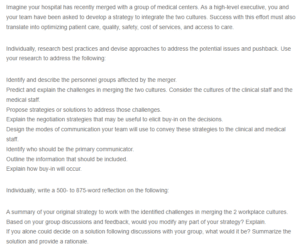
Imagine your hospital has recently merged with a group of medical centers. As a high-level executive, you and your team have been asked to develop a strategy to integrate the two cultures. Success with this effort must also translate into optimizing patient care, quality, safety, cost of services, and access to care.
Merging Hospital Cultures
Individually, research best practices and devise approaches to address the potential issues and pushback. Use your research to address the following:
Identify and describe the personnel groups affected by the merger.
Predict and explain the challenges in merging the two cultures. Consider the cultures of the clinical staff and the medical staff.
Propose strategies or solutions to address those challenges.
Explain the negotiation strategies that may be useful to elicit buy-in on the decisions.
Design the modes of communication your team will use to convey these strategies to the clinical and medical staff.
Identify who should be the primary communicator.
Outline the information that should be included.
Explain how buy-in will occur.
Individually, write a 500- to 875-word reflection on the following:
A summary of your original strategy to work with the identified challenges in merging the 2 workplace cultures.
Based on your group discussions and feedback, would you modify any part of your strategy? Explain.
If you alone could decide on a solution following discussions with your group, what would it be? Summarize the solution and provide a rationale.
 Complete the order form and upload all of your files, including any instructions, rubrics, or other materials provided by your instructor.
  Complete the order payment after filling in the order form. We’ll receive your order and assign it to a writer.
 The assigned writer will complete your paper and forward it to our Editing Team for review and approval.
 Once approved by the editor, the completed paper will be uploaded to your account for you to download, review and approve.