
Article Critique – Fall Prevention in Hospitals
Modern healthcare systems increasingly emphasize quality healthcare, with value-based innovative approaches maintaining relevancy in quality improvement measures across care organizations. Fall prevention in hospitals is one of the quality improvement measures that is gaining prominence in institutionalized care. Many hospitals are implementing fall prevention measures as a health preservation measure for patients at high risk for falls. Many studies have detailed fall prevention interventions by identifying at-risk populations and risk factors for falls postulated as best practices in hospital fall prevention (Heng et al., 2020). Nevertheless, organizational and environmental factors have been implicated in severe falls. This paper analyzes a quantitative study on factors associated with the severity of falls in hospitalized patients.
Overview of the Quantitative Study Selected
Ghosh et al.’s (2022) quantitative study is selected in this article critique. This quantitative study analyzes the factors associated with the severity of falls among adults in institutionalized care settings. According to this article, the severity of the fall scale is divided into three tiers that correspond to the low, medium, and high severity of falls. A retrospective cohort analysis of inpatient records on falls utilizing univariable and multivariable regression models revealed several causal factors for falls, each correlating to varying severity. Age-related, medication-related, mobility-related, and history-related fall-related factors were identified (Ghosh et al., 2022). While there was a positive correlation between these factors and hospital falls, their severity scales varied.
Patients aged above 50 and female gender were associated with high-risk falls. Patients in these categories experienced considerable harm whenever they fell. Fall incidents in this category were mostly reported during toileting and bathing activities. Comorbidity with depression, substance abuse disorders, and the use of medications were also linked to high-severity falls. The authors concluded that identifying these factors remains a best practice in fall prevention. Fall prevention strategies in institutionalized care settings should thus focus on screening for these factors.
An Explanation of Strengths of the Study
Fall prevention is integral to all quality improvement initiatives in institutional care settings. Findings from this study affirm the need for screening for fall risk factors as a preventive measure for hospital falls. This study concludes an analysis of numerical data on risk factors for falls and the severity of falls experienced by adults in an inpatient setting. This is a strength because it enabled the authors to provide more accurate and reliable correlations between the identified risk factors and the severity of falls. Besides, Noyes et al. (2019) report that quantitative approaches that give due consideration to measurable numerical data provide more factual information than the opinions and characteristics that other research methodologies present. Therefore, Ghosh et al.’s (2022) findings can be used to inform guidelines on fall prevention and can also be leveraged to investigate other quality improvement measures on other quality improvement indicators in hospitals.
The use of numerical data in quantitative methods also provides a straightforward and clear framework for analyzing the study results. As evident in the article, large multivariate study results can be condensed into smaller, easily analyzable clusters. This is a strength because it provides the basis for exploring other populations and healthcare aspects presented in the study and provides descriptive data. The article’s authors make a descriptive conclusion on the risk factors for hospital falls by detailing the correlation between each risk factor and fall severity. The descriptive aspects of these risk factors enable the identification of individual patients and environmental factors that predispose an individual to severe risks and inform the priority interventions that can be implemented. These findings can also form the groundwork for other studies. For these reasons, quantitative data maintains utility in guiding healthcare practices.
Weakness of Study
Despite the article’s benefits and strengths, Ghosh et al.’s (2022) study has some weaknesses. The study draws its findings from hospital records from a hospital in the Perth region of Australia. While the findings may be true for this hospital and the vast Perth area, they do not reflect practices in other healthcare settings across the globe. The extrapolation of these data may give insight into standard practice across healthcare systems worldwide, but it is not an actual or accurate presentation of the same. This casts doubts on the utility of its findings in informing universally accepted best practices in fall prevention in other hospitals. Godøy & Huitfeldt (2020) note that the regional diversification and variations in healthcare administration and approaches affect the levels of adoption of various standards and guidelines by individual care organizations. Thus, the article’s recommendations may not necessarily be feasible in some care organizations across the globe.
Another weakness of Ghosh et al.’s (2022) quantitative study is that it does not consider factors other than the mentioned risk factors that may have influenced hospital falls. The restrictive nature of quantitative methods limits their outcomes to addressing the research question. This study eliminates aspects of generalization by providing a unilateral correlation of the results to the research question (Godwin et al., 2021). In this case, the findings reveal factors associated with fall severity. It does not consider other environmental, patient, or provider-related factors that may have influenced the fall severity.
Additionally, Ghosh et al. (2022) draw their findings from an analysis of hospital records bound to human interference and errors at the time of recording. Diverse nurse groups with varying experience levels often complete clinical incident books. Their classification of patient factors may, in this respect, be prone to variations in opinion and clinical judgment. Therefore, the findings may be a true representation of what was recorded rather than what took place. This further cast doubts on the utility of the study’s findings in informing universally accepted fall prevention guidelines.
An Explanation of Proposed Changes
The significance of fall prevention as a quality improvement measure warrants the establishment of best practices in curtailing hospital falls. While findings inform, in part, measures for curtailing these falls, several improvements can be made to enhance the effectiveness of these interventions further. Future studies seeking to correlate the identified risk factors for falls and the severity of falls should consider matching groups at high risk for falls (faller groups) and groups not considered high risk (non-faller groups) on the selected demographic variables used in investigating fall severity, and then compare their similarities and differences. This will eliminate biases or opinion diversification when reporting fall incidents (Ghosh et al., 2022). It will also produce more conclusive findings that can be generalized in other populations.
Future studies investigating the correlation between fall severity and the identified risk factors should also consider investigating disease-specific risk factors for the severity of falls. While this study details a positive correlation between patients’ illnesses at the time of the fall and the severity of the fall, it gives little information on the nature of illnesses (Ghosh et al., 2022). By stratifying illnesses based on their likelihood to cause severe falls, caregivers can gain better insight into what preventive approaches to employ to prevent harmful effects on the patients.
Multisite studies are also valuable for future reference. This considers the geographical and geopolitical influences affecting healthcare administration and management in some areas of the globe. It stems from the understanding that countries adopt healthcare systems aligned with their population’s defining characteristics and the geopolitical influences on care management and administration (Alam et al., 2020). Factors such as age and depression, which were identified as modulating factors for hospital falls, may not be an issue in another country due to demographic differences. This way, findings will be more universal and may be used to inform fall prevention measures that are adaptable by many care organizations worldwide.
The Implication of Study to Nursing Practice
Fall prevention remains an important endeavor for all caregivers. As the pursuit for quality, patient-centered care heightens, nurses are implored to have better knowledge of fall prevention interventions to remain accountable when caring for high-risk populations. Healthcare organizations have introduced elaborate fall prevention strategies that mainly focus on screening for falls to establish the patients’ risk level. Despite this approach’s effectiveness in identifying the risk level for hospitalized patients, the effectiveness of fall prevention measures depends on how the patients identified as high-risk are supervised. Constant supervision is sometimes difficult, and many patients in this category still fall. This warrants a paradigm shift in how caregivers can lower the severity of falls in hospitals.
The study highlights fall risk factors and details how they are associated with fall severity. It highlighted risk factors that can be considered during patient management to prevent severe patient harm whenever they fall. The risks highlighted are stratified into medication-related, mobility-related, behavior-related, and patients’ history of fall-related factors. These factors have been implicated in many hospital fall incidents and form the basis for hospital screening programs for falls to enable early identification of patients at high risk for falls. Nurses’ role in healthcare places them in a strategic position to identify these risk factors. Therefore, all nurses must be knowledgeable about these risk factors to enhance their accountability in lowering fall incidents in the hospitals where they work.
The adjusted odds reported against all the identified risk factors are also useful to nurses. This enhances their understanding of the varying fall severity each fall risk presents and how they can align their roles to address them. These findings can thus inform nursing scheduling to ensure that highly experienced nurses take care of patients with high care acuity for optimal clinical outcomes. Additionally, nurses can use these findings to develop localized interventions to prevent severe falls and fall-related injuries in their patients. These findings can also be used for educational purposes to educate other caregivers and communities on these risks. Subsequently, this will also help patients involved to be vigilant of their disease and play a more proactive role in preventing falls.
Conclusion
Fall prevention remains an important quality improvement measure in hospitals. Literature findings reveal the effectiveness of various fall prevention measures in preserving the lives of patients susceptible to falls. Despite these efforts, fall incidents are still reported in various care facilities. Focusing on addressing risk factors that lead to severe falls results in lowered impacts of falls on patients’ lives. The study under scrutiny highlights risk factors associated with severe falls. Findings from this study are thus useful for nurses as they enhance nurses’ accountability in preventing falls and inform them of the factors resulting in severe falls. Consequently, they can save the lives of patients who would have been affected by severe falls.
References
Alam, M. Z., Hoque, M. R., Hu, W., & Barua, Z. (2020). Factors influencing the adoption of mHealth services in a developing country: A patient-centric study. International Journal of Information Management, 50, 128–143. https://doi.org/10.1016/j.ijinfomgt.2019.04.016
Ghosh, M., O’Connell, B., Afrifa-Yamoah, E., Kitchen, S., & Coventry, L. (2022). A retrospective cohort study of factors associated with severity of falls in hospital patients. Scientific Reports, 12(1). https://doi.org/10.1038/s41598-022-16403-z
Godwin, A., Benedict, B., Rohde, J., Thielmeyer, A., Perkins, H., Major, J., Clements, H., & Chen, Z. (2021). New epistemological perspectives on quantitative methods: An example using topological data analysis. Studies in Engineering Education, 2(1), 16. https://doi.org/10.21061/see.18
Godøy, A., & Huitfeldt, I. (2020). Regional variation in health care utilization and mortality. Journal of Health Economics, 71, 102254. https://doi.org/10.1016/j.jhealeco.2019.102254
Heng, H., Jazayeri, D., Shaw, L., Kiegaldie, D., Hill, A.-M., & Morris, M. E. (2020). Hospital falls prevention with patient education: A scoping review. BMC Geriatrics, 20(1). https://doi.org/10.1186/s12877-020-01515-w
Noyes, J., Booth, A., Moore, G., Flemming, K., Tunçalp, Ö., & Shakibazadeh, E. (2019). Synthesizing quantitative and qualitative evidence to inform guidelines on complex interventions: Clarifying the purposes and designs and outlining some methods. BMJ Global Health, 4(Suppl 1). https://doi.org/10.1136/bmjgh-2018-000893
ORDER A PLAGIARISM-FREE PAPER HERE
We’ll write everything from scratch
Question 
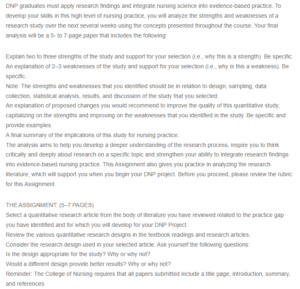
DNP graduates must apply research findings and integrate nursing science into evidence-based practice. To develop your skills in this high level of nursing practice, you will analyze the strengths and weaknesses of a research study over the next several weeks using the concepts presented throughout the course. Your final analysis will be a 5- to 7-page paper that includes the following:
Article Critique – Fall Prevention in Hospitals
Explain two to three strengths of the study and support for your selection (i.e., why this is a strength). Be specific.
An explanation of 2–3 weaknesses of the study and support for your selection (i.e., why is this a weakness). Be specific.
Note: The strengths and weaknesses that you identified should be in relation to design, sampling, data collection, statistical analysis, results, and discussion of the study that you selected.
An explanation of proposed changes you would recommend to improve the quality of this quantitative study, capitalizing on the strengths and improving on the weaknesses that you identified in the study. Be specific and provide examples.
A final summary of the implications of this study for nursing practice.
The analysis aims to help you develop a deeper understanding of the research process, inspire you to think critically and deeply about research on a specific topic and strengthen your ability to integrate research findings into evidence-based nursing practice. This Assignment also gives you practice in analyzing the research literature, which will support you when you begin your DNP project. Before you proceed, please review the rubric for this Assignment.
THE ASSIGNMENT: (5–7 PAGES)
Select a quantitative research article from the body of literature you have reviewed related to the practice gap you have identified and for which you will develop for your DNP Project.
Review the various quantitative research designs in the textbook readings and research articles.
Consider the research design used in your selected article. Ask yourself the following questions:
Is the design appropriate for the study? Why or why not?
Would a different design provide better results? Why or why not?
Reminder: The College of Nursing requires that all papers submitted include a title page, introduction, summary, and references
 Complete the order form and upload all of your files, including any instructions, rubrics, or other materials provided by your instructor.
 Complete the order payment after filling in the order form. We’ll receive your order and assign it to a writer.
 The assigned writer will complete your paper and forward it to our Editing Team for review and approval.
 Once approved by the editor, the completed paper will be uploaded to your account for you to download, review and approve.