
Workplace Environment Assessment
Organizational success is dependent on employee motivation and satisfaction with their work environment. Every organization hopes that its employees have a conducive and productive environment. The Clark Healthy Workplace Inventory provides a framework for determining the health of a workplace. Through this tool, organizational managers can make adjustments to create environments that stimulate employees’ productivity.
Part 1: Work Environment Assessment
Assessment of the work environment revealed a score of 58, indicating that the work environment is barely healthy. The assessment findings revealed deep-seated issues within the organizational leadership and workforce that created a conceptual divergence in the operationalization framework. As revealed by the assessment tool, the lack of trust between organizational leaders and other staff seems to be weighing down the organization. Lack of transparency in communication was another finding that unfavoured the workplace’s health. It diminishes team spirit and employees’ accountability in their roles. Lack of employee appreciation, unreasonable and unfair workload distribution among employees, and the inability to attract and retain the best employees were other undoings of the organization that resulted in poor assessment scores.
The low score on employee appreciation came as a surprise to me. While I expected the organization to lay down measures to show appreciation to their employees, this was the case in the organization, as it did not prioritize staff motivation. The organization’s ability to ensure that its members shared their vision and mission also surprised me, as the organization showed little effort in engaging members in decision-making processes. An idea that I had and was confirmed by the assessment was the organization’s commitment to profitability. The organization preferentially invested in employee development while neglecting its work environment.
The assessment results suggest that the workplace is barely healthy. These findings point to specific strains within the organizational framework of operationalization that may hinder its effectiveness. Such may include strained leader-employee relationships, employee demotivation towards work, and a lack of collectivism and inspiration among the employees. In such an environment, organizational productivity may be low, and the organization may run at a loss.
Part 2: Reviewing the Literature
Literature findings affirm the significance of organizational work environment to organizational success. Broome & Marshall (2020) postulate that a conducive work environment optimizes employees’ input toward organizational performance and enhances their commitment to the organization’s goals. This highlights the need for leadership to invest in their employees’ environments. Vidman & Strömberg (2020) add that poor workplace management affects the employees’ motivation towards meeting the organizational goals. This casts the burden on leadership to put all interactive parameters within an organization in their rightful places to encourage a collectivistic approach to organizational operationalization.
The assessment findings are an affirmation of the theoretical presentation of the impact of the work environment on organizational performance and success. Theoretical perspectives envision a successful organization as one that creates a positive work environment that fosters healthier relationships between organizational leadership and the workforce. The assessment findings reveal a disconnect between the practices envisioned by these theories and the practice within the workplace scrutinized. Findings unearth vices such as a lack of trust and transparency in communication that may not only diminish employees’ motivation towards meeting the organizational goals but also create a divergence within the organization that limits its success.
The pursuit of optimizing organizational success implores organizational leadership to use best practices to create a conducive work environment. In this case, the organization should focus on perfecting its leadership and enhancing its operational efficiencies. Through effective and firm leadership, this organization can adequately address issues such as lack of transparency in communication, lack of trust among leaders, workforce division among employees, and employee appreciation. This stems from the belief that employees are central to organizational success, as Vidman & Strömberg (2020) affirmed. This organization will improve its workplace environment and create stronger work teams by instilling effective and good leadership.
Part 3: Evidence-Based Strategies to Create High-Performance Interprofessional Teams
Lack of trust and transparency in communication are some of the vices unearthed by the assessment findings. Trust building is integral to organizational success. Kähkönen et al. (2021) assert that the pursuit of building long-lasting trust within workplaces requires organizational leadership to communicate effectively with its employees, honor their commitments to them, maintain honesty in their engagements, and admit whenever they are wrong. These measures help establish a ground of commonality between organizational leaders and their subjects and preserve their commitment to the organization. This strategy can be used to mend the apparent trust issues within the organization and contribute to its poor assessment scores.
Transparent communication is also vital for a healthy leader-employee relationship. According to Nadkarni et al. (2021), transparent communication creates a good reputation among organizational workers. Maintaining consistency, establishing a direct channel of communication between organizational leadership and employees, and respecting employees’ privacy may foster transparent communication. The organization under scrutiny can utilize these strategies to improve its assessment scores.
The organization was found to be able to ensure that members live by a shared vision and mission based on respect, trust, and collegiality. Conformity to the organizational vision and mission is key to organizational success. Alvarado-Alvarez et al. (2021) report that communicating the organizational vision and mission to the members enhances their conformity to the vision and may improve their commitment to the vision and mission of the organization. The organization can use this strategy under scrutiny to bolster this practice within the organization. Another strategy that this organization can use to create and maintain a shared vision and mission is imploring organizational leadership to educate employees on the significance of the vision to the employees. Alvarado-Alvarez et al. (2021) report that sharing the organization’s vision and explaining its significance can help organizational employees achieve long-term aspirations that are beneficial to the organization. Through these strategies, the organization will be able to improve its assessment scores.
References
Alvarado-Alvarez, C., Armadans, I., Parada, M. J., & Anguera, M. T. (2021). Unraveling the role of Shared Vision and trust in constructive conflict management of family firms. An empirical study from a mixed methods approach. Frontiers in Psychology, 12. https://doi.org/10.3389/fpsyg.2021.629730
Broome, M. E., & Marshall, E. S. (2020). Transformational leadership in nursing: From expert clinician to influential leader. Springer Publishing Company.
Kähkönen, T., Blomqvist, K., Gillespie, N., & Vanhala, M. (2021). Employee Trust Repair: A systematic review of 20 years of empirical research and future research directions. Journal of Business Research, 130, 98–109. https://doi.org/10.1016/j.jbusres.2021.03.019
Nadkarni, A., Levy-Carrick, N. C., Kroll, D. S., Gitlin, D., & Silbersweig, D. (2021). Communication and transparency as a means to strengthen workplace culture during COVID-19. NAM Perspectives. https://doi.org/10.31478/202103a
Vidman, Å., & Strömberg, A. (2020). Leadership for a healthy work environment – a question about who, what, and how. Leadership in Health Services, 34(1), 1–15. https://doi.org/10.1108/lhs-06-2020-0041
ORDER A PLAGIARISM-FREE PAPER HERE
We’ll write everything from scratch
Question 
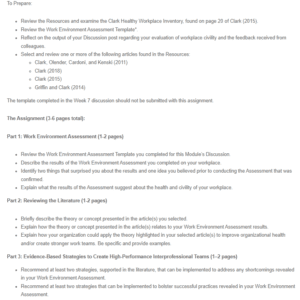
Workplace Environment Assessment
To Prepare:
- Review the Resources and examine the Clark Healthy Workplace Inventory, found on page 20 of Clark (2015).
- Review the Work Environment Assessment Template*.
- Reflect on the output of your Discussion post regarding your evaluation of workplace civility and the feedback received from colleagues.
- Select and review one or more of the following articles found in the Resources:
- Clark, Olender, Cardoni, and Kenski (2011)
- Clark (2018)
- Clark (2015)
- Griffin and Clark (2014)
The template completed in the Week 7 discussion should not be submitted with this assignment.
The Assignment (3-6 pages total):
Part 1: Work Environment Assessment (1-2 pages)
- Review the Work Environment Assessment Template you completed for this Module’s Discussion.
- Describe the results of the Work Environment Assessment you completed on your workplace.
- Identify two things that surprised you about the results and one idea you believed prior to conducting the Assessment that was confirmed.
- Explain what the results of the Assessment suggest about the health and civility of your workplace.
Part 2: Reviewing the Literature (1-2 pages)
- Briefly describe the theory or concept presented in the article(s) you selected.
- Explain how the theory or concept presented in the article(s) relates to your Work Environment Assessment results.
- Explain how your organization could apply the theory highlighted in your selected article(s) to improve organizational health and/or create stronger work teams. Be specific and provide examples.
Part 3: Evidence-Based Strategies to Create High-Performance Interprofessional Teams (1–2 pages)
- Recommend at least two strategies, supported in the literature, that can be implemented to address any shortcomings revealed in your Work Environment Assessment.
- Recommend at least two strategies that can be implemented to bolster successful practices revealed in your Work Environment Assessment.
 Complete the order form and upload all of your files, including any instructions, rubrics, or other materials provided by your instructor.
 Complete the order payment after filling in the order form. We’ll receive your order and assign it to a writer.
 The assigned writer will complete your paper and forward it to our Editing Team for review and approval.
 Once approved by the editor, the completed paper will be uploaded to your account for you to download, review and approve.