
Case Study – 46-year-old Female with a Family History of Breast Cancer
The patient is a 46-year-old female with a family history of breast cancer. She weighs 230 lbs and has been compliant with her yearly mammograms. Also, the patient has a medical history of hypertension. She has been experiencing night sweats, genitourinary symptoms, and hot flushing for the past month. She underwent a pap smear five years ago that was positive for ASCUS. Her current medicatiomns include hydrochlorothiazide 25mg OD and novarsc 10 mg OD. The patient’s current blood pressure is 150/90 mmHg. Her monthly cycles are regular; she had her last monthly period one month ago.
The Patient’s Health Needs
Menopause mostly begins at 45 years old and even earlier for some women. Night sweats, hot flashes, and genitourinary systems are some symptoms and signs of menopause (Peacock & Ketvertis, 2022). The patient is a 46-year-old female experiencing signs and symptoms of menopause; therefore, she is assessed for menopause. Menopause is defined by the presence of amenorrhoea for 12 months. The patient had her last monthly period a month ago; therefore, menopause is not a primary diagnosis. The perimenopause symptoms should be managed. The average weight of a 46-year-old woman is 176 lbs; therefore, the patient is overweight at 230 lbs. Weight gain is a clinical manifestation of menopause. The patient’s health needs, therefore, include weight loss. The patient is known to be hypertensive with a blood pressure of 150/90. The blood pressure readings signify stage 2 hypertension (Iqbal & Jamal, 2022). Therefore, the patient’s health care needs include adequate hypertension management.
Treatment Regimen
Although the patient’s current medications include antihypertensives, her blood pressure shows stage 2 hypertension. It is crucial to ensure the patient is compliant with her antihypertensives. In case of compliance, the patient’s dose for hydrochlorothiazide and amlodipine is increased. Alternatively, the frequency is increased from OD to BD. Hormonal estrogen therapy is recommended if the perimenopause symptoms are not well managed through non-pharmacological interventions.
Patient Education
The patient should be educated on non-pharmacological interventions for weight loss, such as exercise and dietary adjustment. Also, she should be educated on perimenopause and menopause. It is crucial to highlight expected challenges from menopause, such as osteoporosis, and how to prevent them (Keen & Reddivari, 2022). The patient is educated on menopause and breast cancer to highlight that with her family history, she needs to continue being compliant with her annual mammogram (Peacock & Ketvertis, 2022).
References
Iqbal, A. M., & Jamal, S. F. (2022). Essential Hypertension. StatPearls https://www.ncbi.nlm.nih.gov/books/NBK539859/.
Keen, M. U., & Reddivari, A. K. R. (2022). Osteoporosis in Females. StatPearls. https://www.ncbi.nlm.nih.gov/books/NBK559156/.
Peacock, K., & Ketvertis, K. M. (2022). Menopause. StatPearls. https://www.ncbi.nlm.nih.gov/books/NBK507826/.
ORDER A PLAGIARISM-FREE PAPER HERE
We’ll write everything from scratch
Question 
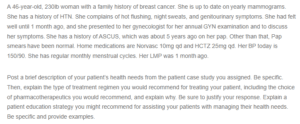
A 46-year-old, 230lb woman with a family history of breast cancer. She is up to date on yearly mammograms. She has a history of HTN. She complains of hot flushing, night sweats, and genitourinary symptoms. She had felt well until 1 month ago, and she presented to her gynecologist for her annual GYN examination and to discuss her symptoms. She has a history of ASCUS, which was about 5 years ago on her pap. Other than that, Pap smears have been normal. Home medications are Norvasc 10mg qd and HCTZ 25mg qd. Her BP today is 150/90. She has regular monthly menstrual cycles. Her LMP was 1 month ago.
Case Study – 46-year-old Female with a Family History of Breast Cancer
Post a brief description of your patient’s health needs from the patient case study you assigned. Be specific. Then, explain the type of treatment regimen you would recommend for treating your patient, including the choice of pharmacotherapeutics you would recommend, and explain why. Be sure to justify your response. Explain a patient education strategy you might recommend for assisting your patients with managing their health needs. Be specific and provide examples.
 Complete the order form and upload all of your files, including any instructions, rubrics, or other materials provided by your instructor.
 Complete the order payment after filling in the order form. We’ll receive your order and assign it to a writer.
 The assigned writer will complete your paper and forward it to our Editing Team for review and approval.
 Once approved by the editor, the completed paper will be uploaded to your account for you to download, review and approve.