
Role and Engagement of Stakeholders Summary
Stakeholders and their Roles
Stakeholders directly involved in the capstone project implementation include nurse practitioners, physicians, pharmacists, patients, and their family members. These stakeholders are supportive of my capstone project. Each stakeholder will play a unique role in promoting my project’s success. Physicians will be key in selecting evidence-based drugs used in venous thromboembolism prophylaxis and risk stratification. Nurses will play a key role in safely administering medication and risk stratification. Pharmacists will promote the rational use of medications used in venous thromboembolism prophylaxis. Physicians and nurses will be involved in patient monitoring to determine the effectiveness of the intervention. Laboratory technicians will play a key role in performing tests such as ultrasound screening to determine the risk of deep venous thrombosis (DVT). Members of the interdisciplinary team will collaborate with patients and their families to obtain their buy-in into the capstone project.
Stakeholders Interested in the Results
Stakeholders interested in the project’s results include the leadership of the healthcare facility, insurers, and the community. The administration of the healthcare facility is concerned about the outcomes because they impact the quality of healthcare services. Quality healthcare creates a good reputation for the healthcare facility. By so doing, it gains a positive competitive advantage over other health facilities. Insurers are concerned about the outcomes because they emphasize value-based healthcare. In this scenario, positive outcomes will be demonstrated by a reduction in the cases of DVT due to adequate thromboprophylaxis. Community members are interested in the outcomes because they impact the quality of healthcare services offered in the healthcare facility. For instance, positive outcomes will improve the community’s satisfaction levels and increase their likelihood of visiting the healthcare facility.
Promoting Stakeholder Participation
Various techniques can be used to promote stakeholder participation. Firstly, open communication will ensure that all stakeholders receive background information about the capstone project (Dagne & Beshah, 2021). Background information communicates the goals, objectives, and timelines of the project. It enables stakeholders to understand the project’s benefits, increasing the likelihood of stakeholder participation. Secondly, compromise will ensure that the concerns of all stakeholders are acknowledged and respected (Dagne & Beshah, 2021). Compromising increases the likelihood of buy-in because all stakeholders participate in modifying the capstone project.
Possible Concerns/Barriers from Stakeholders
Various factors may impede the implementation of the capstone project. Lack of adequate knowledge and skills is the first barrier. Stakeholders may not be aware of the best medication or screening technique used in VTE prophylaxis. This can be mitigated by training and education. The other barrier is a demoralized team. Demoralization may be caused by limited human and financial resources or an individualistic organizational culture (Anggraeni et al., 2019). A demoralized team does not collaborate effectively toward the success of the capstone project.
Strategies to Gain Support and Assistance from Stakeholders
As stated earlier, Dagne and Beshah (2021) report that open communication will ensure that all stakeholders receive background information about the capstone project’s goals, objectives, benefits, and timelines. Also, all stakeholders will be informed about their unique role in the project’s success. By doing so, stakeholders will understand the project’s benefit, increasing the likelihood of participation. Secondly, regular training and education will improve stakeholders’ skills and knowledge base (Tembo et al., 2021). A competent workforce will work in concert to promote the project’s success. Thirdly, reward systems will be used to motivate the best-performing teams.
References
Anggraeni, M., Gupta, J., & Verrest, H. J. L. M. (2019). Cost and value of stakeholders participation: A systematic literature review. Environmental Science and Policy, 101(October 2018), 364–373. https://doi.org/10.1016/j.envsci.2019.07.012
Dagne, A. H., & Beshah, M. H. (2021). Implementation of evidence-based practice: The experience of nurses and midwives. PLoS ONE, 16(8 August), 1–12. https://doi.org/10.1371/journal.pone.0256600
Tembo, D., Hickey, G., Montenegro, C., Chandler, D., Nelson, E., Porter, K., Dikomitis, L., Chambers, M., Chimbari, M., Mumba, N., Beresford, P., Ekiikina, P. O., Musesengwa, R., Staniszewska, S., Coldham, T., & Rennard, U. (2021). Effective engagement and involvement with community stakeholders in the co-production of global health research. The BMJ, 372, 1–6. https://doi.org/10.1136/bmj.n178
ORDER A PLAGIARISM-FREE PAPER HERE
We’ll write everything from scratch
Question 
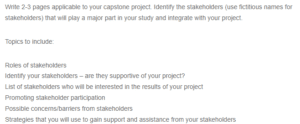
Write 2-3 pages applicable to your capstone project. Identify the stakeholders (use fictitious names for stakeholders) that will play a major part in your study and integrate with your project.
Role and Engagement of Stakeholders Summary
Topics to include:
Roles of stakeholders
Identify your stakeholders – are they supportive of your project?
List of stakeholders who will be interested in the results of your project
Promoting stakeholder participation
Possible concerns/barriers from stakeholders
Strategies that you will use to gain support and assistance from your stakeholders
Expectations
Length: 2-3 pages
Format: APA 6th ed.
Research: At least one peer-reviewed reference within the last 5 years
See the NUR Writing Assignment Rubric for additional details and point weighting. ( I attached this from the previous)
 Complete the order form and upload all of your files, including any instructions, rubrics, or other materials provided by your instructor.
  Complete the order payment after filling in the order form. We’ll receive your order and assign it to a writer.
 The assigned writer will complete your paper and forward it to our Editing Team for review and approval.
 Once approved by the editor, the completed paper will be uploaded to your account for you to download, review and approve.