
Annotated Bibliography – Diabetes in Elderly Patients
AL-Musawe, L., Martins, A. P., Raposo, J. F., & Torre, C. (2019). The association between polypharmacy and adverse health consequences in elderly type 2 diabetes mellitus patients; a systematic review and meta-analysis. Diabetes Research and Clinical Practice, 155, 107804. https://doi.org/10.1016/J.DIABRES.2019.107804
This article reviews the literature on the link between polypharmacy and adverse health outcomes in elderly patients with type 2 diabetes mellitus. Polypharmacy is a highly prevalent issue among elderly patients due to having multiple chronic conditions, including hypertension, dyslipidemia, coronary heart disease, and chronic kidney disease. Elderly patients with diabetes use more than nine different types of medications in a day. Polypharmacy is, therefore, a risk for high mortality rates, complications, and hospitalizations. The article is authoritative and credible as experts in the pharmacy field have authored it, and it has been published in a peer-reviewed journal. The information was essential in understanding the risks associated with diabetes treatment in elderly patients.
Borba, A. K. de O. T., Arruda, I. K. G., Marques, A. P. de O., Leal, M. C. C., & Diniz, A. da S. (2019). Knowledge and attitude about diabetes self-care of older adults in primary health care. Ciência & Saúde Coletiva, 24(1), 125–136. https://doi.org/10.1590/1413-81232018241.35052016
This article provides a number of interdisciplinary educational actions that can be utilized to promote positive attitudes toward self-care among elderly patients with diabetes. Poor education, knowledge, and living alone for elderly patients with diabetes are the reasons for their negative attitudes toward self-care. The interdisciplinary educational actions to improve self-care include focusing on the socioeconomic, psycho-emotional, and educational aspects of elderly patients. These educational actions are aimed at achieving and maintaining elderly autonomy and functionality. The article is authoritative, current, and relevant to my topic. The article is informative and creates a wider perspective on improving self-care for diabetes patients.
Rodriguez-Mañas, L., Laosa, O., Vellas, B., Paolisso, G., Topinkova, E., Oliva-Moreno, J., Bourdel-Marchasson, I., Izquierdo, M., Hood, K., Zeyfang, A., Gambassi, G., Petrovic, M., Hardman, T. C., Kelson, M. J., Bautmans, I., Abellan, G., Barbieri, M., Peña-Longobardo, L. M., Regueme, S. C., … Sinclair, A. J. (2019). Effectiveness of a multimodal intervention in functionally impaired older people with type 2 diabetes mellitus. Journal of Cachexia, Sarcopenia and Muscle, 10(4), 721–733. https://doi.org/10.1002/JCSM.12432
The article evaluates the effectiveness of a multimodal intervention in older people living with type 2 diabetes mellitus with functional impairment. The articles effectively demonstrate how a structured multimodal intervention program applied in various clinical settings across different European countries significantly improved relevant clinical and cost improvements associated with the functional status of older frail and pre-frail patients with type 2 diabetes mellitus. The article provides a 12-month implementation period for the intervention. This article is credible, current, and authoritative. The article is very informative and insightful regarding maintaining the physical health of elderly patients with diabetes.
References
AL-Musawe, L., Martins, A. P., Raposo, J. F., & Torre, C. (2019). The association between polypharmacy and adverse health consequences in elderly type 2 diabetes mellitus patients; a systematic review and meta-analysis. Diabetes Research and Clinical Practice, 155, 107804. https://doi.org/10.1016/J.DIABRES.2019.107804
Borba, A. K. de O. T., Arruda, I. K. G., Marques, A. P. de O., Leal, M. C. C., & Diniz, A. da S. (2019). Knowledge and attitude about diabetes self-care of older adults in primary health care. Ciência & Saúde Coletiva, 24(1), 125–136. https://doi.org/10.1590/1413-81232018241.35052016
Rodriguez-Mañas, L., Laosa, O., Vellas, B., Paolisso, G., Topinkova, E., Oliva-Moreno, J., Bourdel-Marchasson, I., Izquierdo, M., Hood, K., Zeyfang, A., Gambassi, G., Petrovic, M., Hardman, T. C., Kelson, M. J., Bautmans, I., Abellan, G., Barbieri, M., Peña-Longobardo, L. M., Regueme, S. C., … Sinclair, A. J. (2019). Effectiveness of a multimodal intervention in functionally impaired older people with type 2 diabetes mellitus. Journal of Cachexia, Sarcopenia and Muscle, 10(4), 721–733. https://doi.org/10.1002/JCSM.12432
ORDER A PLAGIARISM-FREE PAPER HERE
We’ll write everything from scratch
Question 
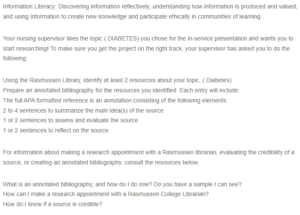
Information Literacy: Discovering information reflectively, understanding how information is produced and valued, and using information to create new knowledge and participate ethically in communities of learning.
Annotated Bibliography – Diabetes in Elderly Patients
Your nursing supervisor likes the topic ( DIABETES) you chose for the in-service presentation and wants you to start researching! To make sure you get the project on the right track, your supervisor has asked you to do the following:
Using the Rasmussen Library, identify at least 2 resources about your topic. ( Diabetes)
Prepare an annotated bibliography for the resources you identified. Each entry will include:
The full APA formatted reference is an annotation consisting of the following elements:
2 to 4 sentences to summarize the main idea(s) of the source
1 or 2 sentences to assess and evaluate the source
1 or 2 sentences to reflect on the source
For information about making a research appointment with a Rasmussen librarian, evaluating the credibility of a source, or creating an annotated bibliography, consult the resources below.
What is an annotated bibliography, and how do I do one? Do you have a sample I can see?
How can I make a research appointment with a Rasmussen College Librarian?
How do I know if a source is credible?
 Complete the order form and upload all of your files, including any instructions, rubrics, or other materials provided by your instructor.
 Complete the order payment after filling in the order form. We’ll receive your order and assign it to a writer.
 The assigned writer will complete your paper and forward it to our Editing Team for review and approval.
 Once approved by the editor, the completed paper will be uploaded to your account for you to download, review and approve.