
The Use of Clinical Systems to Improve Outcomes and Efficiencies
Healthcare technologies continue to redefine care operationalizations. As modern healthcare shifts towards value-based approaches, these technologies maintain significance in improving the effectiveness and efficiency of healthcare provisions. The use of clinical systems is an area of health information technology that has gained significant recognition in global healthcare operationalizations. Clinical systems such as electronic health records (EHR), clinical decision support (CDS), and remote patient monitoring have found considerable use across global healthcare systems. EHR provides a systematic way of collecting patient and population health data electronically. These automated systems eliminate paperwork that traditionally characterized data transmission within care systems. This paper annotates four resources on EHR, detailing lessons learned from their implementation and their effectiveness in improving clinical outcomes.
Annotated Bibliographies
Afrizal, S. H., Hidayanto, A. N., Handayani, P. W., Budiharsana, M., & Eryando, T. (2019). Narrative review for exploring barriers to the readiness of electronic health record implementation in primary health care. Healthcare Informatics Research, 25(3), 141. https://doi.org/10.4258/hir.2019.25.3.141.
This review article explores factors that impede readiness for EHR implementation in primary healthcare facilities. Organizational barriers such as poor care coordination, poor organizational management, and inadequate or lack of skilled manpower to operate these systems impede organizational readiness for implementing EHR. They were also implicated in the poor utilization of these systems in various healthcare systems across the globe. Unfamiliarity with these systems was also found to impede the utilization and implementation of EHR in developed countries. This study summarizes lessons learned from EHR implementation and utilization. It details factors observed to lower the implementation and utilization of electronic health records systems in various healthcare organizations. The author postulates that addressing these factors will enhance healthcare organizational readiness for these systems and the effectiveness of their use. Findings from this study inform specific areas that require improvement for the full benefits of EHR use to be realized.
Schopf, T. R., Nedrebø, B., Hufthammer, K. O., Daphu, I. K., & Lærum, H. (2019). How well does the electronic health record support the clinical tasks of hospital physicians? A survey of physicians at three Norwegian hospitals. BMC Health Services Research, 19(1). https://doi.org/10.1186/s12913-019-4763-0.
This paper investigates the effectiveness of EHR systems in supporting physicians in executing their routine duties. EHRs maintain effectiveness in supporting physicians in executing their roles in health care. Through these systems, their communication processes with other caregivers are enhanced. Additionally, clinical support integrated into these systems guides their decision-making processes. Its effectiveness notwithstanding, the utilization of this technology sometimes presents profound difficulties. Interruptions or delays accustomed to system crashes are sometimes apparent, and its use may be cumbersome where the workload is high. This highlights the need to improve EHR aspects, such as clinical workflow support. This study details the effectiveness of EHR use and the lessons learned from its implementation. It showcases the caregiver’s perspective on EHR use, emphasizing specific areas that present difficulties when using this system. It informs areas for improvement to further enhance the effectiveness of this system in improving outcomes.
Upadhyay, S., & Hu, H.-fen. (2022). A qualitative analysis of the impact of electronic health records (EHR) on Healthcare Quality and safety: Clinicians’ lived experiences. Health Services Insights, 15, 117863292110707. https://doi.org/10.1177/11786329211070722.
This article assesses the role of electronic health records in improving the safety and quality of care by exploring clinicians’ experiences. Clinicians have mixed feelings about the effectiveness of EHR in improving safety and quality of care. While some opine on its effectiveness, citing its success in facilitating the flow of information and healthcare communications, others lament its interoperability challenges. EHR maintains effectiveness in improving data accessibility throughout its transmission. By automating data collection and transmission processes, healthcare providers at different points of the healthcare provision process can have access to this data. Additionally, automation and electronic transmission minimize data losses and security breaches that characterize paper-pen transmission of health data. It also provides a framework for lessening medication errors. Due to its limited system integration, interoperability remains a challenge with EHR use. Findings from this resource affirm the effectiveness of EHR in improving clinical outcomes. It can inform healthcare organizations of the need to implement these systems as a quality improvement and safety enhancement measure. It, however, casts doubts on its interoperability. This highlights the need to redesign the system and improve its implementation processes.
Uslu, A., & Stausberg, J. (2021). Value of the electronic medical record for hospital care: Update from the literature. Journal of Medical Internet Research, 23(12). https://doi.org/10.2196/26323.
This review article investigates the value of using EHR for hospital care. EHR implementation and utilization confer care organizations considerable economic advantage as they enhance the efficiency of care delivery and improve the quality of care. By enhancing care efficiency, these systems lower healthcare administration costs that otherwise drive the overall cost of healthcare up. Additionally, these systems improve the quality of care by eliminating mistakes during care administration that jeopardize the safety of patients. This resource details how EHR enhances the efficiency of care provision and improves clinical outcomes. These systems are, therefore, valuable in value-based care that emphasizes quality but cost-effective care. Findings from this resource can inform the need to implement these systems across healthcare systems. As care approaches tend towards value-based and patient-centered care, EHR plays a role in ensuring care is provided that conforms to the prescribed standards of efficiency and quality. This further reinforces its significance in modern healthcare.
Conclusion
The resources annotated detail various aspects of EHR use. These include lessons learned from their implementation and their effectiveness in improving clinical outcomes. Implementation of EHR across healthcare systems across the globe has elicited ambivalent assessments from patients and caregivers. Upadhyay & Hu (2022) note that while some caregivers laud the effectiveness of EHR in enhancing clinical communications and information flow, others lament specific challenges associated with its use. The use of HER remains cumbersome where the workload is high and has met specific barriers that impede its use. Lack of knowledge on its use, poor organizational leadership, and others have lowered its adoption in some healthcare settings (Afrizal et al., 2019). These lessons continue to inform improvement areas. Schopf et al. (2019) report a growing need to redesign EHR to allow interoperability. Additionally, improving the operationalization of these systems to prevent system crashes and downtime that increases the time for treatment may further enhance the effectiveness of these systems.
There is a consensus on the effectiveness of EHR in improving clinical outcomes and the efficiency of care processes. Uslu & Stausberg (2021) assert that the implementation of EHR considerably improved the quality of care provided by healthcare organizations. These systems automated the flow of information and minimized safety concerns such as medication errors that characterized the paper pen transmission of health information. Additionally, these systems enhanced the efficiency of healthcare provision by facilitating healthcare communication and the flow of health data. These systems also offer valuable aid to physicians. Schopf et al. (2019) report that integrated clinical support into these systems guides clinicians’ decision-making processes and minimizes errors associated with selecting inappropriate therapeutic modalities. This underpins their necessity in healthcare.
Findings from these resources maintain significance in informing aspects of EHR. These findings affirm the use of EHR across care organizations. They also propose specific interventions to enhance the effectiveness of EHR. As healthcare systems shift towards value-based approaches, these findings can inform improvement areas that may enhance the effectiveness of using this technology.
References
Afrizal, S. H., Hidayanto, A. N., Handayani, P. W., Budiharsana, M., & Eryando, T. (2019). Narrative review for exploring barriers to the readiness of electronic health record implementation in primary health care. Healthcare Informatics Research, 25(3), 141. https://doi.org/10.4258/hir.2019.25.3.141
Schopf, T. R., Nedrebø, B., Hufthammer, K. O., Daphu, I. K., & Lærum, H. (2019). How well does the electronic health record support the clinical tasks of hospital physicians? A survey of physicians at three Norwegian hospitals. BMC Health Services Research, 19(1). https://doi.org/10.1186/s12913-019-4763-0
Upadhyay, S., & Hu, H.-fen. (2022). A qualitative analysis of the impact of electronic health records (EHR) on Healthcare Quality and safety: Clinicians’ lived experiences. Health Services Insights, 15, 117863292110707. https://doi.org/10.1177/11786329211070722
Uslu, A., & Stausberg, J. (2021). Value of the electronic medical record for hospital care: Update from the literature. Journal of Medical Internet Research, 23(12). https://doi.org/10.2196/26323
ORDER A PLAGIARISM-FREE PAPER HERE
We’ll write everything from scratch
Question 
The Use of Clinical Systems to Improve Outcomes and Efficienciess
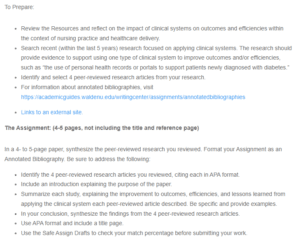
To Prepare:
- Review the Resources and reflect on the impact of clinical systems on outcomes and efficiencies within the context of nursing practice and healthcare delivery.
- Search recent (within the last 5 years) research focused on applying clinical systems. The research should provide evidence to support using one type of clinical system to improve outcomes and/or efficiencies, such as “the use of personal health records or portals to support patients newly diagnosed with diabetes.”
- Identify and select 4 peer-reviewed research articles from your research.
- For information about annotated bibliographies, visit https://academicguides.waldenu.edu/writingcenter/assignments/annotatedbibliographies
The Assignment: (4-5 pages, not including the title and reference page)
In a 4- to 5-page paper, synthesize the peer-reviewed research you reviewed. Format your Assignment as an Annotated Bibliography. Be sure to address the following:
- Identify the 4 peer-reviewed research articles you reviewed, citing each in APA format.
- Include an introduction explaining the purpose of the paper.
- Summarize each study, explaining the improvement to outcomes, efficiencies, and lessons learned from applying the clinical system each peer-reviewed article described. Be specific and provide examples.
- In your conclusion, synthesize the findings from the 4 peer-reviewed research articles.
- Use APA format and include a title page.
- Use the Safe Assign Drafts to check your match percentage before submitting your work.
 Complete the order form and upload all of your files, including any instructions, rubrics, or other materials provided by your instructor.
 Complete the order payment after filling in the order form. We’ll receive your order and assign it to a writer.
 The assigned writer will complete your paper and forward it to our Editing Team for review and approval.
 Once approved by the editor, the completed paper will be uploaded to your account for you to download, review and approve.