
The No Surprise Act
Health coverage increases access to quality healthcare services by reducing out-of-pocket expenditure. However, insured patients are likely to incur extra costs when they seek healthcare from out-of-network facilities and providers. This paper discusses the No Surprise Act of 2022 and describes how it impacts various stakeholders.
Defining the No Surprises Act (NSA) of 2022
Hoadley and Lucia (2020) report that the NSA is a federal policy that safeguards against unexpected medical expenditures. Unexpected medical expenditures occur when insured individuals inadvertently seek healthcare from physicians they did not select an out-of-network (OON) healthcare facility (Hoadley & Lucia, 2020). The prevalence of unexpected medical expenditures is about one in every five trips to the emergency department (Pollitz, 2021). Also, Pollitz (2021) indicates that unexpected medical expenditures occur in about nine to sixteen per cent of insured patients seeking care from in-network healthcare facilities. This is attributed to the presence of out-of-network specialists in these facilities. To address this, the NSA proposes various approaches. Firstly, all disputes regarding out-of-network remunerations will be resolved independently (CMS.gov, 2022). Secondly, it provides a framework for appealing undesirable plans. Thirdly, it requires accurate and honest billing for insured and uninsured who inadvertently seek healthcare services (CMS.gov, 2022).
Stakeholders Impacted by the No Surprise Act of 2022
The NSA impacts various stakeholders. The first group consists of consumers. Accordingly, consumers consist of insured patients seeking care from different healthcare facilities. The NSA applies to consumers with employer-provided and individual health coverage (CMS.gov, 2022). The second group consists of insurers. Insurers provide coverage to eligible consumers. In addition, they work in concert with providers, physicians, and healthcare facilities to ensure accurate billing. Insurers provide reimbursements to providers and healthcare facilities. Further, the third group comprises providers and healthcare facilities. Notably, providers consist of physicians and other stakeholders involved in patient care. Pollitz (2021) indicates that facilities and providers that consumers have chosen are described as “in-network,” whereas those that have not been selected are termed “out-of-network”.
The Financial Impact of the No Surprise Act of 2022
The NSA financially impacts the consumer, insurers, providers, and healthcare facilities. Regarding consumers, the NSA will lower treatment costs for insured patients by averting the incidence and prevalence of unexpected medical expenditures. AHIP.org (2022) reports that the NSA averted approximately two million cases of unexpected medical expenditures within the first two months of its enactment. AHIP.org (2022) also projected that approximately twelve million incidences of unexpected medical expenditures will be averted in 2022. Regarding insurers, the NSA will optimize the billing process for patients receiving out-of-network services. This will eliminate the likelihood of billing fraud and reduce extra costs incurred on billing fraud. For instance, the NSA prohibits billing practices that charge patients more than in-network costs. Providers who contravene this provision will be penalized about $10,000 per violation (Pollitz, 2021). Furthermore, insurers will benefit from the dispute resolution procedure that addresses out-of-network stakeholders’ payments (Pollitz, 2021). Regarding providers and healthcare facilities, they risk penalization for violating the NSA. In some scenarios, they will be forced to wait for the outcome of the independent dispute resolution (IDR) procedure to get their remunerations (CMS.gov, 2022).
The Benefits of the No Surprise Act of 2022
The NSA will benefit consumers, insurers, providers, and healthcare facilities. Firstly, consumers will be protected against unexpected medical expenditures (Hoadley & Lucia, 2020). Consequently, this will minimize costs incurred in the treatment process. Also, consumers will be allowed to appeal health plans and contact enforcement authorities to address billing fraud (Pollitz, 2021). Additionally, consumers will benefit from an elaborate compliant system to report unexpected medical expenditures. Secondly, insurers will benefit from a reduction in billing fraud. The IDR will enable insurers to settle billing disputes involving OON providers (Pollitz, 2021). Providers and healthcare facilities will benefit from the IDR process. The NSA guides providers on the procedure to be adopted when submitting complaints. Furthermore, some OON providers may seek consent waivers from consumers. In this context, the providers have flexibility in billing and are not restricted by in-network rates (CMS.gov, 2022).
Drawbacks of the No Surprise Act of 2022
The NSA presents various drawbacks to providers, healthcare facilities, consumers, and insurers. According to providers and healthcare facilities, the IDR gives predetermined outcomes and favours insurers (Pollitz, 2021). In this context, the IDR process is based on the rates provided by the in-network services and payments based on the provider’s qualifications. The NSA allows OON providers to seek consumer consent waivers (Pollitz, 2021). As such, patients seeking specialist help have limited options and are likely to consent to incur higher medical bills. Insurers may be required to increase reimbursements for OON providers that obtain consumer consent waivers.
Conclusion
The NSA will limit unexpected medical expenditures incurred by insured individuals who inadvertently seek healthcare from OON providers and facilities. By so doing, out-of-pocket expenditures will be reduced, and hence, treatment costs will be lower. The NSA will also standardize the billing process and benefit insurers by eliminating extra reimbursements to OON providers and facilities. Providers should have an in-depth understanding of the NSA to avoid the likelihood of penalization and litigation. Also, the state and the federal government should implement the NSA judiciously to benefit all stakeholders.
References
AHIP.org. (2022). New Study: No Surprises Act Prevented Over Two Million Potential Surprise Bills for Insured Americans. https://www.ahip.org/news/press-releases/new-study-no-surprises-act-prevented-over-two-million-potential-surprise-bills-for-insured-americans
CMS.gov. (2022). Overview of rules & fact sheets: Rules focused on specific protections and provisions. https://www.cms.gov/nosurprises/policies-and-resources/overview-of-rules-fact-sheets
Hoadley, J., & Lucia., K. (2022). The No Surprises Act: A Bipartisan Achievement to Protect Consumers from Unexpected Medical Bills. https://doi.org/10.1215/03616878-9417470
Pollitz, K. (2021). No Surprises Act Implementation: What to Expect in 2022. https://www.kff.org/health-reform/issue-brief/no-surprises-act-implementation-what-to-expect-in-2022/
ORDER A PLAGIARISM-FREE PAPER HERE
We’ll write everything from scratch
Question 
The No Surprise Act
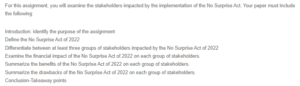
For this assignment, you will examine the stakeholders impacted by the implementation of the No Surprise Act. Your paper must include the following:
Introduction: identify the purpose of the assignment
Define the No Surprise Act of 2022
Differentiate between at least three groups of stakeholders impacted by the No Surprise Act of 2022
Examine the financial impact of the No Surprise Act of 2022 on each group of stakeholders.
Summarize the benefits of the No Surprise Act of 2022 on each group of stakeholders.
Summarize the drawbacks of the No Surprise Act of 2022 on each group of stakeholders.
Conclusion-Takeaway points
 Complete the order form and upload all of your files, including any instructions, rubrics, or other materials provided by your instructor.
 Complete the order payment after filling in the order form. We’ll receive your order and assign it to a writer.
 The assigned writer will complete your paper and forward it to our Editing Team for review and approval.
 Once approved by the editor, the completed paper will be uploaded to your account for you to download, review and approve.