
Scope of Practice and Patient’s Healthcare Accessibility
Nurse practitioners (NPs) are an important part of the health care delivery system. They help in providing both primary and acute care services. They also assist in disease diagnosis, medication prescription, administration, health promotion, provision of health education, counseling, and mental health services to patients and communities, as well as in treatment planning and managing acute to chronic diseases. However, the scope of practice of NP is varied across different states. Some states permit full authority, while others restrict the scope of practice. This paper aims to review the scope of practice required for nurse practitioners in California for NP licensure, barriers to practice within the state, how they contribute to healthcare disparities, and lastly, how improved access to nursing practitioners can impact healthcare disparities.
The Scope of Practice and NP Requirements in California
California is among the remaining states with a restrictive NP scope of practice. Although practicing in California as an NP practice may be restricted, the state allows registered nurses (RNs) to carry out nurse practitioner roles and practice as nursing practitioners by only completing the NP programs approved by the California Board of Nursing without the requirement for national certification (Montague, 2020). Nurse practitioners practicing within the state are required to have a written agreement with the physicians they practice with for them to be able to collaborate with the physicians in the delivery of healthcare services and making treatment decisions. Under current legislation and practice regulations, nurse practitioners have also been granted full prescription authority. They can make medication prescriptions, sign orders, dispense, and administer medication in collaboration with physicians (California Board of Registered Nursing, n.d.).
Although the current scope of practice for nurse practitioners is restricted authority, they can diagnose and treat acute, chronic, and complex diseases and attend to different types of patients. However, California Board of Nursing regulations require physician oversight for NPs to perform these nursing roles. They must also follow the standard procedure and set protocols to diagnose and treat patients. California’s legislature has compromised on the AB 890 legislation to expand the current scope of practice for NPs (Montague, 2020). Notably, this means that as of early 2023, nurse practitioners licensed to practice in California will be able to have full authority to practice independently. However, they must complete three years of practice within their care settings to achieve this independence of practice. To be licensed to practice in California, NPs must first be registered nurses in the state, have a master’s degree or higher in nursing or a related clinical discipline, finish a California state program given by the Board, and fulfill requirements set by a recognized school (California Board Registered Nursing, n.d.).
NP Practice Barriers and Access to Healthcare in California
The current restrictions on the scope of practice for NPs in California have negatively impacted healthcare access, costs, and the quality and safety of care. Restricting nurse practitioners from full practice authority denies them the opportunity to practice as per their training, denying the Californian healthcare system an essential element of the care delivery system, especially in emergency care. The current number of physicians does not meet the needs of Californians. For that reason, with the current shortage of healthcare staff, especially primary care providers, restricting the scope of practice for NPs translates to further insufficiency in the number of legally permitted healthcare providers in the primary and acute care settings across California. This limits the ability of healthcare providers and health systems to provide effective and safe healthcare services to private health (Drennan & Ross, 2019). A limited number of providers also contributed to an increase in the costs of care. Only a few people can access healthcare services, such as those in the emergency department (Montague, 2020). This also leads to limited accessibility of care services and providers, further contributing to healthcare disparities in California.
The Impact of Access to NPs on Healthcare Disparities
If granted full practice, nurse practitioners will have an expanded scope of practice, allowing them to act as primary care providers. The State of California, by expanding the scope of practice for nurse practitioners, will therefore have an increased number of qualified primary healthcare primary for both primary and acute care settings. The state will be able to meet the growing demands for emergency services as nurse practitioners can practice independently with the authority to diagnose, treat, and create treatment plans for patients. Based on research evidence, expanding the scope of practice for nurse practitioners has a positive impact on the accessibility, quality, safety, and cost-effectiveness aspects of healthcare (Morgan et al., 2019). The expanded NP scope of practice will improve the utilization of care services in California, further reducing health disparities across the community.
References
California Board Registered Nursing. (n.d.). Nurse Practitioners: Laws & Regulations. NURSE PRACTITIONERS: LAWS & REGULATIONS. Retrieved November 28, 2022, from www.rn.ca.gov
Drennan, V. M., & Ross, F. (2019). Global nurse shortages: The facts, the impact, and action for change. British Medical Bulletin, 130(1), 25-37.
Montague, A. (2020, December 15). Expanding Scope of Practice for Nurse Practitioners in California: AB 890 Compromises to Permit Independent Practice – The Source on HealthCare Price and Competition. California Legislative Beat. https://sourceonhealthcare.org/expanding-scope-of-practice-for-nurse-practitioners-in-california-ab-890-compromises-to-permit-independent-practice/
Morgan, P. A., Smith, V. A., Berkowitz, T. S. Z., Edelman, D., van Houtven, C. H., Woolson, S. L., Hendrix, C. C., Everett, C. M., White, B. S., & Jackson, G. L. (2019). Impact of physicians, nurse practitioners, and physician assistants on utilization and costs for complex patients. Health Affairs, 38(6), 1028–1036. https://doi.org/10.1377/HLTHAFF.2019.00014
ORDER A PLAGIARISM-FREE PAPER HERE
We’ll write everything from scratch
Question 
Purpose
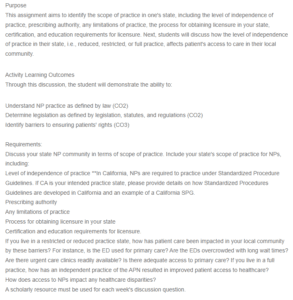
This assignment aims to identify the scope of practice in one’s state, including the level of independence of practice, prescribing authority, any limitations of practice, the process for obtaining licensure in your state, certification, and education requirements for licensure. Next, students will discuss how the level of independence of practice in their state, i.e., reduced, restricted, or full practice, affects patient’s access to care in their local community.
Scope of Practice and Patient’s Healthcare Accessibility
Activity Learning Outcomes
Through this discussion, the student will demonstrate the ability to:
Understand NP practice as defined by law (CO2)
Determine legislation as defined by legislation, statutes, and regulations (CO2)
Identify barriers to ensuring patients’ rights (CO3)
Requirements:
Discuss your state NP community in terms of scope of practice. Include your state’s scope of practice for NPs, including:
Level of independence of practice **In California, NPs are required to practice under Standardized Procedure Guidelines. If CA is your intended practice state, please provide details on how Standardized Procedures Guidelines are developed in California and an example of a California SPG.
Prescribing authority
Any limitations of practice
Process for obtaining licensure in your state
Certification and education requirements for licensure.
If you live in a restricted or reduced practice state, how has patient care been impacted in your local community by these barriers? For instance, is the ED used for primary care? Are the EDs overcrowded with long wait times? Are there urgent care clinics readily available? Is there adequate access to primary care? If you live in a full practice, how has an independent practice of the APN resulted in improved patient access to healthcare?
How does access to NPs impact any healthcare disparities?
A scholarly resource must be used for each week’s discussion question.
 Complete the order form and upload all of your files, including any instructions, rubrics, or other materials provided by your instructor.
 Complete the order payment after filling in the order form. We’ll receive your order and assign it to a writer.
 The assigned writer will complete your paper and forward it to our Editing Team for review and approval.
 Once approved by the editor, the completed paper will be uploaded to your account for you to download, review and approve.