
Alzheimer’s Disease – A 76-year-old man is Brought to the Primary Care Office With Concerns About his Worsening Memory
Alzheimer’s disease affects the whole brain, mainly the hippocampus and the posterior cortex, while frontotemporal dementia affects the temporal and frontal lobes of the brain (Kumar et al., 2022). Alzheimer’s disease in its early stages presents with memory loss and a decrease in cognitive abilities, while frontotemporal dementia in the early stages presents with personality and behavioral changes (Khan & De Jesus, 2022). Clinical findings that support a diagnosis of Alzheimer’s disease include a mini mental examination with a baseline score of 12 out of 30 and hippocampal atrophy seen on an MRI. The patient presenting complaints of memory loss, getting lost in the neighborhood, inability to dress, inability to balance his checkbook, and personality changes are signs and symptoms seen in Alzheimer’s disease. The amyloid hypothesis explains the development of Alzheimer’s disease and argues that the accumulation and deposition of fibrillary or oligomeric amyloid β peptide are the primary cause of Alzheimer’s disease (Kumar et al., 2022).
This patient’s likely stage of Alzheimer’s disease is mild Alzheimer’s disease. Patients diagnosed with mild Alzheimer’s disease present with memory loss, poor decision-making and compromised judgment, mood and personality changes, taking longer to accomplish daily activities, confusion on the location of familiar places, loss of sense of initiative, and challenges in handling money (Kumar et al., 2022). The patient’s wife reports that the patient has memory loss. He allowed a stranger into their house, which is a sign of compromised judgment and poor decision-making. The patient cannot find his way around the neighborhood despite living there for the past 35 years, which shows difficulty locating familiar places. The patient’s physical examination reveals that he is angry, which shows personality and mood changes. He cannot accomplish daily tasks such as dressing and might need the help of a caregiver. In addition, the patient is experiencing trouble handling money since he cannot balance his checkbook.
References
Khan, I., & De Jesus, O. (2022). Frontotemporal Lobe Dementia. StatPearls Publishing. https://www.ncbi.nlm.nih.gov/books/NBK559286/.
Kumar, A., Sidhu, J., Goyal, A., et al. (2022). Alzheimer Disease. StatPearls Publishing. https://www.ncbi.nlm.nih.gov/books/NBK499922/.
ORDER A PLAGIARISM-FREE PAPER HERE
We’ll write everything from scratch
Question 
Case Scenario
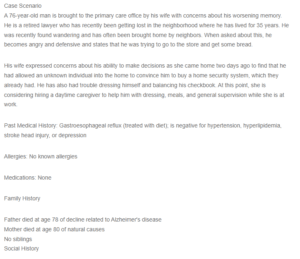
A 76-year-old man is brought to the primary care office by his wife with concerns about his worsening memory. He is a retired lawyer who has recently been getting lost in the neighborhood where he has lived for 35 years. He was recently found wandering and has often been brought home by neighbors. When asked about this, he becomes angry and defensive and states that he was trying to go to the store and get some bread.
Alzheimer’s Disease
His wife expressed concerns about his ability to make decisions as she came home two days ago to find that he had allowed an unknown individual into the home to convince him to buy a home security system, which they already had. He has also had trouble dressing himself and balancing his checkbook. At this point, she is considering hiring a daytime caregiver to help him with dressing, meals, and general supervision while she is at work.
Past Medical History: Gastroesophageal reflux (treated with diet); is negative for hypertension, hyperlipidemia, stroke head injury, or depression
Allergies: No known allergies
Medications: None
Family History
Father died at age 78 of decline related to Alzheimer’s disease
Mother died at age 80 of natural causes
No siblings
Social History
Denies smoking
Denies alcohol or recreational drug use
Retired lawyer
Hobby: Golf at least twice a week
Review of Systems
Constitutional: Denies fatigue or insomnia.
HEENT: Denies nasal congestion, rhinorrhea, or sore throat.
Chest: Denies dyspnea or coughing
Heart: Denies chest pain, chest pressure, or palpitations.
Lymph: Denies lymph node swelling.
Musculoskeletal: denies falls or loss of balance; denies joint point or swelling.
General Physical Exam
Constitutional: Alert, angry, but cooperative
Vital Signs: BP-128/72, T-98.6 F, P-76, RR-20
Wt. 178 lbs., Ht. 6’0″, BMI 24.1
HEENT
Head normocephalic; Pupils equal and reactive to light bilaterally; EOM’s intact
Neck/Lymph Nodes
No abnormalities noted
Lungs
Bilateral breath sounds clear throughout lung fields.
Heart
S1 and S2 regular rate and rhythm, no rubs or murmurs.
Integumentary System
Warm, dry, and intact. Nail beds pink without clubbing.
Neurological
Deep tendon reflexes (DTRs): 2/2; muscle tone and strength 5/5; no gait abnormalities; sensation intact bilaterally; no aphasia
Diagnostics
Mini-Mental State Examination (MMSE): Baseline score 12 out of 30 (moderate dementia)
MRI: hippocampal atrophy
Based on the clinical presentation and diagnostic findings, the patient is diagnosed with Alzheimer’s type dementia.
Discussion Questions
Compare and contrast the pathophysiology between Alzheimer’s disease and frontotemporal dementia.
Identify the clinical findings from the case that support a diagnosis of Alzheimer’s disease.
Explain one hypothesis that explains the development of Alzheimer’s disease.
Discuss the patient’s likely stage of Alzheimer’s disease.
 Complete the order form and upload all of your files, including any instructions, rubrics, or other materials provided by your instructor.
 Complete the order payment after filling in the order form. We’ll receive your order and assign it to a writer.
 The assigned writer will complete your paper and forward it to our Editing Team for review and approval.
 Once approved by the editor, the completed paper will be uploaded to your account for you to download, review and approve.