
Enhancing Quality and Safety-Dosing
The pursuit of high-quality care and safety safeguards in healthcare is a pertinent health agenda that attracts political and public health interest. Quality improvement and safety enhancements in healthcare are integral to health promotion and preservation efforts. These interventions are pivotal in reducing the incidence of sentinel events in healthcare as well as medical and medication-related errors. Medication administration errors are one of the most common quality and safety compromises in healthcare. These errors have been implicated in over 7000 deaths. The healthcare costs for patients with medication-related health errors are approximately 40 billion dollars. Healthcare providers have been implicated in over 60% of medication-related errors, with nurses accounting for the majority of these cases. Wrong dosing is one of the most common causal factors for medication administration errors (Rasool et al., 2020). This paper details wrong dosing as a medication administration error in healthcare.
Factors Leading to Wrong Dosing
Wrong dosing encompasses under-dosing, overdosing, and extra-dosing. These errors occur when a patient is given medication at a dose not ordered or inappropriate to their indications, omission, or when a drug is given through the wrong route of administration. Several factors have been implicated as causal for wrong dosing. Illegible writing can lead to wrong dosing. Also, illegible dosing instructions have long been a plague to pharmacists and nurses. This issue is particularly a concern in manual prescription transmission and is accustomed to physicians being in a hurry to scribble down medications and dosing instructions. Nurses and pharmacists, in this case, have to make the best guess of the physician’s intentions. In rare cases of incorrect interpretations, the patients may end up receiving the wrong dose. Due to the negative implications of illegibility in prescriptions, many healthcare organizations have enforced policies on prescriptions, imploring physicians to maintain responsibility during prescriptions. With electronic use, the manual transmission of prescriptions is slowly being phased out. It, however, remains a concern in healthcare institutions where electronic health records have not been fully implemented.
Fragmented communications between nurses and pharmacists may also result in wrong dosing (Wondmieneh et al., 2020). Pharmacists, being experts in medication, are responsible for informing nurses on the administrative routes of drugs and the dosing instructions. Therefore, poor communication may result in dosing mistakes. The criticality of pharmacists in medication administration reinforced the need for streamlined nurse-pharmacist communication. This calls for the constant presence of pharmacists during medication administration to minimize nurse-related medication errors.
Inadequate nurses’ knowledge of the pharmacokinetic properties of some medications may contribute to nurses’ errors during medication administration. Pharmacokinetic knowledge of medication assists in determining the right dose of various medications as well as the most appropriate route of administration. Medications with narrow therapeutic indices are particularly delicate to handle. This is because minimal shifts in dosing may result in catastrophic health effects. Nurses’ pharmacokinetic knowledge can help them avert mistakes attributable to improper dosing or the use of inappropriate routes of administration.
Distractions during care provisions have also been implicated in extra dosing. Distractions during medication administration can be either on the physicians’ side or the nurses’ side. Physicians’ distraction may lead to lapses in clinical judgment and the consequential prescription of overdose or underdose. Nurses’ distractions during medication administration have also been implicated in extra dosing and administration of the wrong dose to the wrong patients. All these have detrimental effects on the patients and underpin the need for addressing them.
Evidence-Based and Best-Practice Solutions to Improve Patient Safety
Correcting dosing errors as a form of medication administration errors remains a priority patient safety enhancement measure. Best practices in reducing medication administration errors and, consequently, costs include expanding nurses’ knowledge of medications, fostering nurse-pharmacist partnerships, and creating a favorable environment for medication handling and administration (Manias et al., 2020). Expanding nurses’ knowledge of the pharmacokinetic properties of medications may be valuable in minimizing medication administration errors. This can be attained through a systematic approach entailing continuous medical education on these topics and equipping nurses with reference materials and educational resources on various medications. Valuable reference material for nurses includes medication leaflets, journals, textbooks, and other pieces of literature on medication handling and administration.
Expanding nurses’ knowledge will bridge the information gap on some medications that contribute to wrong dosing. Fostering nurses- pharmacist partnerships in care provision is another important strategy that may reduce medication administration errors. Pharmacists, in this regard, play a vital role in informing nurses on medication knowledge utilizable in drug administration. Streamlining communication between nurses and pharmacists may eliminate most errors resulting from nurses’ knowledge inadequacy when administering medications.
Creating a favorable environment for medication handling may also help minimize medication errors. A clinical environment that is devoid of distraction may eliminate medication-related errors that are attributable to nurses’ or physicians’ distractions. This can be attained by asking other clinicians to refrain from distracting physicians when they are seeing their patients. Nurses can also be asked to embrace the culture of not disrupting their fellows when administering medications. These measures can minimize distraction and subsequent errors.
How Nurses Can Help Coordinate Care to Increase Patient Safety with Medication Administration and Reduce Costs
Nurses play a role in coordinating care approaches in healthcare. To help coordinate care that enhances patients’ safety, nurses should form healthy partnerships with other healthcare providers such as pharmacists, share valuable patient information that may guide dosing and administration requirements on the patients, and communicate openly and frequently with other members of clinical healthcare teams (Russ-Jara et al., 2021). Frequent and open communication provides a platform for peer consultation and may enable nurses to consult on dosing and route considerations in their patients. Information sharing is integral to coordinative approaches as it enables the establishment of patients and disease factors that may influence treatment plans. These measures optimize medication administration processes and lower medication administration errors that may drive the cost of care higher and have detrimental effects on the patients.
Stakeholders with Whom Nurses Coordinate to Enhance Safety Concerning Medication Administration
Pharmacists, physicians, and healthcare administration are stakeholders with whom nurses can coordinate to drive safety enhancement with medication administration. Physicians, primary prescribers, have a role in prescribing the right doses to patients. Physician-related errors have been implicated in medication-related errors. Nurses can coordinate with physicians to ensure correct dosing by informing them about patients and disease factors that may influence dosing considerations. Nurse-pharmacist coordination is also important. Pharmacists provide vital medication information, including dosing, route considerations, and drug interactions that may influence dosing. This may minimize dosing-related errors. In addition, the hospital administration plays a role in facilitating an enabling environment for medication handling. Nurses can notify the hospital’s administration of infrastructural limitations that may cause distraction and result in medication errors.
Conclusion
Medication-related errors remain a source of quality and safety compromise. Wrong dosing is an example of medication administration error that may result from distraction during medication administration and inadequate nursing knowledge of medications. Expanding nurses’ knowledge of medicines and eliminating distractions are some measures that can minimize medication administration among nurses. Nurses play a role in this regard. Their coordination with pharmacists, physicians, and the hospital administration may provide a platform for addressing these causal factors, thus minimizing errors and eliminating costs that would have otherwise been incurred in managing medication errors related to adverse events.
References
Manias, E., Kusljic, S., & Wu, A. (2020). Interventions to reduce medication errors in adult medical and surgical settings: A systematic review. Therapeutic Advances in Drug Safety, 11, 204209862096830. https://doi.org/10.1177/2042098620968309/
Rasool, M. F., Rehman, A. ur, Imran, I., Abbas, S., Shah, S., Abbas, G., Khan, I., Shakeel, S., Ahmad Hassali, M. A., & Hayat, K. (2020). Risk factors associated with medication errors among patients suffering from chronic disorders. Frontiers in Public Health, 8. https://doi.org/10.3389/fpubh.2020.531038.
Russ-Jara, A. L., Luckhurst, C. L., Dismore, R. A., Arthur, K. J., Ifeachor, A. P., Militello, L. G., Glassman, P. A., Zillich, A. J., & Weiner, M. (2021). Care coordination strategies and barriers during medication safety incidents: A qualitative, cognitive task analysis. Journal of General Internal Medicine, 36(8), 2212–2220. https://doi.org/10.1007/s11606-020-06386-w.
Wondmieneh, A., Alemu, W., Tadele, N., & Demis, A. (2020). Medication administration errors and contributing factors among nurses: A cross-sectional study in tertiary hospitals, Addis Ababa, Ethiopia. BMC Nursing, 19(1). https://doi.org/10.1186/s12912-020-0397-0.
ORDER A PLAGIARISM-FREE PAPER HERE
We’ll write everything from scratch
Question 
For this assessment, you will develop a 3-5 page paper that examines a safety quality issue about medication administration in a health care setting. You will analyze the issue and examine potential evidence-based and best-practice solutions from the literature and the role of nurses and other stakeholders in addressing the issue.
Enhancing Quality and Safety-Dosing
Healthcare organizations and professionals strive to create safe environments for patients; however, maintaining safety can be challenging due to the complexity of the healthcare system. Since nurses comprise the largest group of healthcare professionals, a great deal of responsibility falls in the hands of practicing nurses. Quality improvement (QI) measures and safety improvement plans are effective interventions to reduce medical errors and sentinel events such as medication errors, falls, infections, and deaths. A 2000 Institute of Medicine (IOM) report indicated that almost one million people are harmed annually in the United States (Kohn et al., 2000), and 210,000–440,000 die as a result of medical errors (Allen, 2013).
The role of the baccalaureate nurse includes identifying and explaining specific patient risk factors, incorporating evidence-based solutions to improve patient safety, and coordinating care. A solid foundation of knowledge and understanding of safety organizations such as Quality and Safety Education for Nurses (QSEN), the Institute of Medicine (IOM), and The Joint Commission and its National Patient Safety Goals (NPSGs) program is vital to practicing nurses about providing and promoting safe and effective patient care.
You are encouraged to complete the Identifying Safety Risks and Solutions activity. This activity offers an opportunity to review a case study and practice identifying safety risks and possible solutions. We have found that learners who complete course activities and review resources are more successful with first submissions. Completing course activities is also a way to demonstrate course engagement.
Demonstration of Proficiency
By completing this assessment, you will demonstrate your proficiency in the following course competencies and assessment criteria:
Competency 1: Analyze the elements of a successful quality improvement initiative.
Explain evidence-based and best-practice solutions to improve patient safety, focusing on medication administration and reducing costs.
Competency 2: Analyze factors that lead to patient safety risks.
Explain factors leading to a specific patient safety risk focusing on medication administration.
Competency 4: Explain the nurse’s role in coordinating care to enhance quality and reduce costs.
Explain how nurses can help coordinate care to increase patient safety with medication administration and reduce costs.
Identify stakeholders with whom nurses must coordinate to drive quality and safety enhancements with medication administration.
Competency 5: Apply professional, scholarly, evidence-based strategies to communicate in a manner that supports safe and effective patient care.
Organize content so ideas flow logically with smooth transitions; contain few errors in grammar or punctuation, word choice, and spelling.
Apply APA formatting to in-text citations and references, exhibiting nearly flawless adherence to APA format.
References
Allen, M. (2013). How many die from medical mistakes in U.S. hospitals? Retrieved from https://www.npr.org/sections/health-shots/2013/09/20/224507654/how-many-die-from-medical-mistakes-in-u-s-hospitals.
Kohn, L. T., Corrigan, J., & Donaldson, M. S. (Eds.). (2000). To err is human: Building a safer health system. Washington, DC: National Academy Press.
Professional Context
As a baccalaureate-prepared nurse, you will be responsible for implementing quality improvement (QI) and patient safety measures in healthcare settings. Effective quality improvement measures result in systemic and organizational changes, ultimately leading to the development a patient safety culture.
Scenario
Consider a previous experience or hypothetical situation about medication errors and how the error could have been prevented or alleviated with evidence-based guidelines.
Choose a specific condition of interest surrounding a medication administration safety risk and incorporate evidence-based strategies to support communication and ensure safe and effective care.
For this assessment:
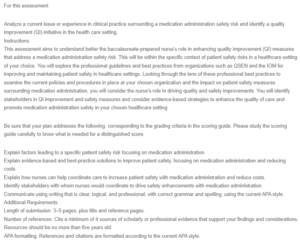
Analyze a current issue or experience in clinical practice surrounding a medication administration safety risk and identify a quality improvement (QI) initiative in the health care setting.
Instructions
This assessment aims to understand better the baccalaureate-prepared nurse’s role in enhancing quality improvement (QI) measures that address a medication administration safety risk. This will be within the specific context of patient safety risks in a healthcare setting of your choice. You will explore the professional guidelines and best practices from organizations such as QSEN and the IOM for improving and maintaining patient safety in healthcare settings. Looking through the lens of these professional best practices to examine the current policies and procedures in place at your chosen organization and the impact on patient safety measures surrounding medication administration, you will consider the nurse’s role in driving quality and safety improvements. You will identify stakeholders in QI improvement and safety measures and consider evidence-based strategies to enhance the quality of care and promote medication administration safety in your chosen healthcare setting.
Be sure that your plan addresses the following, corresponding to the grading criteria in the scoring guide. Please study the scoring guide carefully to know what is needed for a distinguished score.
Explain factors leading to a specific patient safety risk focusing on medication administration.
Explain evidence-based and best-practice solutions to improve patient safety, focusing on medication administration and reducing costs.
Explain how nurses can help coordinate care to increase patient safety with medication administration and reduce costs.
Identify stakeholders with whom nurses would coordinate to drive safety enhancements with medication administration.
Communicate using writing that is clear, logical, and professional, with correct grammar and spelling, using the current APA style.
Additional Requirements
Length of submission: 3–5 pages, plus title and reference pages.
Number of references: Cite a minimum of 4 sources of scholarly or professional evidence that support your findings and considerations. Resources should be no more than five years old.
APA formatting: References and citations are formatted according to the current APA style.
 Complete the order form and upload all of your files, including any instructions, rubrics, or other materials provided by your instructor.
 Complete the order payment after filling in the order form. We’ll receive your order and assign it to a writer.
 The assigned writer will complete your paper and forward it to our Editing Team for review and approval.
 Once approved by the editor, the completed paper will be uploaded to your account for you to download, review and approve.